
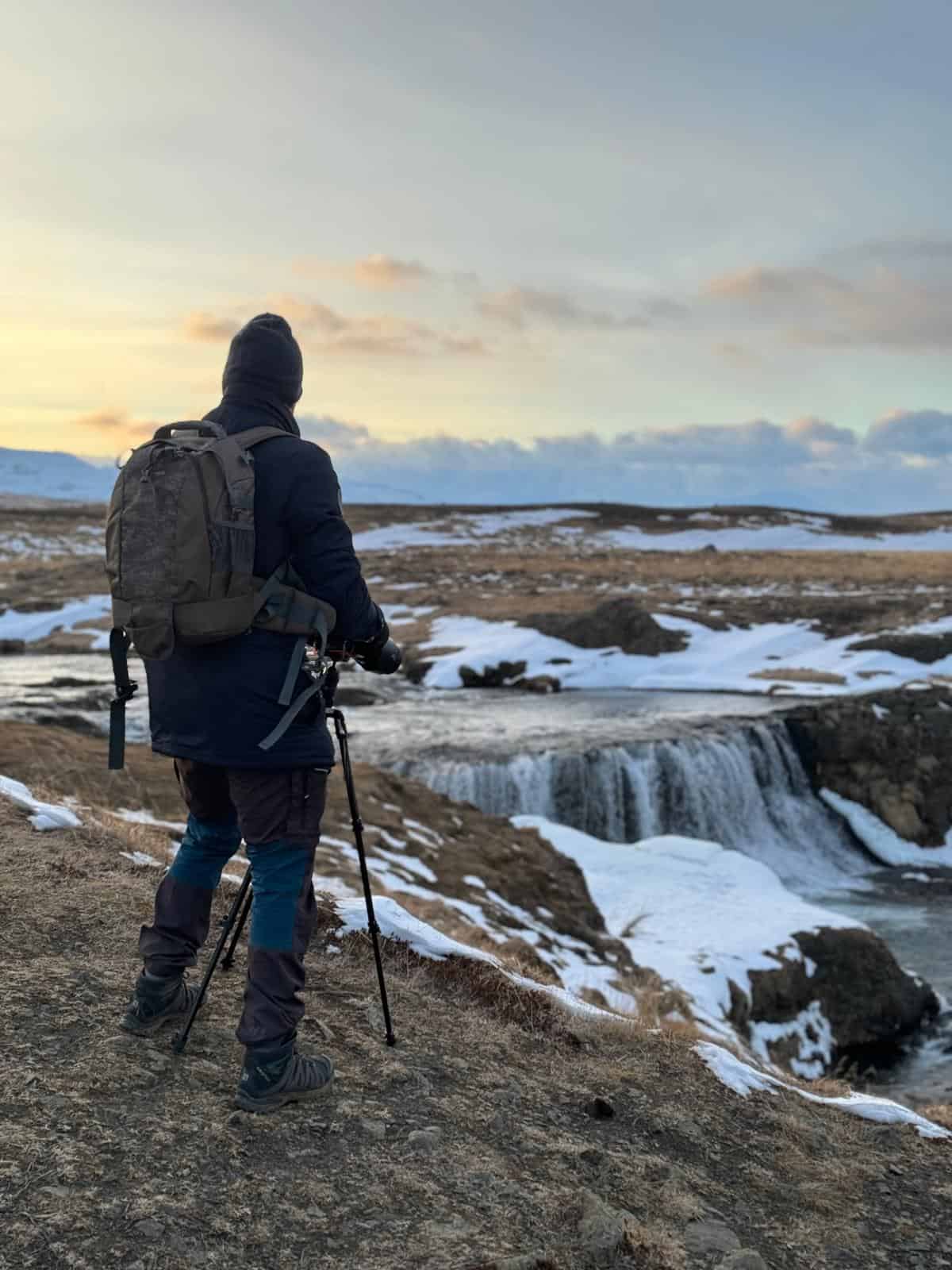
The forecast is not optional reading
In Iceland, checking the weather is not a casual habit — it is part of the kit, as essential as charged batteries or a clean lens. Conditions here change faster and more dramatically than almost anywhere else photographers travel to, and the tools available to track those changes are, fortunately, excellent.
This guide covers the apps and websites that matter, what each one is actually good for, and how to read Iceland’s notoriously localised weather patterns well enough to plan a shoot rather than just react to one.
The Essential Toolkit
Five tools — what each one is actually for
Veðurstofa Íslands — The Foundation
The Icelandic Meteorological Office at vedur.is is the official source for everything weather-related in Iceland, and it should be the first stop for any photography planning.
What it covers:
- Standard weather forecasts — temperature, precipitation, wind, cloud cover
- The aurora forecast — both the KP index and, critically, the cloud cover overlay that determines whether you’ll actually see anything
- Road weather warnings
- Avalanche risk in relevant regions
- Severe weather alerts
Why it matters specifically for photographers: The aurora forecast on its own is close to useless without the cloud cover layer. A KP index of 5 means nothing under full overcast. Veðurstofa Íslands shows both together, which is the combination that actually predicts whether a night is worth going out for.
How to use it: Check in the morning for the day’s overall picture, again before heading out for an evening shoot, and once more before bed if aurora is a possibility — activity often increases after 11pm even when early evening looked quiet.
Windy — Visualising Wind and Waves
Windy (windy.com, also available as an app) is not Icelandic, but it has become one of my most-used tools for Iceland specifically — for two related reasons.
Wind visualisation: Windy shows wind speed and direction as an animated overlay across the map, with forecasts extending several days ahead. For tripod stability and drone decisions, this is more useful than a single numerical forecast — you can see how wind develops over a day and across a region, not just a number for “now.”
My pre-hike drone decision: Before any hike where I’m considering bringing the drone, I check Windy first. If the wind forecast for the time and location is strong, the drone stays in the bag — not just for image stability, but because flying a small drone in genuinely strong wind in Iceland is how drones get lost. Checking this the night before saves carrying weight you won’t use.
Wind Reference
What wind speed means for photographers in Iceland
On Súgandisey (Stykkishólmur) in October: standing upright required leaning into the wind at a significant angle. The tripod stayed low, exposures stayed short, and the images from that session are among the strongest from that trip. Strong wind is not a reason to stay in the car — it is a reason to prepare for it and work with it. Iceland’s most dramatic conditions produce Iceland’s most dramatic photographs.
Reading wave conditions for mood: This is a less obvious use, but one I rely on. Windy’s wave height and swell overlays give you a sense, before you arrive, of whether a coastal location will have dramatic surf or calm water. For locations like Reynisfjara or Diamond Beach, where the difference between a stormy, wave-crashing atmosphere and a calm, reflective one entirely changes the photographic character of a visit, Windy lets you plan toward the conditions you want — or at least arrive with the right expectations.
The honest caveat: Windy has not seriously misled me, but Iceland’s weather changes fast enough that any forecast beyond 24–48 hours should be treated as a general indication rather than a plan. Check again closer to the day. Conditions that looked calm three days out can shift — and the inverse is just as true. A forecast showing poor conditions can clear faster than expected. Stay flexible in both directions.
Viewfindr — Aurora and Location Scouting Combined
Viewfindr is a photography-specific tool that combines aurora forecasting with location data — showing not just whether conditions are favourable, but how that maps onto specific places you might shoot from.
What it adds over Veðurstofa Íslands alone: The official forecast gives you the raw data. Viewfindr helps translate that into “where should I be tonight” — useful when you’re in an unfamiliar region and trying to match a forecast to an actual foreground.
How I use it: Alongside Veðurstofa Íslands, not instead of it. The official source remains the most reliable for raw aurora and cloud data; Viewfindr is the layer that helps turn that data into a plan.
Moon phase — the overlooked variable
For aurora planning specifically, pair the forecast with moon phase and illumination. A bright moon has the same washing-out effect as light pollution — worth knowing before you commit to a night’s plan → Iceland Moon Calculator.
Vegagerðin / road.is — Road Conditions
road.is is the official source for road conditions across Iceland — essential for any photographer planning to drive beyond the immediate Ring Road, and non-negotiable for F-roads, which open and close based on conditions rather than a calendar.
What it shows:
- Real-time road status — open, closed, difficult driving conditions
- Webcams at key locations and mountain passes
- Winter road closures and warnings
How to use it: Check before every significant drive, not just once at the start of a trip. A road open in the morning can close by afternoon — particularly mountain passes and F-roads, and particularly in shoulder season when conditions are most volatile.
The 112 Iceland App — Safety Infrastructure
The 112 Iceland app connects to Iceland’s emergency services and includes a “Check in” feature that shares your location with search and rescue services — useful if you’re heading somewhere remote and want a record of your planned route in case something goes wrong.
This isn’t a planning tool in the same sense as the others, but it belongs in any Iceland photographer’s toolkit. Download it before your trip, register, and use the check-in feature whenever you’re heading into terrain where help would take time to arrive.
Reading Iceland’s Localised Weather
Iceland’s weather is famous for changing within short distances — sun on one side of a mountain, rain on the other, completely different conditions twenty minutes apart by road. A few things that help:
Microclimates are real and specific. We’ve covered this directly at Vestrahorn — the Stokksnes peninsula has a documented tendency for weather to “stick” even when the rest of the south coast is clear. Locations with mountains close to the coast often have their own weather, somewhat independent of the regional forecast.
Multiple sources, cross-checked. No single forecast is reliable enough on its own for Iceland. Veðurstofa Íslands for the official picture, Windy for visual wind and wave development, and — if your destination has a webcam on road.is — a direct look at current conditions. Three sources agreeing gives you confidence; disagreement is itself useful information about how unstable the situation is.
Build in flexibility, always. The single most useful planning principle for Iceland: have a plan B for every shoot, ideally in a different direction or microclimate than plan A. If the forecast for one location looks marginal, having an alternative twenty minutes away in a different direction has saved more shoots than any single forecast ever has.
Flexibility also means being willing to return. If your accommodation is nearby, revisiting a location at a different time of day — or the same evening for aurora — costs nothing but time. Iceland’s weather can shift the character of a place completely within a few hours: flat midday light becomes golden hour, overcast morning becomes dramatic cloud, and a location that felt ordinary at noon can be extraordinary by 9pm. I regularly build return visits into a stay — not as a backup plan, but as a deliberate strategy. The second visit to a location, in different light or different conditions, often produces the stronger images.
Less is more — a lesson learned the hard way
Early in my Iceland trips I made the classic mistake: packing as many locations as possible into a single day, treating the itinerary like a checklist. It doesn’t work. You arrive at each place already thinking about the next one, you don’t take the time to walk around and find the right position, and you certainly don’t notice when the light starts doing something interesting because you’re already back at the car.
The better approach is to plan less and stay longer. Two or three locations in a day, with genuine time at each. The practical photography benefit is significant — Iceland’s weather can shift within thirty minutes from flat and grey to the kind of light that makes you forget everything else. That shift only rewards the photographer who is still there when it happens. The one who left twenty minutes ago for the next sight on the list gets nothing.
Slow travel and good photography want the same thing: enough time to let the place show you what it actually is.
Forecasts degrade with distance in time, not just accuracy. A forecast for tomorrow is more reliable than one for four days out — but in Iceland, even a 24-hour forecast can shift meaningfully. Check again in the morning. Check again before you leave. The habit of re-checking, not the initial check, is what actually protects a shoot.
A Practical Planning Routine
What this looks like in practice, the evening before a shoot:
- Veðurstofa Íslands — general forecast, aurora forecast and cloud cover if relevant, any warnings
- Windy — wind development over the shoot window, wave conditions if coastal
- road.is — status of the roads you’ll need, webcam check if available
- Viewfindr — if aurora is the target, cross-reference location options
And again in the morning, and again before leaving for an evening shoot. The routine takes a few minutes and consistently pays for itself.
Planning Routine
The evening before a shoot — in this order
The habit that actually protects a shoot
The first check the night before is not sufficient. The re-checking habit — morning, before leaving, before bed — is what actually makes the difference. Iceland’s forecasts degrade with time, not just accuracy. A 36-hour forecast will have shifted meaningfully by the time it becomes a 12-hour forecast. Check again. The routine takes five minutes and consistently pays for itself.
The lesson learned early: packing too many locations into a single day and checking the forecast once at breakfast. The result was arriving at each place already thinking about the next one, and missing the shift in light that happened at the third location — thirty minutes after leaving. Two or three locations with genuine time at each, and a forecast checked before leaving for each one. That is the routine that actually works.