
Some places reveal themselves fully only once
I have been to Jökulsárlón three times — in autumn, in late winter, and in summer. Each visit was different. The light changed, the ice changed, the colours of the water shifted between seasons.
Three Locations
Jökulsárlón, Diamond Beach, and Fjallsárlón — what each one offers
The complete visit covers all three — lagoon at sunrise, Diamond Beach at high tide, Fjallsárlón in the early morning calm. They are within 10km of each other and reward being treated as a single day’s photography rather than three separate stops.
The first visit was the one I carry with me.
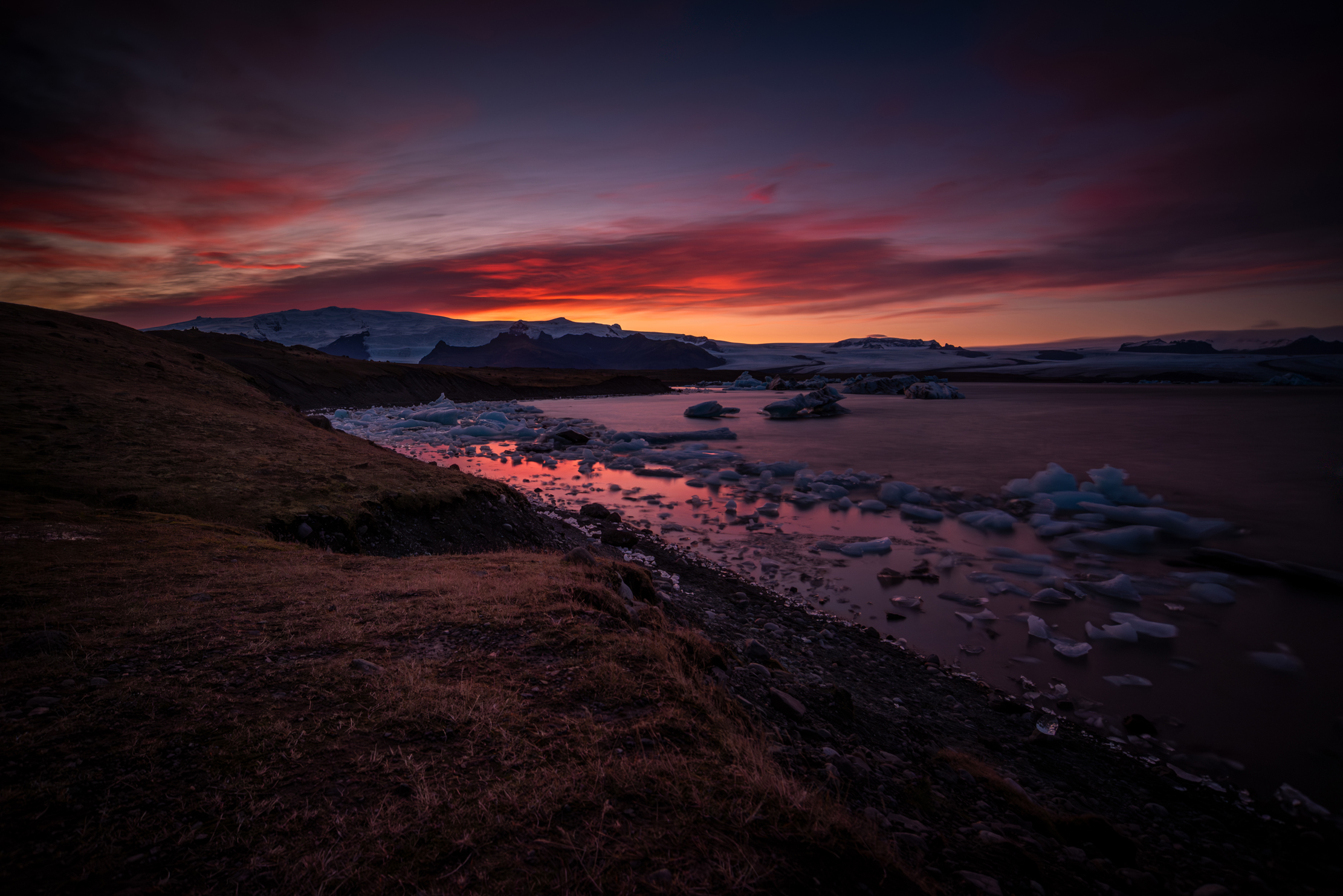
The sun was setting over the lagoon, and the icebergs that had calved from Breiðamerkurjökull glacier were among the largest I have ever seen there — sculptural, blue-white forms drifting slowly in water that reflected the sky in orange and gold. The combination of scale, colour, and light was something I have not experienced there since, across two further visits. Iceland does that. It shows you something once, fully, and then never quite repeats it.
The photographs from that evening are some of the strongest I have taken in Iceland. The image of an ice block meeting the Atlantic surf at Diamond Beach — the wave crashing against glacial ice on black sand — came from the same trip.
This guide covers both locations: the glacier lagoon and the black sand beach directly beside it. They are inseparable photographically, and they deserve to be treated as a single destination.
At a Glance
Jökulsárlón & Diamond Beach — Key Facts
Marcel’s recommendation: Stay two nights minimum. Photograph the lagoon at sunrise, Diamond Beach at high tide in the afternoon, and return to the lagoon for aurora after dark. The same location looks entirely different across a single day.
This guide is one part of the complete guide to photographing Iceland responsibly — start there if you are planning a first trip.
The Two Locations
Jökulsárlón Glacier Lagoon
Jökulsárlón is a glacial lagoon formed where Breiðamerkurjökull — a tongue of the Vatnajökull ice cap — calves icebergs directly into the water. The lagoon has grown significantly over the past century as the glacier has retreated, and it is now Iceland’s deepest lake.
The icebergs drift slowly from the glacier face toward the outlet channel, where they pass under the Ring Road bridge and into the sea. Some are enormous — multi-storey blocks of ancient ice that carry within them the compressed air and volcanic ash of centuries. The colour of glacial ice varies from white through pale blue to a deep, almost luminous turquoise, depending on density and the light conditions at the time.
Photographically, the lagoon offers a subject that changes by the hour. The ice moves. The light shifts. The same composition looks entirely different at sunrise, midday, golden hour, and blue hour. It is the kind of location that rewards staying longer than planned.
Diamond Beach
Directly opposite the lagoon car park, across the Ring Road, is Diamond Beach — a black sand beach where icebergs that have passed through the outlet channel wash ashore and rest before the Atlantic eventually breaks them apart. The combination of glacial ice — sometimes crystal clear, sometimes blue, sometimes marked with dark volcanic ash — against the black sand and white surf is one of Iceland’s most striking visual contrasts.
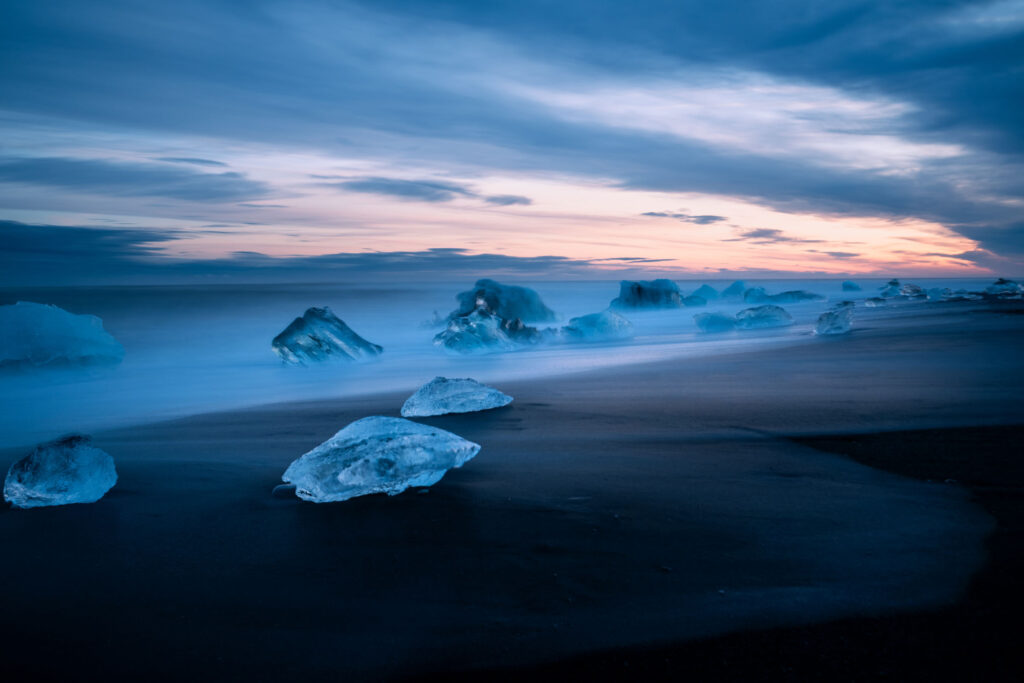
The beach changes with every tide. Ice that was there yesterday may be gone today. New pieces arrive continuously. The size varies enormously — from small fragments you could hold in your hands to blocks the size of a car. In autumn, when the glacier has been calving through the summer, the largest pieces are often present.
No two visits produce the same beach.
When to Go
Autumn — September to November
My strongest personal experience at Jökulsárlón came in autumn, and it remains the season I would recommend first. The tourist numbers drop after the summer peak, the light becomes low and golden for extended periods, and the Northern Lights become possible after dark — with the lagoon and the icebergs as a foreground that few aurora locations can match.
The ice volume on Diamond Beach is often highest in autumn — the summer calving season has been producing ice for months, and the largest blocks tend to accumulate on the beach through September and October.
Winter and Spring — December to April
I have visited in March and April, when Iceland’s winter conditions still hold at this latitude. The lagoon in winter has a different character — quieter, more austere, with the possibility of snow on the surrounding landscape and ice forming at the lagoon’s edges. The light is extraordinary: low, warm, and persistent.
March and April also bring longer days than deep winter while maintaining the conditions — cold, limited crowds, dramatic skies — that make the location most rewarding for photography.
Summer — June to August
Summer brings the midnight sun and Iceland’s largest visitor numbers. The lagoon is beautiful year-round, and the midnight sun creates shooting opportunities that don’t exist in other seasons — the ability to photograph in warm, low-angle light at 1am is genuinely extraordinary.
The trade-off is significant. Summer crowds at Jökulsárlón are substantial, and Diamond Beach at midday in July requires patience to find compositions without other visitors in the frame. Early morning — before 6am — and late evening give you the best combination of light and solitude.
Photographic Tips
At the Lagoon
Foreground: The lagoon’s edge gives you ice fragments and still water reflections as foreground elements. A wide angle lens (16–24mm) placed low to the water creates a sense of depth and draws the viewer into the scene. Longer focal lengths compress the icebergs against the glacier face in the background.
Light direction: The lagoon faces roughly south, which means morning light comes from the east and catches the glacier face and eastern icebergs directly. Evening light from the west warms the entire scene. Both are worth planning around — arrive before sunrise and stay past sunset if conditions allow. Use the Iceland Light Calculator to find exact sunrise, golden hour, and blue hour times for Jökulsárlón on your travel dates.
Reflections: On calm days, the lagoon surface mirrors the icebergs perfectly. Wind destroys this. Check the forecast for wind speed — a calm morning after a windy night can produce extraordinary reflection conditions as the surface settles.
Long exposure: A 6 or 10-stop ND filter at the lagoon edge, with a slow shutter speed of 30 seconds or more, smooths the water surface and turns drifting ice into soft motion trails. The contrast between the sharp, static icebergs and the silky water emphasises the scale and stillness of the scene.
Aurora: Jökulsárlón is one of Iceland’s best aurora foreground locations. The combination of moving ice, reflective water, and the glacier behind creates a layered composition that few other locations offer. Check the aurora forecast on Veðurstofa Íslands and be prepared to stay late — or return at midnight.
At Diamond Beach
Wave Safety — Diamond Beach
The ocean here does not give warnings — you have to watch for yourself
From personal experience: the strongest Diamond Beach images from that first autumn visit were made from a position of awareness — knowing where the water was, watching its pattern, and moving when necessary. The drama in the photographs came from the conditions, not from proximity. You do not need to be close to the water to make the image work.
Timing with the tide: Low tide exposes more beach and moves the waterline further from the ice, giving you more compositional options. High tide brings the waves closer to larger ice blocks — creating the kind of wave-meets-ice drama that the best Diamond Beach images capture. Check the tidal range for your date → Iceland Tide Calculator, and the harbour table for Höfn before you drive.
Wave safety: This is non-negotiable. The waves at Diamond Beach arrive without warning, travel faster than they appear from a distance, and reach further up the beach than the dry sand line suggests. Never position yourself between an ice block and the incoming sea. Never turn your back on the ocean to review images on the camera. Keep your attention on both the composition and the water at all times.
I have photographed at Diamond Beach in conditions where the waves were breaking directly against the largest ice blocks. The images are among my strongest from Iceland. They were made from a position of awareness — knowing where the water was, watching its pattern, and moving when necessary.
Composition: The classic Diamond Beach image positions a large, clear ice block in the foreground with the surf breaking around it and the black sand receding into the distance. Work the ice from multiple angles — the colour and transparency of glacial ice changes dramatically depending on the direction of the light. Backlit ice glows. Side-lit ice shows structure and texture.
Focal length: Both wide and telephoto work at Diamond Beach. A wide angle (16–24mm) captures the full environmental context — ice, sand, sea, and sky. A telephoto (100–200mm) isolates details within the ice — the bubbles, the mineral striations, the colour gradations — that a wide lens renders as background.
Boat Tours
Amphibian boat tours operate on the lagoon, taking visitors among the icebergs at close range. I have not taken one personally, so I cannot speak to the experience from the water. What I can say is that the photography from the tours produces a perspective — looking up at icebergs from water level — that is not available from the shore.
If you are considering a tour, book in advance. Peak season tours sell out. Check current operators and schedules locally.
Getting There
Jökulsárlón sits directly on the Ring Road (Route 1), approximately 378 kilometres from Reykjavík — roughly a 4.5 to 5 hour drive without stops. It is not a day trip unless you are specifically making it one and are comfortable with a long drive.
The most rewarding approach is to stay in the area — accommodation options exist in Höfn, approximately 80 kilometres to the east, and at guesthouses closer to the lagoon. A two-night stay allows you to photograph at multiple times of day and in different light conditions.
If you are driving on to Höfn, Vestrahorn at Stokksnes is 80 kilometres further east and works best at low water — two nights in this corner of Iceland is not excessive.
Road conditions in winter: Route 1 is paved and generally kept open year-round, but winter driving in this region requires a 4WD vehicle and careful attention to conditions. The section between Vík and Höfn crosses exposed highland terrain where wind and ice can make driving demanding. Check road.is before every drive.
Leave No Trace
No ice removal
This needs to be stated directly: do not take ice from Diamond Beach. Not a fragment as a souvenir, not a piece to use as a prop for a photograph, not a small section to hold up for a portrait. The ice belongs to the beach, and its removal — multiplied across thousands of visitors — changes the character of the place.
Wave awareness applies to Leave No Trace too
Chasing waves to get closer to ice blocks, or repositioning ice to create a better composition, causes direct harm — both to the person doing it and to the beach ecosystem. The ice is where it is for reasons that have nothing to do with your composition.
Stay on the beach
The land surrounding Jökulsárlón is protected. Do not walk onto the lagoon — ice thickness is unpredictable and the water beneath is glacially cold. Do not approach the glacier face on foot without a licensed guide.
Drone restrictions
Drone flight at Jökulsárlón and Fellsfjara (Diamond Beach) is completely prohibited between April 15th and July 15th due to bird nesting. Outside this period, time-of-day restrictions apply depending on season — early morning and evening windows only. The heavily visited car park area is always a no-fly zone due to crowds. Full details and current time windows at vatnajokulsthjodgardur.is.
Alternative: Fjallsárlón
Approximately ten kilometres west of Jökulsárlón, Fjallsárlón is a smaller glacial lagoon that sees a fraction of the visitors. The glacier face at Fjallsárlón is closer to the viewing point than at Jökulsárlón, and the icebergs — though smaller — drift in water that is often completely still. On a calm morning, the reflections are extraordinary.
Fjallsárlón has no boat tours, no café, and no crowds. It is exactly the kind of location this site exists to highlight.