The beach that changes — and demands your full attention
Reynisfjara is one of Iceland’s most visited and most photographed locations. The black volcanic sand, the basalt column formations, the Reynisdrangar sea stacks rising from the Atlantic — the images are everywhere, and they draw visitors from around the world with good reason.
It is also Iceland’s most dangerous beach. Not metaphorically. The sneaker waves that arrive without warning at Reynisfjara have killed multiple people over the years, and the beach has undergone dramatic physical changes following storms and a major landslide in February 2026 that significantly reshaped the shoreline.
This guide covers how to photograph Reynisfjara responsibly — including an honest assessment of current conditions, what the beach looks like now compared to older photographs, and why your attention to the ocean is not optional here.
Access — 2026
Reynisfjara — current conditions and warning system
Beach warning system — follow this without exception
What Happened in February 2026
Before anything else, visitors to Reynisfjara in 2026 need to understand that the beach has changed substantially.
In February 2026, a combination of powerful Atlantic storms and a major landslide from the slopes of Reynisfjall dramatically reshaped the shoreline. A large section of the cliff face collapsed onto the beach. An extraordinary volume of black sand was swept away by the sea — the result of an unusual weather pattern that sent persistent easterly winds carrying sand westward rather than the typical south-westerly replenishment pattern.
The practical consequences for photographers: the beach is narrower than it was. The basalt columns and the Hálsanefshellir cave now sit much closer to — or within — the surf zone during high tide and are not safely reachable in most conditions. The warning system remains in place and is enforced more actively than before.
The Reynisdrangar sea stacks are unaffected. They rise from the ocean as they always have. The visual drama of the location remains. The experience is different from what older photographs show.
Always check current access conditions locally before visiting. The situation continues to evolve.
The Sneaker Wave Problem — A Personal Note
I first visited Reynisfjara in 2019. At that time there were fewer warning signs than today, and my understanding of the specific hazard here was limited.
Sneaker Waves
Reynisfjara is Iceland’s most dangerous beach
Not metaphorically. Sneaker waves have killed multiple people here. The February 2026 changes have made the risk more acute.
Personal experience, 2019: I was photographing the basalt cave with my back to the ocean. Within a moment I was standing ankle-deep in water — a wave had reached me silently and without any of the visual warning I would have recognised from other beaches. Nothing worse than wet socks and shoes happened. But it changed my behaviour at every beach visit since. The ocean always has my attention now.
I was photographing the basalt cave with my back to the ocean. Within a moment I was standing ankle-deep in water — a wave had reached me silently and without any of the visual warning I would have recognised from other beaches. Nothing worse than wet socks and shoes in October happened. But the experience was enough to change my behaviour at every subsequent visit, and at every beach in Iceland.
I have been back in April, May, and August since. The ocean always has my attention now.
Sneaker waves at Reynisfjara are not large waves that you can see approaching. They are surges — sudden, fast movements of water up the beach that travel further than the visible surf line suggests and arrive with no reliable warning. The beach’s steep gradient means that water moves both up and back quickly, and a person caught off balance can be pulled into the sea before they can recover.
The February 2026 changes have made this more acute. The narrower beach means there is less space to move away from the water. The surf now reaches areas that previously felt safe.
The rules are simple and non-negotiable:
- Never turn your back to the ocean
- Never stand between an ice block or large rock and the incoming surf
- Maintain a distance from the waterline that accounts for a surge significantly larger than what you are currently seeing
- If you are setting up a tripod composition, position yourself so that you can step backward immediately without losing your footing
- The warning light system on the beach — green, yellow, red — reflects current wave conditions. Red means stay back. There is no photograph worth ignoring a red warning. Knowing the tide in advance won’t replace watching the ocean on-site — but it tells you what to expect before you arrive → Iceland Tide Calculator.
What You Can Still Photograph
Despite the changes, Reynisfjara remains a powerful and photogenic location. What is available:
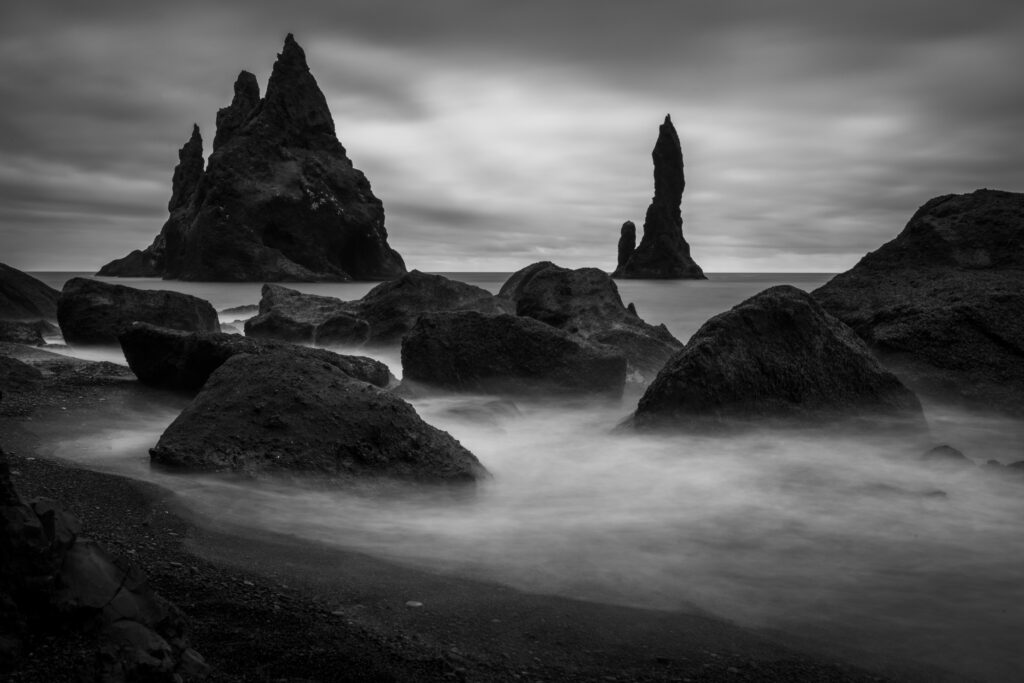
The Reynisdrangar sea stacks are the defining image of the location and are completely unaffected by the erosion. The three basalt columns rising from the surf — said in Icelandic folklore to be petrified trolls caught by sunrise — photograph best from a distance that keeps them in relationship with the ocean and sky rather than trying to approach them directly.
The basalt columns at Hálsanefshellir are still intact but now closer to the waterline than before. In calm conditions and at low tide, they remain accessible. In any significant swell or at high tide, they are not safely reachable. Assess conditions carefully and do not approach if there is any doubt.
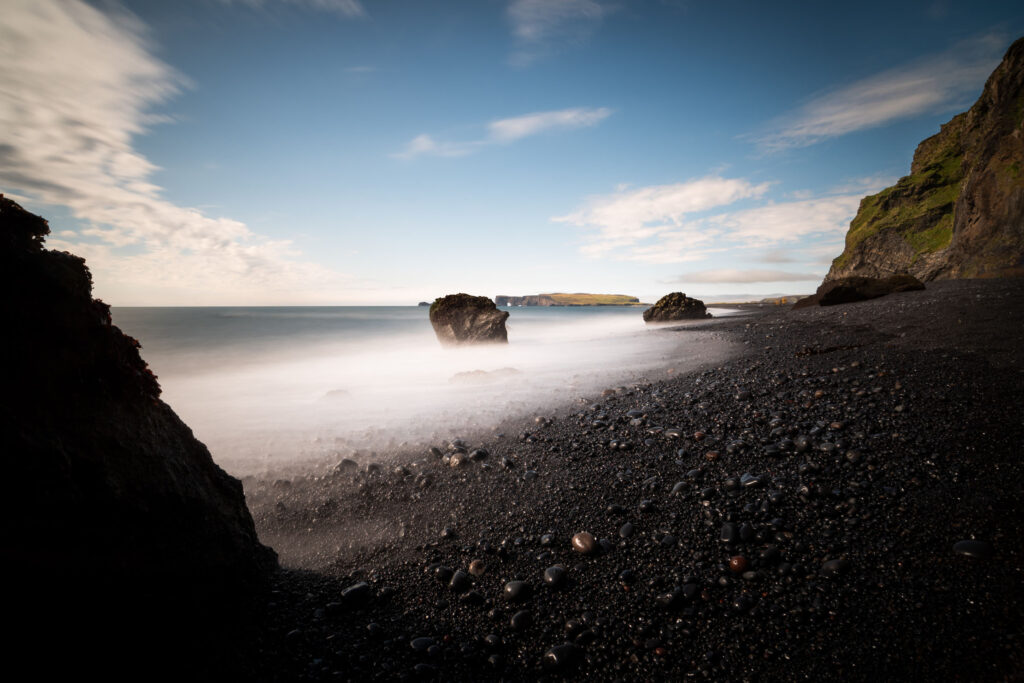
The black sand itself is a photographic subject in its own right. The texture of wet volcanic sand, the patterns left by retreating waves, the contrast between black foreground and white surf — all of this remains available and rewards a wide angle lens placed close to the surface.
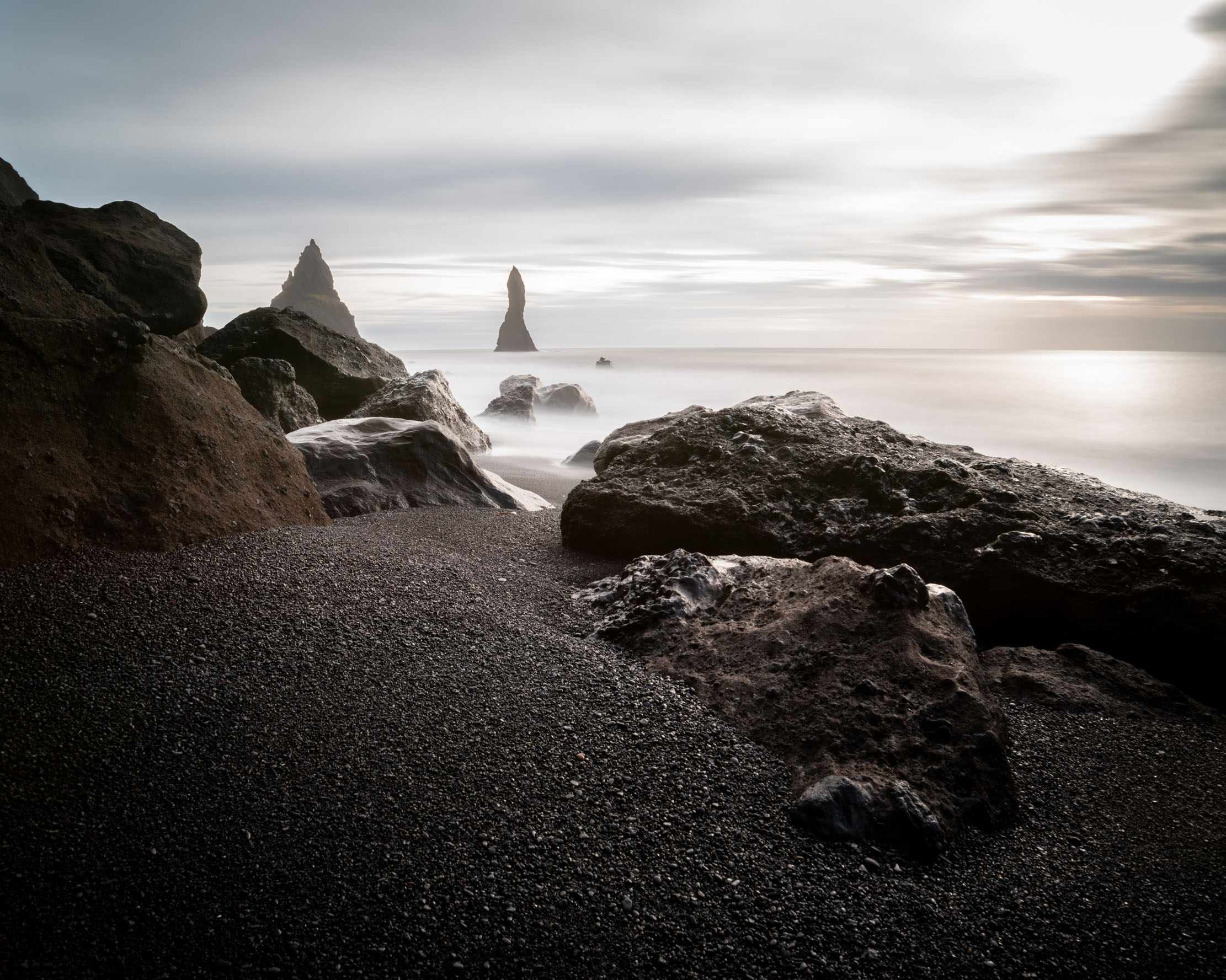
The rock formations near the cave entrance provide foreground interest and natural framing for compositions looking out toward the sea stacks — as in the image taken at this location for my local exhibition, which used the rocks as a frame and the long exposure to reduce the ocean to a soft plane of light between them.
Photographic Tips
Light and timing
Reynisfjara faces roughly south-southwest, which means it receives late afternoon and evening light directly. Golden hour in autumn and winter, when the sun is low, produces the most dramatic conditions — the basalt columns catch warm light from the side, and the ocean surface reflects the sky. Check exact golden hour times for Reynisfjara with the Iceland Light Calculator — the beach faces south-southwest, making evening light particularly reliable.
Overcast light at Reynisfjara is not a problem — it is often an advantage. The diffuse light reduces harsh contrast between the black sand and the white surf, and the absence of direct sun makes long exposure work with ND filters more manageable at any time of day.
Long exposure
Long Exposure Reference
Reynisfjara — shutter speeds and what they produce
Filter selection for Reynisfjara
Safety note on long exposure work here: A 4-minute exposure requires you to stand still at the waterline for an extended period. This is not the right technique if conditions are anything other than calm. Set your position, check wave pattern for several minutes, and do not begin a very long exposure if there is any doubt about conditions.
Reynisfjara is one of Iceland’s strongest long exposure locations. The combination of black sand, constant wave action, and the sea stacks as fixed points in a moving scene produces images that work with shutter speeds from half a second to several minutes.
- 5–30 seconds renders the waves as soft texture while maintaining some movement in the water
- 1–4 minutes (with a strong ND filter) turns the ocean surface completely smooth — the sea stacks appear to float in glass
A 10-stop ND filter handles most daytime conditions. A polarising filter reduces glare from the wet sand and increases tonal separation between the black foreground and the white water.
The basalt columns — when accessible
The hexagonal basalt columns at Hálsanefshellir are a geometry that rewards both wide and close-up photography. A wide angle lens captures the full pattern across the cliff face. A macro or short telephoto isolates individual columns and their relationship to each other. In wet conditions, the columns reflect light in a way that emphasises their structure.
Access is tide and condition dependent following the February 2026 changes. Check locally before planning this as the primary composition.
Puffins at Arnardrangur
The sea stacks near Reynisfjara — specifically Arnardrangur — attract puffins between May and August. I photographed puffins here on a visit when a bird landed directly opposite us on the clifftop grass and remained there long enough for a full shoot. A 200mm+ lens and patience are the requirements. Full details in the Puffin Photography Guide.
Current Access — 2026 Update
The beach operates a colour-coded warning system:
- Green: Open access with strict distance rules from the waterline
- Yellow: Partial restriction — no entry into marked areas
- Red: Full restriction beyond warning points — no access to the surf zone
These designations change based on real-time conditions. What is green in the morning may be red by afternoon. Follow on-site instructions from staff and signage without exception.
The Hálsanefshellir cave area is currently the most restricted section. Check current status locally on arrival.
Getting There
Reynisfjara is located approximately 180 kilometres from Reykjavík via Route 1, near the village of Vík. The car park is clearly signed from the Ring Road. The drive takes approximately two and a half hours.
Vík has accommodation, fuel, and food — it is a practical base for photographing the south coast. The beach itself is a short walk from the car park.
Leave No Trace
No black sand removal. The sand is protected under Icelandic law and may not be taken from the beach.
No approaching the cave or columns in restricted conditions. The barriers and warning system exist because the February 2026 changes brought the ocean into areas that previously felt safe. Respecting the restrictions protects both you and the landscape.
No climbing the basalt columns. The rock face is fragile and the height makes a fall serious. The columns are not a climbing structure.
Wave awareness is Leave No Trace too. A rescue operation on Reynisfjara disrupts the location, involves significant resources, and puts rescue personnel at risk. Staying safe is part of responsible visiting.
Alternative: Kirkjufjara
Immediately east of Reynisfjara, accessible by a short walk, Kirkjufjara beach offers a quieter experience with similar basalt geology. Note that Kirkjufjara was permanently closed following a fatal incident and remains off-limits — do not attempt access.
The alternative I would recommend instead is the coastal viewpoint above Reynisfjara — the elevated perspective from the hillside above the beach gives a completely different relationship between the sea stacks, the surf, and the black sand below. It is accessible, safer than the beach itself in high swell conditions, and produces compositions that most visitors never attempt.
Sources
- Umhverfisstofnun (Environment Agency of Iceland) — ust.is
- Ferðamálastofa (Icelandic Tourist Board) — visiticeland.com
- Veðurstofa Íslands (Icelandic Meteorological Office) — vedur.is
- Vegagerðin (Icelandic Road Administration) — road.is