
Nothing prepares you for the sound
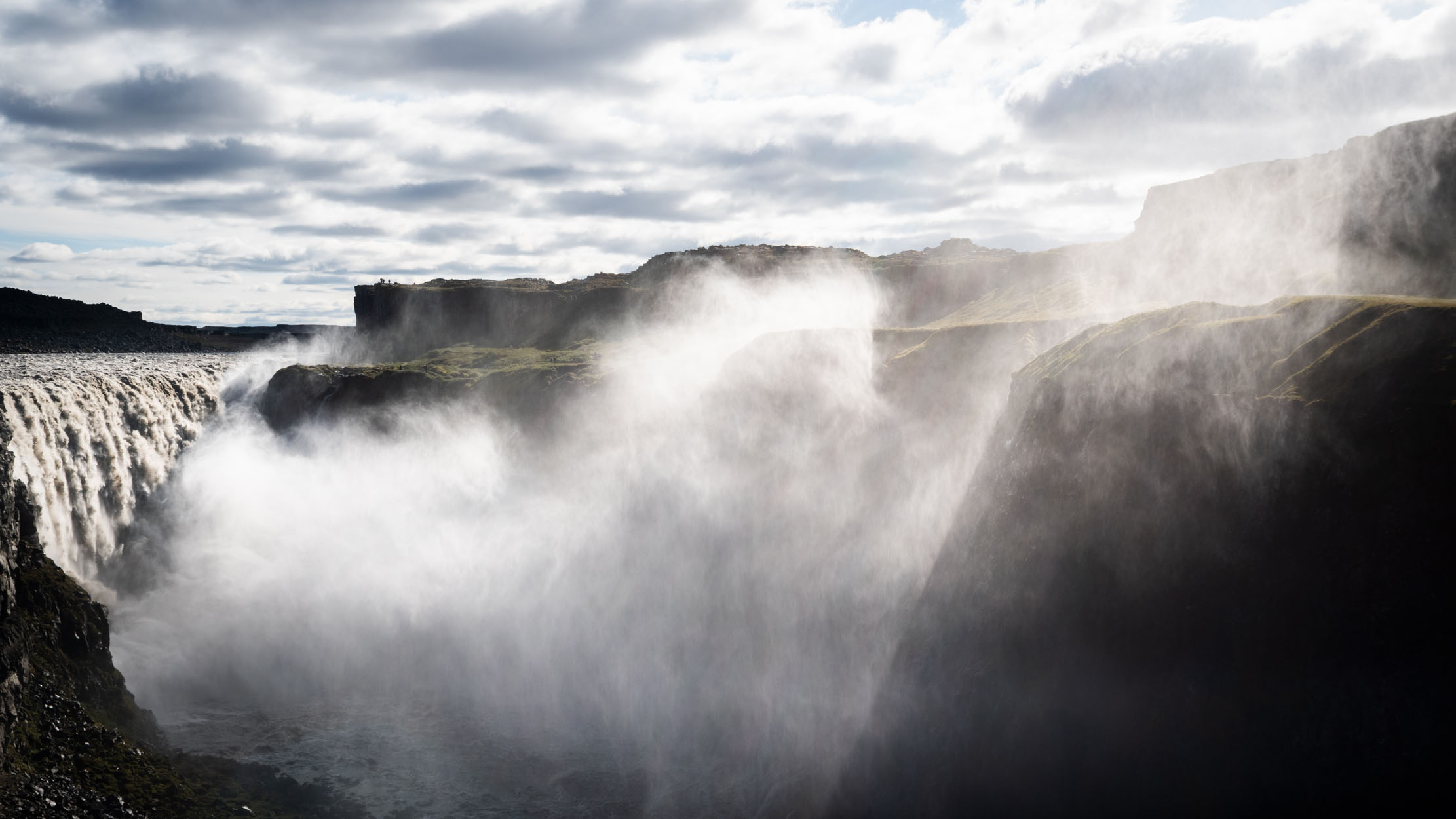
You hear Dettifoss before you see it. The low, constant thunder carries across the lava plateau long before the canyon comes into view — a sound that sits somewhere between a waterfall and something geological, something that feels less like water falling and more like the earth working.
I have been to Dettifoss twice, approaching from different sides on each visit. The two experiences were different enough that they deserve to be described separately — because the side you choose determines not just the composition you get, but the entire character of the encounter.
On one visit, the road to the east bank was closed by snow. We took the west bank instead, with its paved access road and viewing platform. On another, in summer, we drove the 50 kilometres of gravel track to the east bank and sat at the edge of the canyon with the full volume of the river passing beneath us. The east bank is the one I carry with me.
At a Glance
Dettifoss — Key Facts for Photographers
Nearest base: Reykjahlíð and the Mývatn area — within easy reach of Dettifoss and surrounded by one of Iceland’s richest concentrations of photographic locations. A dedicated Mývatn guide is coming to this site.
The Waterfall
Dettifoss drops 44 metres across a width of approximately 100 metres on the Jökulsá á Fjöllum river, which drains meltwater from the Vatnajökull ice cap. The volume of water — up to 500 cubic metres per second at peak flow — makes it the most powerful waterfall in Europe by discharge. The canyon it has carved, Jökulsárgljúfur, extends for kilometres to the north and is part of Vatnajökull National Park.
The water is glacial — grey-brown with suspended sediment — which gives Dettifoss a different visual character from Iceland’s clearer waterfalls. There is nothing delicate about it. The scale and colour together produce something that feels more elemental than scenic.
West Bank vs. East Bank — The Decision That Defines Your Visit
This is the most important practical decision for any photographer visiting Dettifoss. The two banks offer fundamentally different experiences and different photographic possibilities.
The Key Decision
West bank or east bank — what each side offers
If you can only visit one side: east bank in summer or autumn for the more immersive experience. If road conditions or season prevent the east bank, the west bank is worth the visit on its own terms. If you can visit both — on different trips or by driving both roads — do.
West Bank
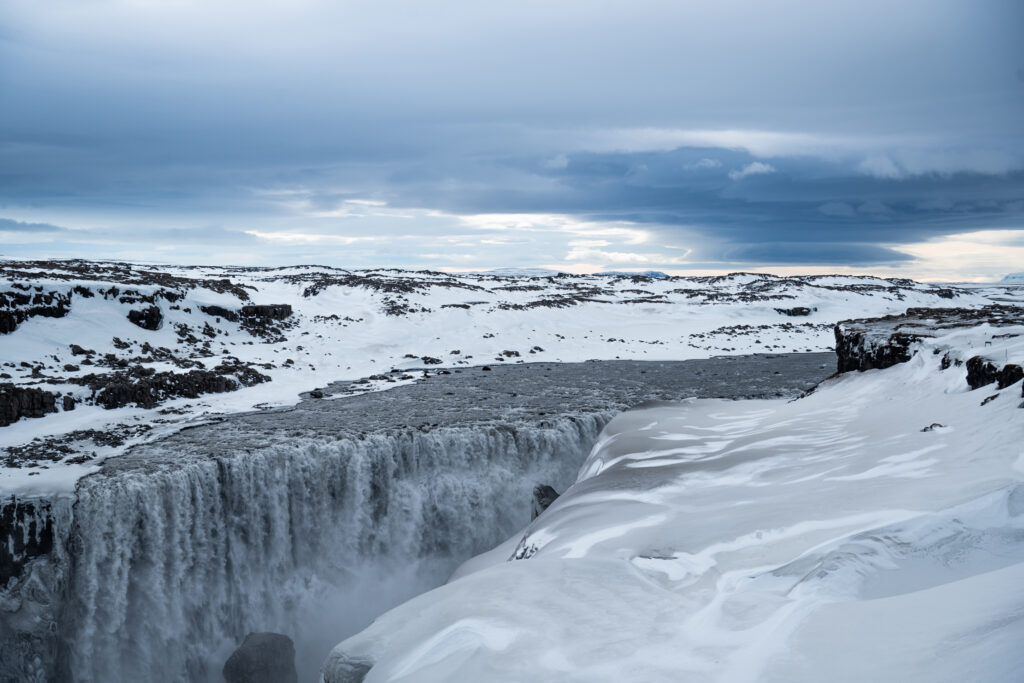
Access: Route 862, fully paved. Open year-round in normal conditions — I reached it easily in March 2022 when the east bank road was completely impassable due to snow. There is a car park and a formal viewing platform above the falls.
The experience: The west bank gives you the classic Dettifoss composition — the full width of the falls visible from the viewing platform, the canyon walls on either side, the spray rising to meet you. It is dramatic and immediately legible. The viewing platform keeps you at a defined distance from the edge, which is both a safety measure and a compositional constraint.
Photographic character: Wide, structured, accessible. The viewing platform position works well with a wide angle lens covering the full fall width. The spray from the west reaches the platform consistently — protect your gear.
East Bank
Access: Route 864, approximately 50 kilometres of gravel track. Significantly rougher than the west bank road — a 4WD vehicle is strongly recommended and makes the drive considerably more manageable. The road is typically only open in summer and autumn; in March 2022 it was closed entirely. Check current status at road.is before attempting. From the east bank car park, the path to the falls involves a moderate descent to the canyon level — allow 15–20 minutes each way. Marked paths are in place and must be followed. The descent brings you progressively closer to the falls and the spray zone — the noise increases steadily as you approach, which gives you a sense of what is coming before you arrive.
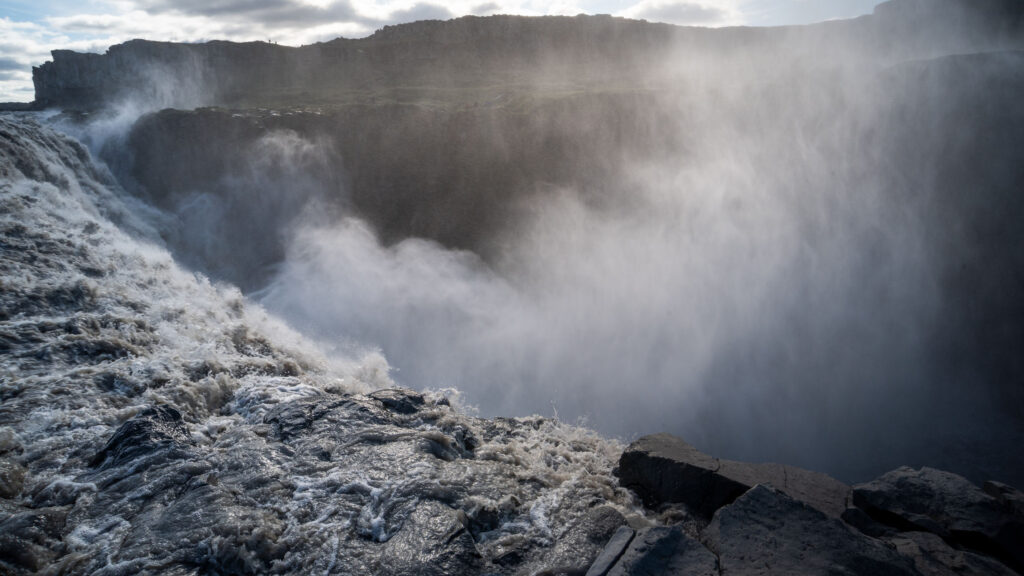
The experience: The east bank has no formal viewing platform. The path brings you to the canyon edge directly, with the full volume of the river passing at your feet before it drops. Sitting at the edge with the water moving beneath you, the sound at full intensity, the spray in your face — it is one of the most physically immediate experiences I have had at any waterfall in Iceland. The scale of the water is impossible to ignore when you are that close to it.
Photographic character: Raw, close, demanding. The east bank gives you access to the canyon rim at close range — the water rushing toward the edge becomes a foreground element rather than a distant subject. The spray management is more challenging because you are closer to it. The compositions available here — looking along the canyon, shooting into the fall from the rim — are not available from the west.
My strong recommendation: if you can only visit one side, visit the east bank in summer or autumn. If road conditions or season make the east bank inaccessible, the west bank is worth the visit on its own terms. If you can visit both — on different trips or by driving both roads — do.
Photographic Tips
Gear Protection & Settings
Dettifoss — spray management and starting point settings
Before You Arrive
At the Falls
Starting point settings — adjust for conditions
On the ground vibration: The volume of water at Dettifoss — up to 500m³/s at peak — produces low-frequency vibration in the rock and earth around the falls. At longer shutter speeds (2 seconds+) this can introduce camera shake even with a solid tripod. Use a remote shutter release, enable mirror lock-up if shooting on DSLR, and if images show blur that isn’t motion blur in the water, the vibration is the cause.
Gear protection — this is critical
Dettifoss produces spray that reaches further than you expect and settles on everything. Within minutes of arriving, your lens front element will be covered in fine water droplets unless you actively manage it.
- Carry multiple lens cloths and keep them accessible — not in the bag
- A rain cover for the camera body is essential, not optional
- At the east bank, where you are closer to the falls, the spray is heavier — consider a UV filter on the front element as a sacrificial layer that is easier to clean than a coated element
- A lens hood reduces direct spray hitting the front element
- Check your lens glass before every shot — a single water droplet in the wrong place softens the entire image
Settings
Dettifoss is bright enough in daylight that a 6 or 10-stop ND filter is required for long exposure work. Without filtration, the shutter speeds needed to smooth the water require a very small aperture (f/16–f/22) which introduces diffraction softness.
For motion in the water: 1/4s to 2 seconds produces soft movement without complete smoothing — the turbulence of glacial water at this volume creates texture even in longer exposures.
For frozen water: 1/500s or faster freezes the individual water columns — effective for showing the scale of the flow but loses the sense of motion that makes the location feel alive.
For the canyon: A small aperture (f/11–f/16) gives sufficient depth of field to keep both foreground rock and the far canyon wall sharp. Focus one third of the way into the scene.
Composition — beyond the obvious
The straight-on view of the full waterfall width is the obvious composition and worth making. Beyond it:
- Along the canyon: From the east bank, a telephoto lens pointed along the Jökulsárgljúfur canyon to the north shows the scale of what the river has carved over centuries — basalt walls receding into the distance with the river far below
- Into the falls from the rim: From the east bank edge, a wide angle lens pointed down and across the falling water gives a perspective unavailable from the west — the full volume of the river disappearing over an edge that you are standing on
- The spray column: On days with good directional light, the spray column above the falls catches the light and creates a natural focal point against the canyon walls behind it — visible in the title image, where the spray fills the canyon and the tiny figures on the west bank platform establish the scale
When spray becomes a problem
Spray direction and intensity at Dettifoss depends almost entirely on wind. On my summer visit to the east bank there was virtually no spray at all — the conditions were calm and the mist rose vertically above the falls rather than blowing toward the viewing positions. On other days, with different wind direction, one bank will be significantly wetter than the other. Check wind direction and speed on Veðurstofa Íslands before choosing your approach — it can make the difference between a manageable shoot and a soaked camera bag. Also use the Iceland Light Calculator to plan your visit around blue hour — soft overcast light reduces harsh contrast from the spray and makes long exposure work significantly easier.
Dettifoss on Screen
Dettifoss appeared in the opening sequence of Ridley Scott’s Prometheus (2012) — a fitting choice for a film about the origins of life, given the primordial quality of the landscape. The scene was filmed on the west bank. It is worth knowing, if only because it explains why some visitors arrive with specific cinematic expectations. The reality is more impressive than the film suggests — and considerably louder.
Getting There
West bank (Route 862): Accessible from the Ring Road (Route 1) near the town of Reykjahlíð on Lake Mývatn. The road is paved and accessible year-round in normal conditions. Distance from Mývatn: approximately 30 kilometres.
East bank (Route 864): Also accessible from the Ring Road, branching south from near Ásbyrgi canyon. Approximately 50 kilometres of gravel road. Route 864 (east bank) is not cleared of snow or ice during winter — it simply closes when conditions make it impassable and reopens when they improve. Route 862 (west bank) is actively maintained and cleared, which is why it remains accessible year-round in normal conditions. This is the decisive practical difference between the two approaches in shoulder season and winter. Summer and autumn only — check road.is for current status. A 4WD vehicle is strongly recommended.
From Akureyri: Approximately 2 hours to the west bank via Route 1 and Route 862. Allow extra time for the east bank approach.
Nearest accommodation: Reykjahlíð and the Mývatn area offer the best base for Dettifoss, with the added benefit of the Mývatn region’s photographic locations within easy reach. A dedicated Mývatn guide is available here.
Goðafoss — 50 kilometres southwest and accessible year-round from the Ring Road — makes a natural addition to any Dettifoss visit. Full guide: Goðafoss — The Waterfall of the Gods
A Third Visit That Didn’t Happen
On one trip, we planned to visit Dettifoss and turned back before reaching it — the road was closed by snow and the conditions made continuing inadvisable. It was the right decision. Iceland’s highland and northern roads close for reasons that are worth respecting, and Dettifoss will still be there on the next trip.
The waterfall has been there for approximately 9,000 years. It does not need you to take a risk to see it.
Leave No Trace
Stay behind barriers and on marked paths. The canyon edge at Dettifoss is unguarded in places, particularly on the east bank. The rock near the edge is wet, spray-covered, and offers unpredictable grip. Several serious incidents have occurred at the falls. The compositions available from safe positions are excellent — there is no photographic justification for approaching the unprotected edge beyond marked viewpoints.
Drones are permitted at Dettifoss on the west bank only, with time-of-day restrictions depending on season. Flights north of the northernmost viewing platform are prohibited for bird protection. The entire Jökulsárgljúfur canyon — including Ásbyrgi and Hafragilsfoss — is a no-fly zone. Verify current time windows at vatnajokulsthjodgardur.is before flying.
Protect the vegetation. The lava plateau surrounding the canyon supports slow-growing vegetation. Stay on marked paths, particularly on the approach from the car parks.
Spray management does not mean using vegetation to shelter your gear. Crouching behind plants for spray protection causes damage. Use your body, a camera rain cover, or a lens hood instead.
Alternative: Selfoss and Hafragilsfoss
Dettifoss sits between two other significant falls on the same river, both within walking distance:
Selfoss — approximately one kilometre upstream from Dettifoss, accessible by a short walk from either bank. Selfoss is lower and wider than Dettifoss, with a different character — more spread out, quieter, with the canyon walls closer on both sides. Worth the walk.
Hafragilsfoss — approximately two kilometres downstream, accessible from the east bank path. The falls are smaller but the canyon here narrows dramatically, creating a compositional intensity that the wider sections above don’t offer. Very few visitors make the walk this far.
Sources
- Vatnajökull National Park — vjp.is
- Nature Conservation Agency of Iceland — nattura.is
- Vegagerðin (Icelandic Road Administration) — road.is
- Veðurstofa Íslands (Icelandic Meteorological Office) — vedur.is