The landscape doesn’t recover the way you think it does
Iceland looks resilient. Volcanic rock, endless lava fields, rugged coastlines that have weathered millennia of Atlantic storms — it is easy to assume that a few footsteps, a shortcut across a field, or a drone flight over a nesting cliff makes no meaningful difference.
It does.
Iceland’s ecosystems are among the most fragile on earth precisely because they look so permanent. The moss covering a lava field may be three hundred years old. A tyre track across highland tundra remains visible for decades. A bird startled from its nest during breeding season may not return.
This guide exists because photographers — more than most visitor groups — put themselves in situations where the temptation to step slightly further, get slightly closer, or fly slightly higher is real and constant. The image is right there. The barrier is just a rope.
This is the guide for when you feel that pull.
This guide is one part of the complete guide to photographing Iceland responsibly — start there if you are planning a first trip.
Why Iceland Is Especially Vulnerable
Quick Reference
Leave No Trace — Eight Rules for Photographers
Iceland’s natural environment developed largely without human presence. Its vegetation, wildlife, and soil structures evolved without the pressure of large mammal populations — which means they have almost no natural resilience to the kind of disturbance that millions of annual visitors now bring.
Umhverfisstofnun — the Environment Agency of Iceland — monitors and enforces environmental protection across the country. Their regulations are not bureaucratic formality. They are a direct response to documented, measurable landscape damage caused by visitor behaviour.
As a photographer, you carry more equipment, stay longer in one spot, and return to locations repeatedly. That makes your individual footprint larger than the average tourist — and your responsibility proportionally greater.
One assumption worth challenging: that this guide applies only to photographers with serious equipment. It does not. A smartphone pointed at a nesting puffin from two metres causes exactly the same disturbance as a professional telephoto setup. The barrier stepped over for an Instagram Reel is the same barrier stepped over for a RAW file — and the damage to the moss, the nest, or the slope behind it is identical. Equipment doesn’t determine responsibility. Being there does.
The Principles
1. Stay on marked paths — without exception
Iceland’s trail markings exist to concentrate foot traffic on ground that can absorb it. The vegetation on either side — particularly lava moss — cannot.
Lava moss grows at a rate of a few millimetres per year. A dense, spongy carpet that reaches your ankles may represent two or three centuries of undisturbed growth. One footstep compresses it. Repeated footsteps kill it. The mark left behind is visible for a generation.
The best composition is rarely worth that trade. And in most cases, the marked path takes you close enough — the difference between the path and the “perfect” spot is usually a matter of metres and a small adjustment in focal length.
If there is no marked path, tread on rock wherever possible. Where rock is not available, spread out rather than following the same line — a single trail of footsteps concentrates damage in one place.
2. Respect barriers, ropes, and closures
Barriers in Iceland are not suggestions. They mark areas that are either ecologically sensitive, structurally dangerous, or both — and often all three at once.
I have seen photographers step over ropes at Geysir, walk past closure signs at Fjaðrárgljúfur, and approach nesting cliffs at Látrabjarg far beyond any reasonable distance. In every case, the justification is the same: the photograph.
Iceland is also genuinely dangerous in ways that are easy to underestimate. I have had two experiences that stayed with me — on separate trips, without leaving any marked route. On one occasion I broke through snow into a deep hole beneath and dislocated my shoulder. On another, I slid down a slope I had no business being on and lost a tripod and some skin. Neither situation involved a barrier. Both situations involved conditions I had not fully respected.
Barriers exist where the risk — to the landscape or to you — is known and documented. Treat them accordingly.
3. Drone use: know the rules before you fly
Drone photography in Iceland is subject to strict regulation, and the rules have tightened in recent years in direct response to wildlife disturbance and safety incidents.
The key rules as set by Umhverfisstofnun:
- National parks and nature reserves prohibit drone flight without a specific permit. This includes Vatnajökull National Park, Snæfellsjökull National Park, and Þingvellir National Park.
- Populated areas and roads have strict altitude and proximity restrictions.
- Wildlife disturbance — particularly near nesting seabirds — is a serious offence. A drone approaching a puffin colony or an Arctic tern nesting ground can cause mass nest abandonment.
Regulations change. Always verify current rules at ust.is before your trip, and again before each flight. A dedicated guide to drone photography in Iceland is available here.
4. Respect nesting seasons and wildlife distances
Iceland’s wildlife is one of its greatest photographic subjects — and one of its most pressured. Puffins, Arctic terns, gyrfalcons, white-tailed eagles, and dozens of other species nest across Iceland between May and August. For specific guidance on photographing Iceland’s most iconic seabird without causing disturbance, see How to Photograph Puffins in Iceland Without Disturbing Them.
The rules that apply to every wildlife encounter:
- Use a telephoto lens. The correct distance for wildlife photography is whatever distance causes no behavioural change in the animal. If a bird looks up, shifts position, or moves away — you are already too close.
- Never approach a nest. Ground-nesting birds will abandon eggs or chicks if repeatedly disturbed. This is not an edge case — it is a documented, common outcome of too-close photography.
- No flash photography near wildlife. Ever.
- Arctic terns will attack. They are protecting their nests. Do not take it personally, but do keep moving.
Icelandic law protects nesting birds and their habitats. Disturbance of nesting sites can result in fines.
5. Take nothing from the landscape
This applies more broadly than you might expect:
- No rocks. Removing rocks from Iceland’s beaches or lava fields is illegal under Icelandic law.
- No moss or vegetation. Even a small piece of lava moss pulled from its surface damages the surrounding growth.
- No black sand. Reynisfjara and other black sand beaches are protected. The sand stays on the beach.
- No “souvenirs” from geothermal areas. Mineral formations around hot springs and geothermal features are not collectibles.
The landscape looks like it has plenty. That is not a reason to take any of it.
6. Leave nothing behind
Pack out everything you bring in. Iceland’s remote and highland areas have no waste infrastructure. A piece of litter left at a roadside viewpoint or a highland trail is a piece of litter that stays there — or ends up in a river or on a coastline.
This includes:
- Food packaging and snack wrappers
- Cigarette ends
- Wet wipes and sanitary items — these do not biodegrade in Iceland’s cold environment
- Human waste — if facilities are not available, pack out or bury waste well away from water sources and paths
7. Off the beaten path is not a licence to ignore the rules
Photographers are often drawn to locations precisely because they are remote and uncrowded. It is easy to feel, in the interior highlands or on a deserted Westfjords coastline, that no one is watching and the rules are less relevant.
For a full guide to legal highland access, vehicle requirements and responsible driving on Iceland’s interior tracks, see Iceland F-Roads for Photographers.
They are not. Iceland’s most remote landscapes are often its most fragile — lower temperatures, shorter growing seasons, and almost no visitor management mean that damage persists far longer than it would elsewhere.
The absence of a crowd is not permission. It is a privilege.
8. Hot springs: beautiful, public, and genuinely dangerous
Iceland has hundreds of naturally occurring hot springs — many of them freely accessible, unmarked, and completely unguarded. That accessibility is part of what makes Iceland feel so extraordinary. It is also what makes them dangerous.
Geothermal water in Iceland can reach temperatures far above boiling point. The surface of a hot spring gives no reliable indication of what lies beneath — water that appears calm may be scalding, and the ground around a spring can be thin and unstable. Every year visitors are seriously burned, and some incidents have been fatal. Children and pets are at particular risk.
The rules are simple:
- Never enter a hot spring unless it is a designated bathing area. Designated spots — like the river pool at Landmannalaugar or the Beer Spa in Árskógssandur — are monitored and maintained for safe use. Unmarked springs are not.
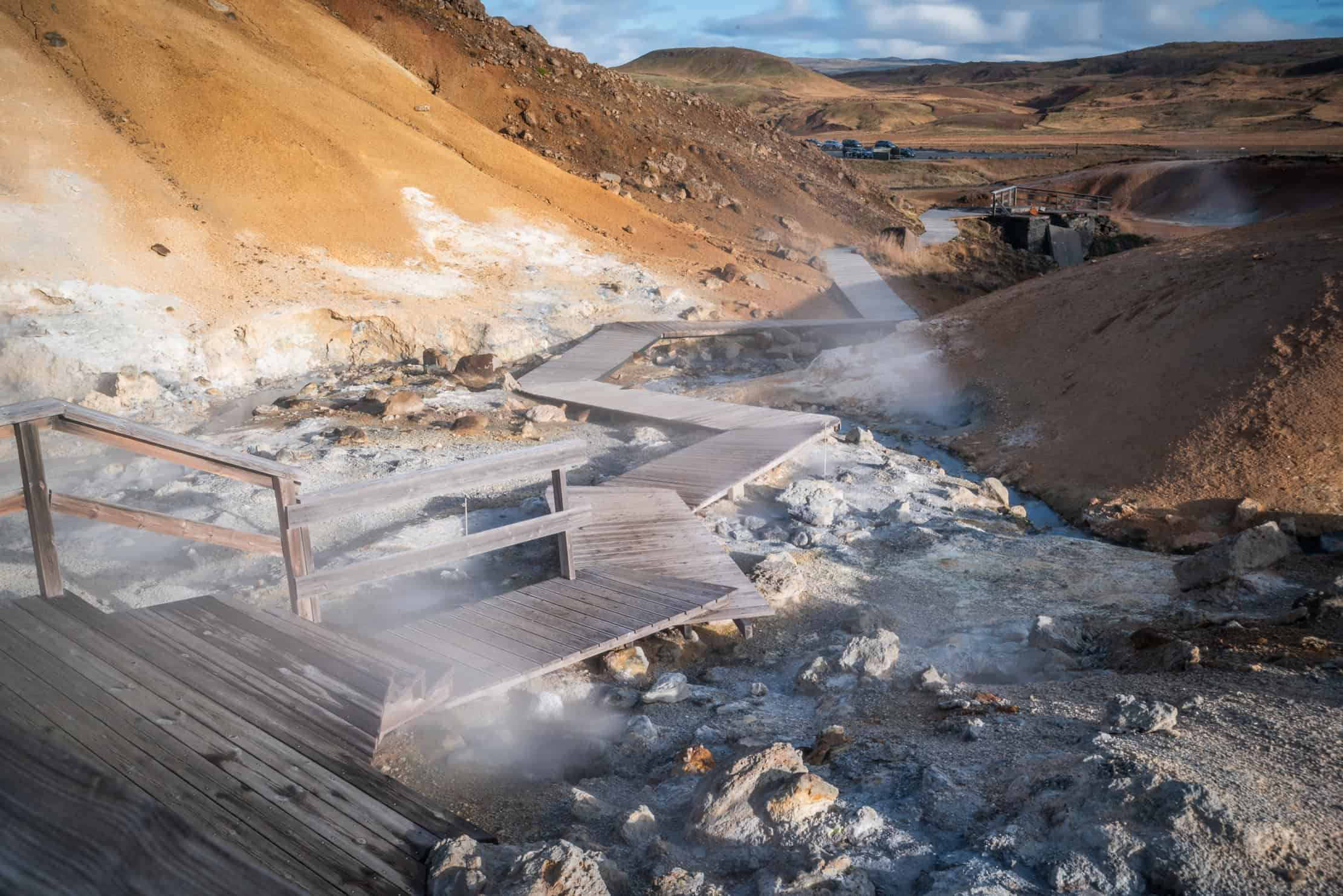
- Do not walk on the ground surrounding a geothermal feature. The crust can be thin. Stick to marked paths and viewing areas.
- Do not wash, use soap, or introduce any foreign substance into a hot spring. These are living ecosystems with unique microbial communities. Contamination — even from biodegradable soap — causes measurable damage. This applies equally to the famous roadside pools and the remote backcountry springs.
- Do not cook food in a hot spring. It happens. It shouldn’t.
The temptation to photograph Iceland’s hot springs from the closest possible angle is understandable — the colours, the steam, the geological drama are genuinely extraordinary. Photograph them from the path. The image is better with the steam rising naturally into the frame anyway.
A Note on Deliberate Non-Publication
Some locations featured on this site will be described only partially — access details withheld, exact coordinates not given. Some locations will not be published at all.
This is a deliberate editorial decision. If a place is fragile, already under pressure, or at genuine risk from further exposure, adding it to a searchable photography guide does real harm. The photography community has seen what happens to locations that go viral — Fjaðrárgljúfur was closed to visitors after damage caused by a surge in tourism following a music video. It has since partially reopened with strict controls.
This applies even at paid-access locations. At Vestrahorn, for example, the entrance fee covers the beach and marked areas only — the surrounding farmland is private. Our Vestrahorn Photography Guide covers the exact boundaries.
We consider non-publication a form of responsibility, not a gap in the content.