A waterfall that rewarded the one who prepared
I have been to Goðafoss several times — in summer, in winter, at different times of day and in different light. Each visit has shown me something the previous one didn’t. It is that kind of location: accessible enough that it is easy to treat as a quick stop, deep enough that it rewards staying longer.
On one visit I was staying nearby when the Northern Lights appeared. I knew immediately that Goðafoss would be an extraordinary foreground — the horseshoe shape of the falls, the water catching the light, the open sky above the canyon. I drove toward it and stopped. Without a headlamp, in complete darkness, approaching an unfenced waterfall with an uneven riverbank was not a reasonable decision.
I turned back.
The image I didn’t make that night is the one I think about most at Goðafoss. Preparation is everything — and a headlamp costs very little compared to what it would have made possible.
At a Glance
Goðafoss — Key Facts for Photographers
Key advantage over Dettifoss: Goðafoss is accessible year-round without a 4WD or gravel road. For photographers based in Akureyri or Mývatn, it is a location you can return to multiple times across a single trip — morning, evening, and on a clear night with the Northern Lights.
The Waterfall and Its History
Goðafoss — “Waterfall of the Gods” — takes its name from an event in Iceland’s history. In the year 1000, the Lawspeaker Þorgeir Ljósvetningagoði was tasked with deciding whether Iceland would adopt Christianity or remain pagan. After two days of contemplation under a fur blanket, he announced that Iceland would convert. On his return home, he threw his statues of the Norse gods into the falls — giving the waterfall its name and Iceland a pivotal moment in its history.
Standing at the falls, knowing this, adds something to the experience. The water that has been falling here for thousands of years was flowing when that decision was made. Iceland’s landscapes carry history in a way that few places do.
Why Goðafoss Works Photographically
Goðafoss is not Iceland’s tallest or most powerful waterfall. What makes it exceptional for photography is its shape and accessibility.
The falls drop approximately 12 metres across a horseshoe-shaped front roughly 30 metres wide. The curved form means that different positions along the riverbank give you fundamentally different relationships with the water — from a wide view of the full horseshoe to intimate compositions that isolate a single section of the fall against the basalt canyon walls.
The location also sits directly off the Ring Road, which makes it genuinely accessible year-round without highland road conditions or long walks. What it offers in accessibility it more than compensates for with compositional variety — if you take the time to find it.
Perspectives Worth Finding
Shooting Positions
Four perspectives at Goðafoss — what each one offers
The visitor pattern: most people spend 20 minutes at position 1 and leave. The compositions at positions 2, 3 and 4 require more time and more willingness to move — but they are the images that look nothing like every other Goðafoss photograph online.
Most visitors stop at the main car park on the north bank, photograph the falls from the obvious viewpoint, and leave. The following positions are what distinguish a Goðafoss visit from a Goðafoss photograph:
The platform above the falls
The elevated viewing platform on the north bank gives you a top-down perspective on the horseshoe shape — the full width of the falls visible in a single frame, with the river above and the pool below. Most visitors see this position. Fewer stop long enough to work the composition properly.
The steps down to the water
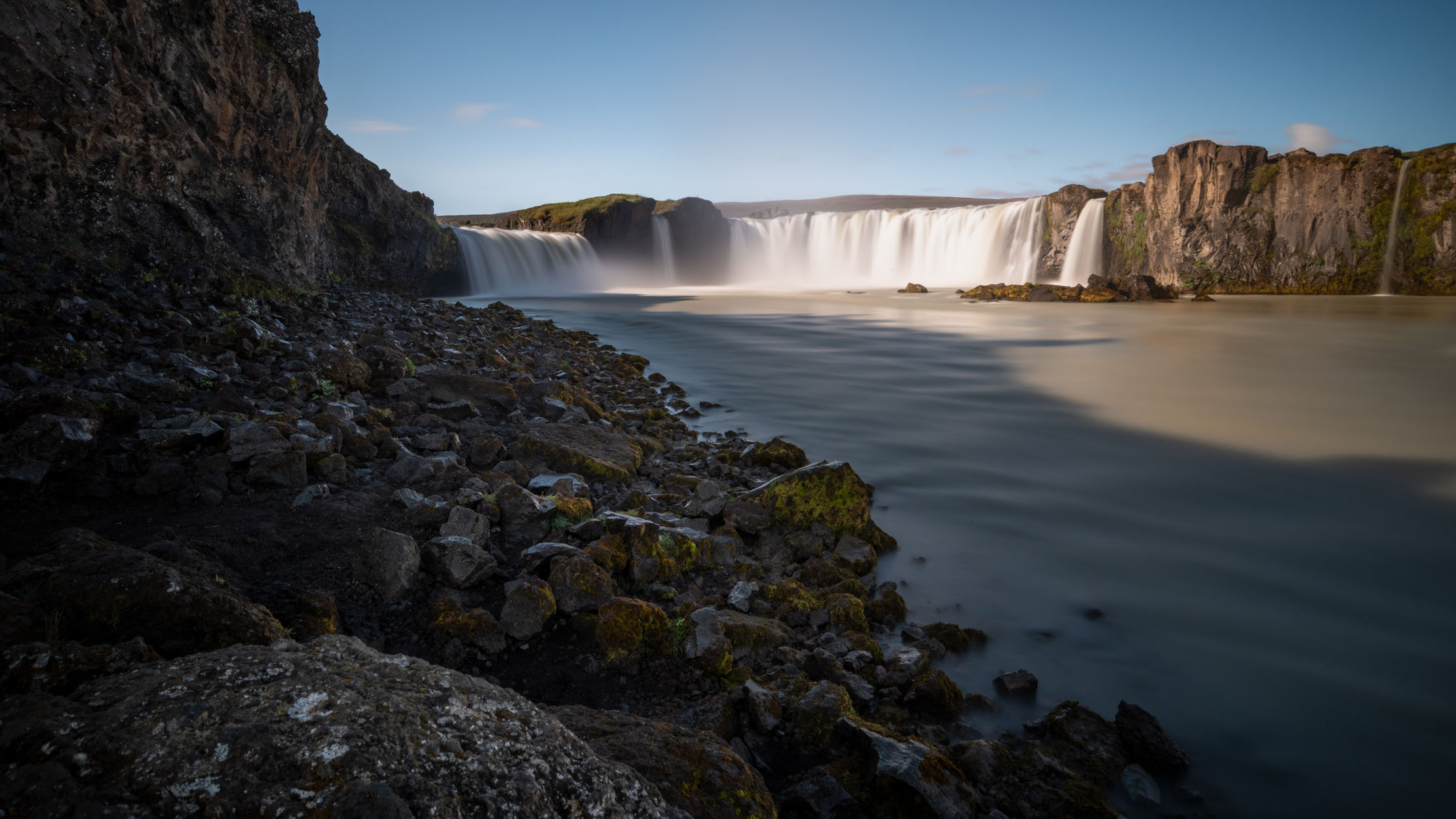
On the north bank, steps lead down toward the water level — closer to the falls, lower in the frame, with the rocks of the riverbank available as foreground. This is where the image above was made: a long exposure from water level with the full horseshoe behind the rocky foreground. It is a perspective that requires a wide angle lens and a low tripod position, and it produces images that look nothing like the standard viewpoint shot.
The south bank
Crossing the Ring Road bridge gives you access to the south bank, which sees significantly fewer visitors. The perspective from here is different — you are looking across the falls rather than toward them, and the relationship between the water, the canyon walls, and the sky changes completely. Worth the short walk.
The canyon walls
Stepping back from the falls and using a short telephoto (70–100mm) to isolate sections of the canyon walls with the water behind them produces abstract compositions that reward patience and a willingness to look away from the obvious subject.
Seasonal Character
Summer
Green vegetation on the canyon walls, full water volume, long daylight. The falls in summer light — particularly in the extended golden hour of June and July — are warm and accessible. The main car park sees significant visitor numbers through the summer peak. Early morning visits give you the best combination of light and solitude.
Winter
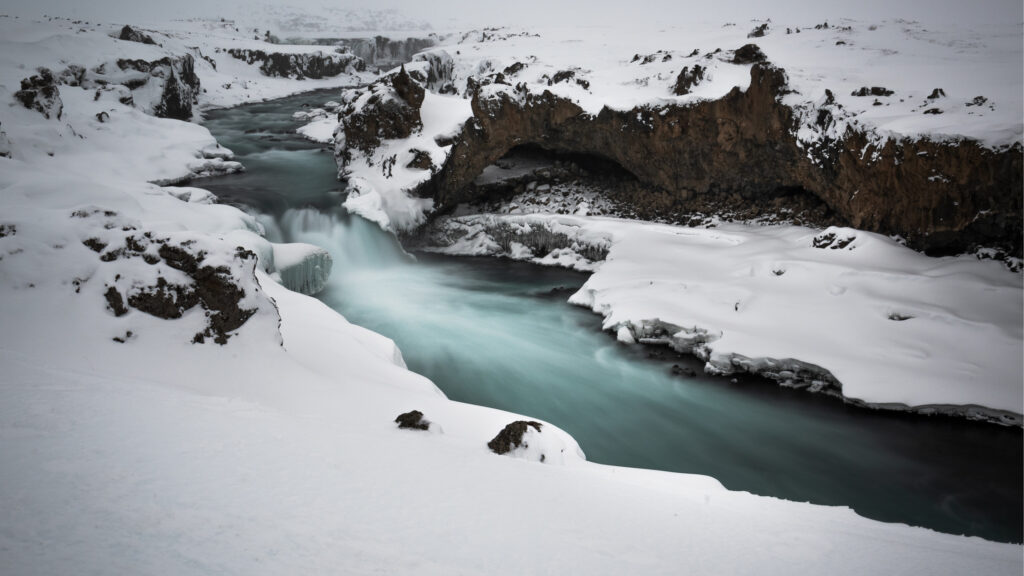
Goðafoss in winter is a different place entirely. Snow covers the surrounding landscape and the canyon edges. Ice formations build up on the basalt walls and at the edges of the falls — in cold winters, the outer sections of the horseshoe partially freeze while the centre continues to flow. The blue of glacial ice against the white of snow and the grey of the water produces a colour palette that summer simply cannot replicate.
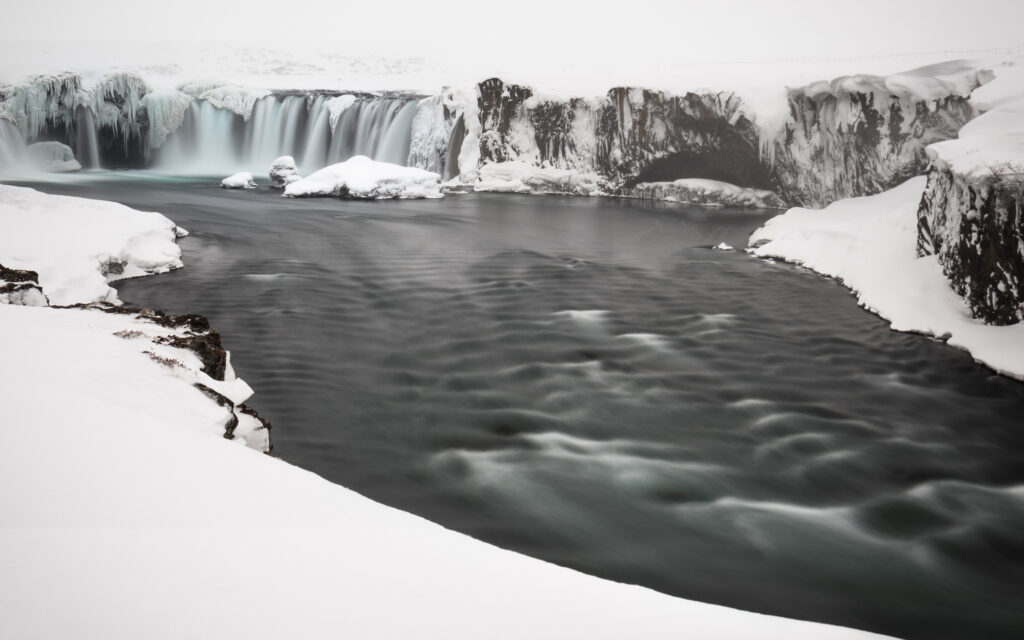
Winter also brings the possibility of Northern Lights above the falls — which is exactly the opportunity I did not take, without a headlamp, in darkness I had not prepared for.
Aurora at Goðafoss
Preparation checklist — the image you won’t miss twice
Every Evening — Autumn & Winter
When the Forecast is Active
Starting point settings for Goðafoss aurora
The image I didn’t make: One evening the Northern Lights appeared while I was staying nearby. Goðafoss would have been an extraordinary foreground — the horseshoe shape, the water catching the light, the open sky above the canyon. I drove toward it and stopped. Without a headlamp, in complete darkness, approaching an unfenced waterfall with an uneven riverbank was not a reasonable decision. I turned back. A headlamp costs very little compared to what it would have made possible.
The lesson: if you are staying anywhere near Goðafoss in autumn or winter, carry a headlamp every evening. Check the aurora forecast on Veðurstofa Íslands before bed. The falls are accessible from the car park in complete darkness if you have the right equipment — and the combination of moving water, open sky, and an unfenced horseshoe waterfall as a foreground is one of the strongest aurora compositions available in north Iceland. Also check the Iceland Light Calculator for blue hour and astronomical twilight times at Goðafoss — the window between last light and full darkness is often the strongest for aurora foreground photography.
Leave No Trace — A Repeated Problem
I have witnessed people crossing barriers at Goðafoss on multiple visits. The pattern is consistent: a slightly better angle is visible on the other side of the rope, the ground beyond the barrier looks stable, and the decision to cross takes a moment.
The consequences are twofold and both are serious.
The vegetation and soil beyond the marked paths is fragile. Iceland’s groundcover recovers over decades, not seasons — every footstep off the designated area leaves a mark that outlasts the visit by years. At a location as heavily visited as Goðafoss, the cumulative damage from these individual decisions is visible.
The second consequence is personal. The riverbank at Goðafoss is uneven, wet, and in places approaches the falls closely. The water moves fast. In winter, snow conceals the true edge of the bank and ice makes surfaces unpredictable underfoot. Iceland is not a playground — the barriers at Goðafoss are not there to limit your photographic options. They are there because the ground beyond them is genuinely hazardous.
The marked paths and designated viewpoints at Goðafoss produce excellent images. The angle you can see from the other side of the barrier is not worth what crossing it costs — to the landscape and potentially to you.
Photographic Tips
Long exposure
The horseshoe shape of Goðafoss lends itself naturally to long exposure work — the curved line of falling water, smoothed by a slow shutter speed, becomes a continuous band of white against the dark basalt. A 6-stop ND filter handles most daylight conditions. At blue hour and dawn, a 3-stop or no filter is often sufficient.
Settings
- Aperture: f/8–f/11 for sufficient depth of field across the full width of the falls
- Shutter speed: 1–4 seconds for smooth water with some texture retained; 30 seconds or longer for complete smoothing
- ISO: As low as possible — 100–200 — to maintain maximum dynamic range in the highlights of the white water
Spray management
Goðafoss produces less spray than Dettifoss but mist settles on lenses consistently at the closer positions. Keep lens cloths accessible and check the front element before every shot.
Winter shooting
In winter conditions, the steps down to the water level may be icy and require care. Carry microspikes or crampons if conditions are cold — the basalt rock at the water’s edge is slippery when wet and dangerous when frozen. The winter light at Goðafoss is short but extraordinary — plan your shoot around the narrow daylight window and be in position before it opens.
Getting There
Goðafoss sits directly on the Ring Road (Route 1) between Akureyri and Lake Mývatn, approximately 50 kilometres east of Akureyri. It is one of the most accessible major waterfalls in Iceland — there is no gravel road, no highland access requirement, and no significant walk from the car park.
From Akureyri: Approximately 45 minutes via Route 1. From Mývatn: Approximately 30 minutes via Route 1.
The north bank car park is on the Ring Road directly. The south bank is accessible via a small road on the opposite side of the bridge — worth the short detour.
Alternative: Aldeyjarfoss
Approximately 60 kilometres south of Goðafoss on the F26 — only accessible with a 4WD in summer — Aldeyjarfoss is a waterfall that most Goðafoss visitors never see. The falls drop into a canyon surrounded by remarkable hexagonal basalt columns that dwarf those at more visited locations. The combination of the column geometry and the waterfall produces compositions unavailable anywhere else in north Iceland.
Check current road conditions at road.is before attempting the F26. The drive is worthwhile but requires the right vehicle and conditions.
Sources
- Nature Conservation Agency of Iceland — nattura.is
- Veðurstofa Íslands (Icelandic Meteorological Office) — vedur.is
- Vegagerðin (Icelandic Road Administration) — road.is
- Ferðamálastofa (Icelandic Tourist Board) — visiticeland.com