The ice makes sounds you don’t expect
The first thing that surprised me about standing close to a glacier was the noise. Iceland’s glaciers are not silent. They crack, they groan, they shift — a constant, low-level conversation between the ice and the geology beneath it. The sound carries across the water at the glacier’s edge and arrives before you are close enough to see the detail in the ice face.
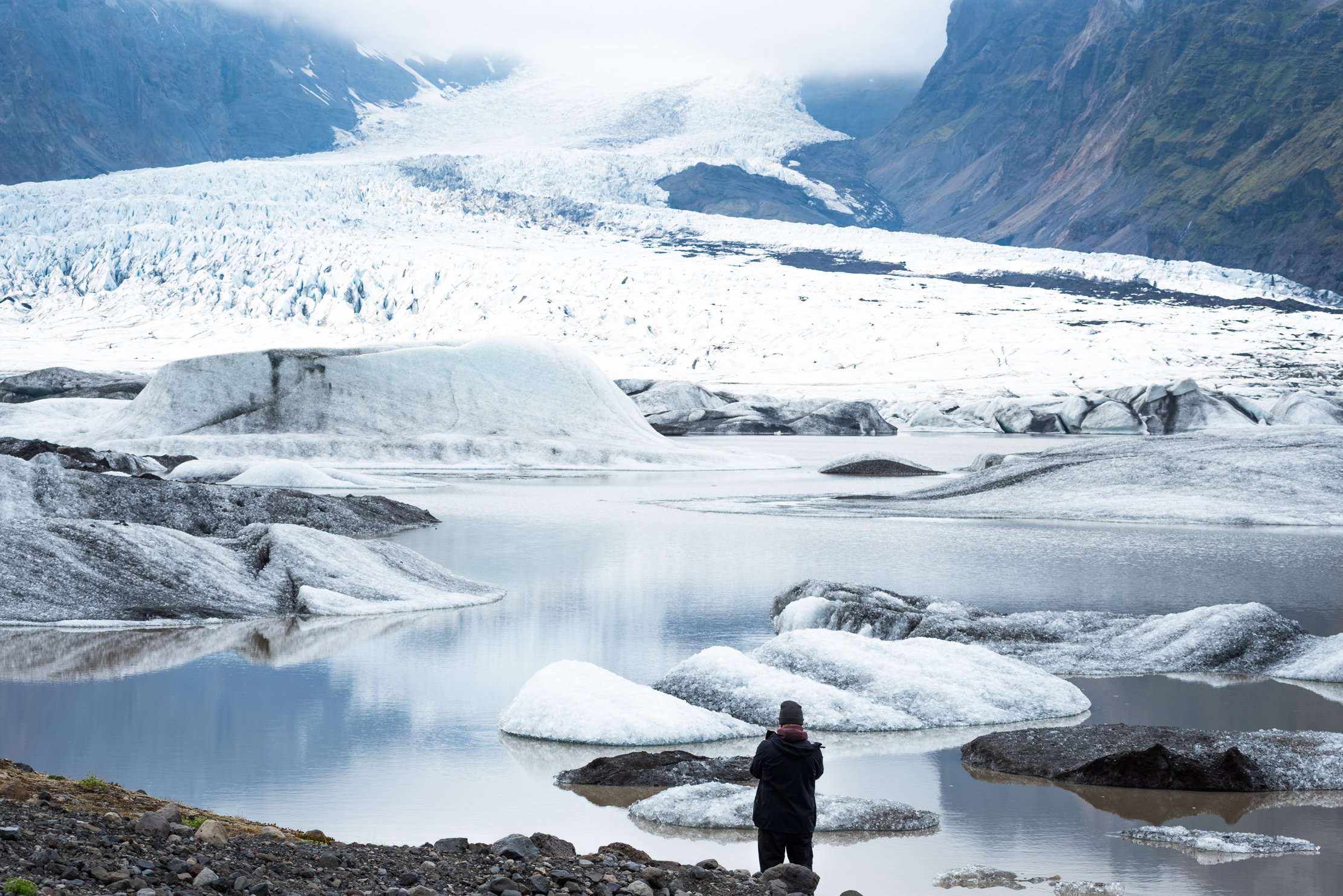
Standing at Kvíárjökull with the full width of the glacier visible behind a small lagoon, that sound and that scale together produce something that photographs can only approximate. The image can show the blue of compressed glacial ice, the dark volcanic ash striped through the formations, the reflections in still water. It cannot convey what it feels like to stand in front of something that has been moving, slowly, for centuries — and that is visibly, measurably retreating within a human lifetime.
This guide covers two glacier tongues of Vatnajökull that offer extraordinary glacier photography without the infrastructure and visitor numbers of Jökulsárlón. Both are accessible from the Ring Road. Neither requires a guided glacier walk to photograph effectively. And both show you ice in a form that most visitors to Iceland never experience.
The Choice
Svínafellsjökull or Kvíárjökull — what each one offers
Combined visit: Both glaciers are within 25 kilometres of each other on Route 1. A single day from a base at Höfn or Skaftafell covers both properly — Svínafellsjökull for the ice detail and colour, Kvíárjökull for the scale and lagoon compositions. They are different enough that seeing only one feels like an incomplete picture.
Vatnajökull — The Ice Behind Everything
Vatnajökull is Europe’s largest glacier by volume in Europe outside the Arctic, covering approximately 8% of Iceland’s total surface area. It sits over several active volcanoes — the combination of ice and volcanic heat produces the subglacial lakes, jökulhlaups (glacial floods), and geothermal features that make Iceland’s south coast landscape so dramatically unstable.
The glacier’s outlet tongues — Svínafellsjökull, Kvíárjökull, Skálafellsjökull, Breiðamerkurjökull, and others — descend from the main ice cap into the valleys below. Each has a distinct character. Some end in lagoons; some reach nearly to the Ring Road; some are retreating faster than others. All are changing within a timescale that is visible in historical photographs.
What you are photographing when you photograph one of these glaciers is not a static landscape. It is a geological process — happening too slowly for the eye to see directly, but fast enough that the ice that was here ten years ago is measurably gone.
Svínafellsjökull
Svínafellsjökull is one of Iceland’s most accessible glacier tongues — directly visible from the Ring Road near Skaftafell, with a short walk from the car park to the glacier edge. It is also one of the most visually striking, producing the deep blue ice formations streaked with dark volcanic ash that define the classic Iceland glacier aesthetic.
Access: The car park for Svínafellsjökull is at Skaftafell within Vatnajökull National Park, approximately 330 kilometres from Reykjavík on Route 1. The walk from the car park to the glacier edge takes approximately 20–30 minutes on a marked path. No guided tour is required to reach the viewpoint and photograph from the edge.
What you find there: The glacier face rises directly from a small proglacial lake. The ice formations at the edge — towers and ridges of compressed blue glacial ice, dark ash layers running through them in horizontal bands — reward both wide angle compositions that capture the full scale and close-up telephoto work that isolates the colour and texture detail. Glacial ice shows its deepest blue in soft, overcast light or at blue hour. Use the Iceland Light Calculator to plan your arrival around these windows — direct midday sun flattens the ice colour considerably.
The ash layers are volcanic records — each dark band marks an eruption, the debris captured in the ice and carried forward over decades. They are the glacier’s own archive, compressed into the formations visible at the edge.
The sound: Standing at the edge of Svínafellsjökull, the glacier is audible. The cracking and shifting of ice under its own weight, the occasional collapse of a small formation at the face — the sounds are subtle but constant. They add a dimension to the experience that no photograph carries. Listen before you raise the camera.
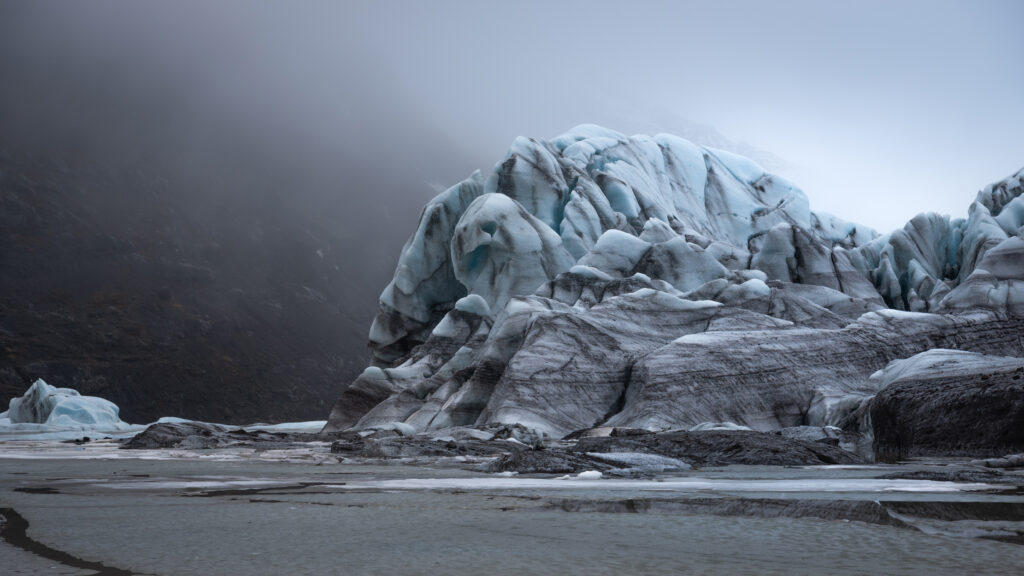
In fog: The image in this article was made at Svínafellsjökull in fog — the dark cloud mass rolling behind the blue ice face produces a composition that clear weather cannot replicate. The contrast between the luminous blue of the ice and the grey of the fog makes the colour more vivid rather than less. Overcast and foggy conditions at glaciers are not a reason to leave. They are often a reason to stay longer.
Kvíárjökull
Kvíárjökull is less visited than Svínafellsjökull and, for photographers willing to make the slightly longer approach, arguably more rewarding. The glacier descends steeply from the ice cap and terminates in a broad proglacial lagoon — Kvíárjökull Bílastæði gives you direct access to the lagoon edge, with the full width of the glacier visible across the water.
Access: The car park at Kvíárjökull is located off Route 1, east of Skaftafell and west of Jökulsárlón. A short walk from the car park leads to the lagoon edge. The path is straightforward and the approach gives you progressively improving views of the glacier as you get closer.
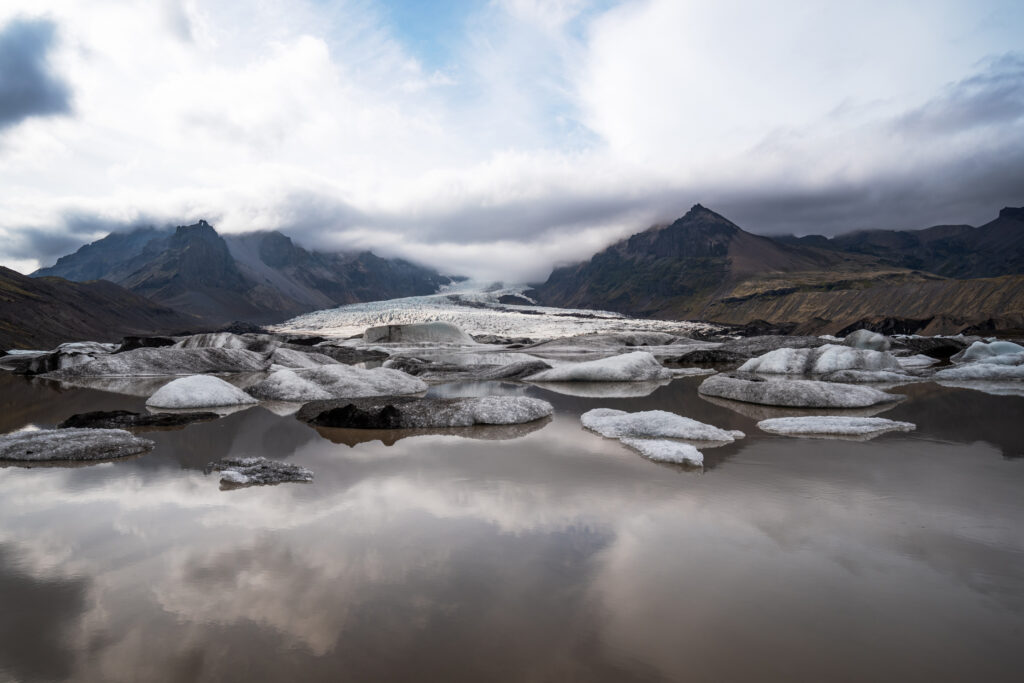
What you find there: The scale at Kvíárjökull is the defining quality of the experience. The glacier fills the entire back of the valley — a wall of ice that extends from the mountain flanks on both sides down to the lagoon. Floating ice fragments of various sizes drift in the lagoon water. Reflected in still conditions, the scene has a quality of absolute stillness that contradicts the sounds coming from the ice face.
The human scale in the image above — a single figure standing at the lagoon edge, the glacier filling the frame behind — communicates what words and technical descriptions cannot: the relationship between a person and a geological feature of this size.
Why it matters photographically: Kvíárjökull gives you the foreground element that Svínafellsjökull’s edge position makes harder to achieve — the lagoon, the floating ice, and the reflected glacier working together in a single composition. A wide angle lens low to the water, with ice fragments in the foreground and the glacier face behind, creates a layered image with genuine depth.
Photographic Tips
Photographic Reference
Glacier photography — four approaches and their settings
Why glacial ice is blue — and how to photograph the colour
The ash layers are not noise in the composition. Each dark horizontal band in the ice marks a volcanic eruption — the debris captured in snowfall and compressed into the glacier over decades. They are geological records visible in the ice face. Including them rather than cropping them out makes the image more honest and more interesting.
Colour in glacial ice
The deep blue of glacial ice is the result of compression — ice under sufficient pressure loses air bubbles and absorbs all wavelengths of light except blue. The oldest, most compressed ice is the most intensely blue. In photographs, this blue is most saturated in overcast light; direct sun bleaches it toward white.
For maximum colour intensity in the ice: shoot in overcast or diffuse light, use a polarising filter to reduce surface reflections, and expose carefully to avoid blowing out the white sections while retaining detail in the blue.
Telephoto for texture
The surface of a glacier face contains extraordinary detail — crevasses, ash layers, meltwater channels, pressure ridges. A telephoto lens (100–400mm) used from the safe viewing area extracts this detail in a way that a wide angle approach cannot. Compress the ice face against the sky or the mountain behind it and look for the abstract patterns within the larger structure.
Wide angle for scale
A wide angle lens (16–24mm) placed low at the lagoon edge, with ice fragments in the foreground and the glacier visible behind, creates the depth and scale that defines the best glacier compositions. The human figure in the Kvíárjökull image works precisely because it establishes what the ice means at a human scale — without it, the size is hard to read.
Reflections
Both locations produce reflection opportunities on calm days. Arrive early — wind picks up as the day progresses and destroys the still water conditions. A long exposure (30 seconds or more with a strong ND filter) smooths any residual water movement and produces a cleaner reflection.
Gear protection
Glacial environments produce meltwater, fine glacial flour (rock ground to powder by the ice), and occasional spray from calving events. All of these affect optics and camera mechanisms. Keep lens cloths accessible, use a camera rain cover, and check the front element regularly.
Before You Go
Glacier photography — access, permits, and what not to do
If you want to walk on the ice: Book with an authorised operator based at Skaftafell. Glacier walking requires crampons, an ice axe, and a licensed guide. The experience of being on the ice is different from photographing in front of it — and worth having separately. But it is not a DIY activity.
On the Glacier Itself
I did not walk on either glacier. Glacier walking in Iceland requires crampons, an ice axe, and — at Vatnajökull specifically — a licensed guide. Solo glacier access without proper equipment is prohibited and genuinely dangerous: crevasses are not always visible from the surface, meltwater channels can open suddenly, and the ice surface is unpredictable.
The photography available from the lagoon and viewpoint positions is extensive and does not require setting foot on the ice. If glacier walking is part of your Iceland plan, book with an authorised operator based at Skaftafell — the experience of being on the ice, rather than in front of it, is different and worth having separately.
Leave No Trace
Stay on marked paths. The ground between the car park and the glacier edge at both locations is fragile — glacial moraine, exposed by ice retreat, is unstable and vegetation is only beginning to establish. Footsteps off the path cause damage that is visible for years.
Do not approach the glacier face on foot. Calving events — sections of ice breaking from the face — occur without warning and produce waves in the lagoon. The exclusion zones at glacier edges exist because calving is unpredictable and the ice that falls is extremely heavy. Photograph from the designated viewing areas.
No drone flight without a permit. Both glaciers fall within Vatnajökull National Park. Follow the park’s drone guidelines at vatnajokulsthjodgardur.is. Time-of-day restrictions apply at Svínafellsjökull — check current rules before flying.
Glaciers are not climbing structures. The ice formations visible from the lagoon edge are not accessible. They are unstable and the water between the viewing area and the glacier face is glacially cold.
A Note on What Is Disappearing
Iceland’s glaciers are retreating. The rate of retreat has accelerated significantly in recent decades. The ice visible at Svínafellsjökull and Kvíárjökull today is less than what was there ten years ago, and less than what will be there ten years from now.
This is not an abstract environmental statistic at these locations — it is directly observable. Historical photographs of both glaciers show ice where there is now open water or exposed moraine. The lagoon at Kvíárjökull is larger than it was. The face of Svínafellsjökull has retreated.
Photographing these glaciers now is, among other things, a form of documentation. The images made here in 2025 will be historical records within a generation.
Getting There
Svínafellsjökull: Skaftafell car park, off Route 1, approximately 330 kilometres from Reykjavík. Signposted from the main Skaftafell visitor area.
Kvíárjökull: Car park off Route 1, approximately 355 kilometres from Reykjavík — between Skaftafell and Jökulsárlón. Smaller and less signposted than Skaftafell; watch for the turn-off.
Combined visit: Both glaciers are within 25 kilometres of each other on Route 1. A single day from a base at Höfn or Skaftafell covers both with time to photograph properly at each.