The Iceland most visitors never see
There is a version of Iceland that appears in every travel magazine, every photography workshop itinerary, every “top 10 Iceland locations” list. Seljalandsfoss. Reynisfjara. Kirkjufell. The Golden Circle. These places are famous because they are genuinely remarkable — but they are also shared, increasingly, with thousands of other visitors.
The Westfjords are something else entirely.
Iceland’s oldest and most remote region juts into the North Atlantic from the country’s northwest corner, connected to the rest of the island by a narrow isthmus. Its fjords cut deep into the landscape, its roads wind along coastlines that see a fraction of the traffic of the south, and its infrastructure — accommodation, restaurants, services — is minimal by design as much as by circumstance.
I visited in October 2021. The combination of the season and the region meant I experienced a version of Iceland that felt genuinely untouched. The Westfjords in autumn are not a compromise — they are, photographically and experientially, one of the strongest arguments for travelling to Iceland outside the summer peak.
At a Glance
Westfjords — Key Facts for Photographers
Allow more time than you think. Distances in the Westfjords are deceptive — roads follow every contour of every fjord. A journey that looks short on a map takes considerably longer in practice.
Why the Westfjords?
The photographic case for the Westfjords rests on three things that are increasingly hard to find elsewhere in Iceland: solitude, variety, and authenticity.
The landscape ranges from towering waterfalls and dramatic sea cliffs to remote beaches, geothermal hot springs, and one of the most atmospheric shipwrecks in Europe. The light in October sits low and warm for hours. And the absence of crowds means you can set up a tripod, take your time, and photograph without negotiating with fifty other lenses pointed in the same direction.
The Westfjords also reward photographers who are willing to slow down. This is not a region you drive through in a day. It is a region you settle into — and it gives back in proportion to the time you invest.
Getting There and Getting Around
The Westfjords are remote by Icelandic standards — which means genuinely remote by any standard.
By road: The most common approach is via Route 60 from the north or Route 68 from the east. The roads are largely paved but narrow, winding, and subject to rapid weather changes. Some mountain passes close in winter. Always check road.is before driving.
By ferry: The Baldur ferry connects Stykkishólmur on the Snæfellsnes Peninsula with Brjánslækur in the southern Westfjords — a scenic crossing that saves significant driving time and is worth considering as part of a longer itinerary.
A 4WD vehicle is strongly recommended, particularly in autumn and winter when road conditions can change quickly. Some of the most rewarding locations require gravel tracks that a standard car handles poorly.
Allow time. Distances in the Westfjords are deceptive — the roads follow every contour of every fjord, and a journey that looks short on a map takes considerably longer in practice. Build this into every day’s plan.
A Practical Note on October Visits
October in the Westfjords is a season of trade-offs that are worth understanding before you go.
On the positive side: the tourists are largely gone, the autumn light is extraordinary, the Northern Lights become possible, and the hot springs scattered across the region are at their most appealing — soaking in geothermal water with a view across an empty fjord in October light is an experience that belongs in a different category from the crowded Blue Lagoon.
The trade-offs are real. Boat trips to Hornstrandir — the uninhabited nature reserve at the Westfjords’ northern tip, one of the most dramatic and ecologically important areas in Iceland — are no longer running by October. If Hornstrandir is on your list, plan for June through early September — boats stop running after that. Always check current schedules directly with the operators in Ísafjörður as departure times and availability depend on weather and passenger numbers. Some restaurants and services in smaller villages are also closed by October, particularly in the more remote areas. Research accommodation and food options carefully before you go — do not assume that a village marked on the map has an open restaurant.
Key Locations
Key Locations
Four locations that define the Westfjords photographically
Dynjandi — The Westfjords’ Cathedral Waterfall
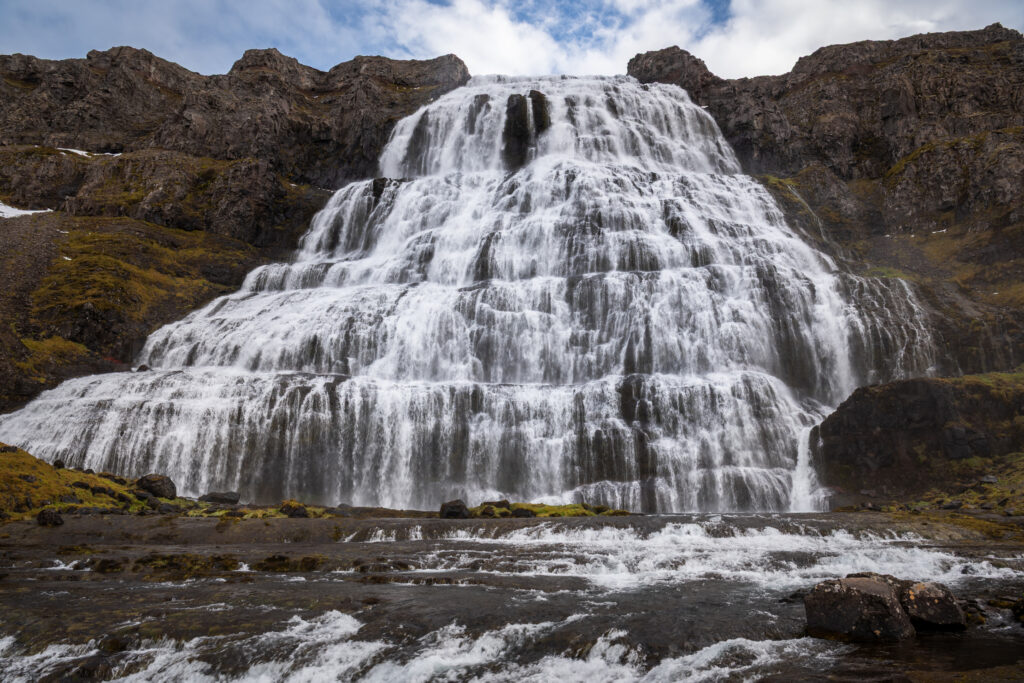
Dynjandi is the defining image of the Westfjords. The waterfall drops 100 metres in a series of cascading tiers, widening as it falls until it reaches a broad base of smaller cascades. The scale is extraordinary — it is one of those landscapes that photographs cannot fully prepare you for.
The approach follows a short but steep path past a series of smaller falls before the main drop comes into view. Each of the smaller falls is worth photographing in its own right; the temptation to walk straight past them toward the main event is understandable but worth resisting.
Photographic tips:
- A wide angle lens (16–24mm) is essential to capture the full height and width of the main fall
- The best light falls on the waterfall in the morning — the western orientation means afternoon light moves behind the cliff face
- A polarising filter reduces the spray and increases colour saturation in the surrounding rock and vegetation
- In October, the vegetation around the falls turns amber and rust — the colour adds warmth to a scene that can otherwise feel cold and monochrome
- The path to the base of the main fall is marked — stay on it. The ground around the falls is wet, uneven, and leads to steep drops
Leave No Trace: Dynjandi sits within a protected area. The path is there for a reason — the vegetation and rock around the falls is fragile. No shortcutting, no scrambling beyond the marked viewpoints.
Látrabjarg — Europe’s Largest Seabird Cliff
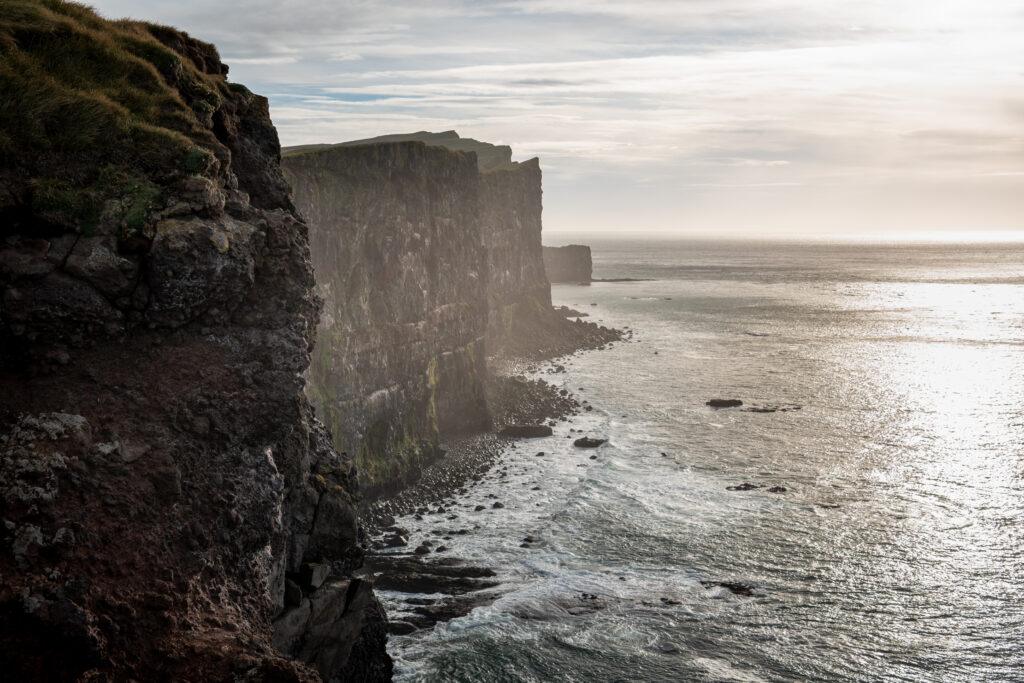
Látrabjarg stretches for fourteen kilometres along the westernmost point of Iceland — and of Europe. The cliffs rise up to 440 metres and host one of the largest seabird colonies on the continent. Razorbills, guillemots, and fulmars nest here in vast numbers. And puffins — in summer, in extraordinary concentrations — occupy the clifftop burrows so close to the path that a standard lens is enough.
By October, the puffins have left for the open ocean. What remains is the cliff itself — an immense, wind-battered wall of rock dropping into the North Atlantic — and the seabirds that stay year-round. The compositional possibilities are extraordinary: the cliff edge, the ocean below, the scale of the rock face against the sky.
A note on safety: Látrabjarg is not fenced. The clifftop path runs close to an edge that drops hundreds of metres. Wind at the cliff edge can be severe. In wet conditions, the grass is slippery. Photograph with both feet firmly on stable ground and a clear sense of where the edge is. This is not a location for inattention.
For puffin photography: For puffin photography: return between May and August. June and July are the most reliable months — by late August the birds begin heading back out to sea. Látrabjarg in summer is one of the best puffin photography locations in Iceland, with the birds nesting close enough to the clifftop path that even a short telephoto lens is sufficient. Use a telephoto lens, stay on the path, and never approach a burrow entrance. A dedicated guide to puffin photography is available here.
Garðar BA 64 — The Shipwreck at Patreksfjörður
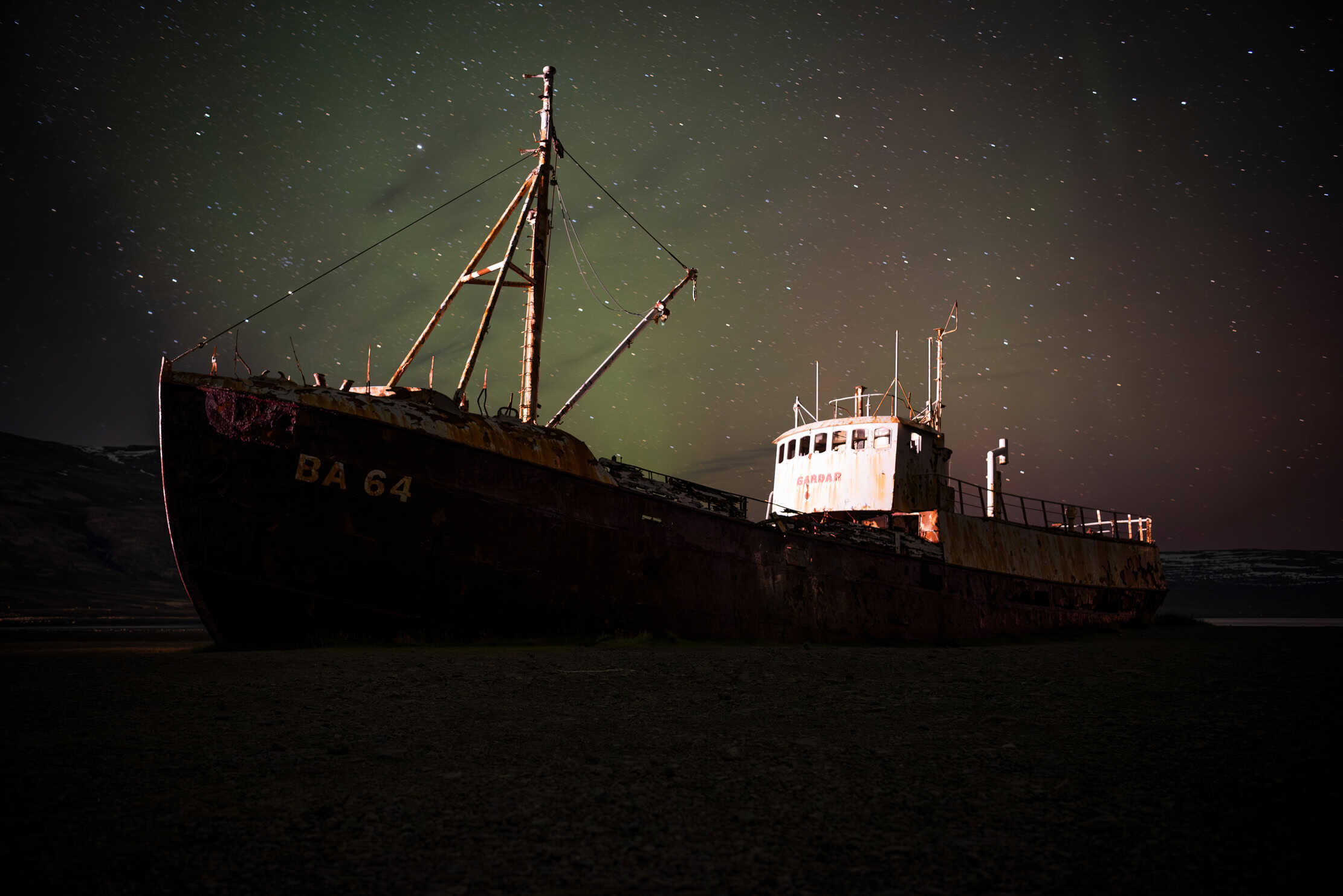
On the beach at Patreksfjörður sits the rusting hull of the Garðar BA 64 — the oldest steel ship in Iceland, beached here in 1981 and left to the elements ever since. It is one of the most atmospheric photography subjects in the Westfjords, and on a clear autumn night, one of the most extraordinary Northern Lights foregrounds I have encountered.
The combination of weathered, rusting steel, black beach, and aurora overhead is not something you find at the popular south coast locations. It requires being in the right place, in the right season, with the right forecast — and a willingness to stand in the cold and wait.
Photographic tips:
- The ship is best approached at low tide when the beach is fully exposed
- Shoot from the seaward side for the classic composition — the hull’s curve leads the eye naturally
- For aurora photography, a wide angle lens (14–20mm), ISO 1600–3200, aperture f/2.8, and a shutter speed of 10–20 seconds is a starting point — adjust based on aurora intensity
- The beach surface is uneven — bring a headlamp and set up your tripod carefully in daylight before the light fades
- Check the aurora forecast on Veðurstofa Íslands the evening before and again at midnight
Hot Springs — The Westfjords’ Best Kept Secret
The Westfjords have an unusually high concentration of naturally occurring hot springs, many of them freely accessible and set against views across fjords and mountains that no spa can replicate. Soaking in geothermal water in October, with the fjord below and the possibility of aurora overhead, is one of those experiences that stays with you.
The most well-known is Hellulaug — a small natural pool near Flókalundur with direct views across Vatnsfjörður. It is simple, undeveloped, and precisely right for what it is.
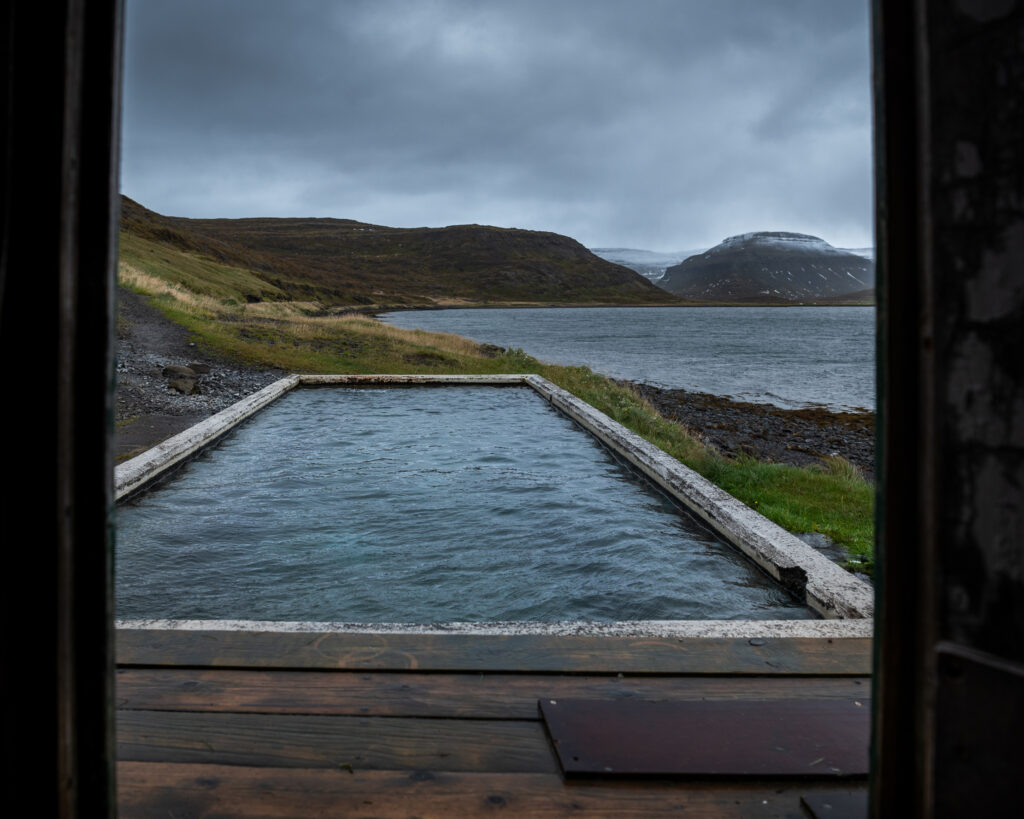
The rules that apply to every hot spring in the Westfjords:
- Enter only designated bathing areas — unmarked springs can reach dangerously high temperatures
- No soap, shampoo, or any foreign substance in the water
- Leave the area exactly as you found it
- In popular spots, respect other bathers — these are shared spaces
A full guide to hot springs and geothermal photography in Iceland is coming to this site.
The Northernmost Brewery
A small detail worth knowing: Ísafjörður is home to Dokkan Brugghús, the Westfjords’ first and only brewery — a family-run microbrewery that even named one of its IPAs after Dynjandi. After a day of cold, wind, and carrying equipment across clifftops, it earns its place in any Westfjords itinerary. Consider it part of the authentic local experience — and a good reason to end a shooting day in warmth.
Wildlife: Expect the Unexpected
The Westfjords have a way of rewarding patience — and punishing distraction.
At Fossfjörður waterfall I was working through compositions from different angles when my companion called me over urgently. I walked across expecting a problem. What I found was an Arctic fox methodically dismembering a fish on the rocks, completely indifferent to our presence. With a telephoto lens and a steady hand I captured some of the best wildlife images I have from Iceland.
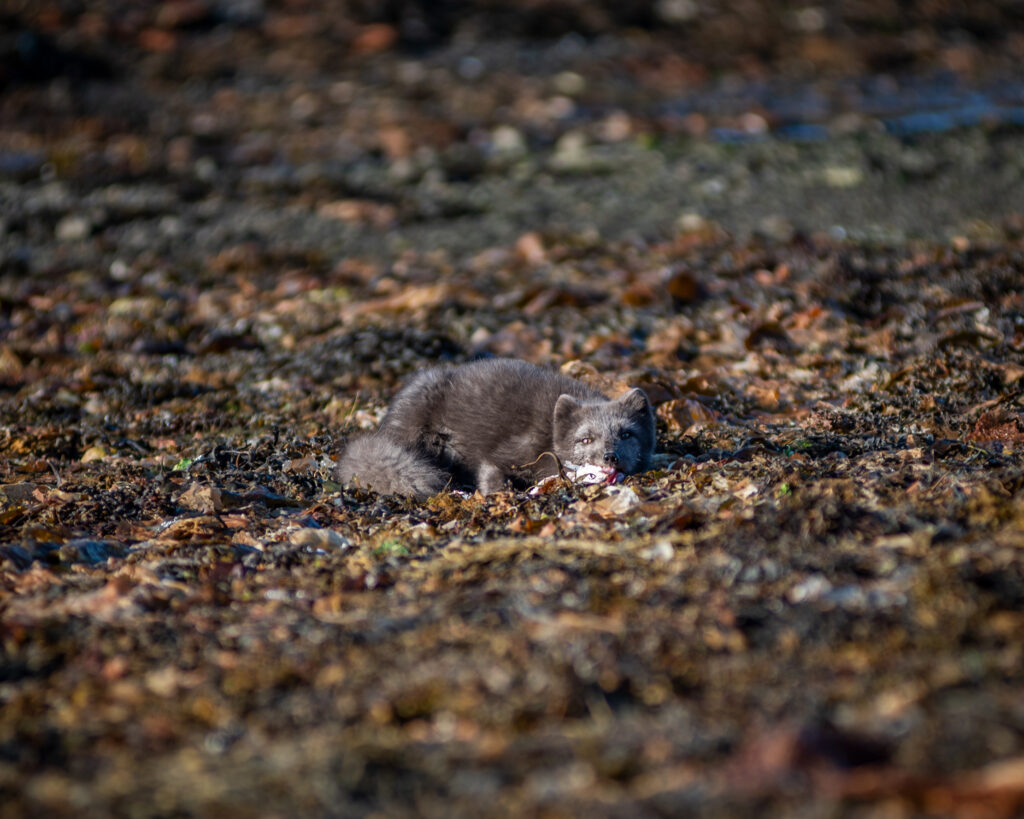
While I was focused entirely on the fox, a humpback whale breached behind me in the fjord.
My companion saw it. I did not.
This is the Westfjords. The wildlife doesn’t announce itself, doesn’t wait, and doesn’t repeat the performance. Carry your telephoto lens. Stay aware of what is happening around you, not just through the viewfinder. And make peace with the fact that Iceland will occasionally give you two extraordinary things at once — and you will only be able to photograph one of them.
Leave No Trace in the Westfjords
Leave No Trace — Westfjords
Why responsibility matters more here than anywhere else in Iceland
The Westfjords carry a particular weight of responsibility. Unlike the south coast, where tourist infrastructure has been built to absorb visitor pressure, much of this region has no such buffer. The landscape absorbs the impact of every visitor directly.
Full Leave No Trace principles for Iceland: A Photographer’s Guide →
The Westfjords’ low visitor numbers create a particular responsibility. Unlike the south coast, where infrastructure has been built around tourist pressure, much of the Westfjords has no such buffer. The landscape absorbs the impact of every visitor directly.
Stay on marked paths. The vegetation in the Westfjords — particularly around the fjord edges and cliff tops — is fragile and slow to recover.
Respect the remoteness. There are no rangers, no barriers, and often no other people. The absence of oversight is not permission. It is a reason to be more careful, not less.
Hot springs. No soap, no foreign substances. These are ecosystems, not bathtubs.
Cliff edges. Látrabjarg and the other sea cliffs of the Westfjords are unfenced and unguarded. Photograph from stable ground with a clear awareness of your surroundings.
Wildlife. Even in October, birds remain on the cliffs. Maintain a respectful distance and do not approach nesting areas.
Practical Information
Best season for photography: May–August for puffins (peak: June–July) and June–early September for Hornstrandir access; September–October for solitude, autumn colour, and Northern Lights.
Accommodation: Book well in advance — options are limited, particularly in the more remote areas. In October, confirm that your chosen accommodation is open before you travel.
Food and services: Research carefully. Some villages have limited services outside the summer season. Carry snacks and water on long driving days.
Weather: The Westfjords receive significant rainfall and are exposed to Atlantic weather systems. Check Veðurstofa Íslands daily and build flexibility into your itinerary.
Emergency services: Mobile coverage is limited in parts of the Westfjords. Download offline maps, tell someone your daily plan, and carry emergency supplies in the vehicle.
Alternative: Hornstrandir Nature Reserve
If you visit in summer, Hornstrandir — accessible only by boat from Ísafjörður — is the Westfjords’ most remote and ecologically sensitive area. No permanent inhabitants, no roads, extraordinary wildlife including Arctic foxes habituated to human presence. Day trips and multi-day hiking are possible with advance planning. Check current access and permit requirements with Umhverfisstofnun before your trip.
In October, as I discovered, the boats are no longer running. Put it on the list for a summer return.
Sources
- Umhverfisstofnun (Environment Agency of Iceland) — ust.is
- Ferðamálastofa (Icelandic Tourist Board) — visiticeland.com
- Veðurstofa Íslands (Icelandic Meteorological Office) — vedur.is
- Vegagerðin (Icelandic Road Administration) — road.is