The season most visitors skip — and why that’s your advantage
Iceland in winter is not for everyone. The days are short, the temperatures are serious, and the conditions can turn hostile with very little warning. The infrastructure that makes summer travel straightforward — open F-roads, long daylight windows, accessible highland routes — is largely gone.
What remains is something rarer: Iceland without the crowds, with light that does things no other season can replicate, and with subjects that simply don’t exist at any other time of year.
Ice caves. Aurora at full intensity. Snow-covered lava fields. Frozen waterfalls. A glacier lagoon with no tour buses in the car park.
This guide is for photographers who are willing to prepare seriously — and who understand that preparation is what makes winter Iceland safe and rewarding rather than dangerous and disappointing.
What Winter Actually Means in Iceland
Winter Season
October to March — what each month offers
Ice cave availability within each month varies by temperature and conditions. Tours can be cancelled on short notice. Always book with a licensed operator and build at least one buffer day into your itinerary near Jökulsárlón.
The Icelandic winter is longer and milder at the coasts than the word suggests to most European visitors — but harsher in the interior and at elevation than most people expect.
October sits at the shoulder of the season. Temperatures along the south coast hover around 4–8°C, autumn colour is still visible, and the Northern Lights have returned. F-roads are closing progressively through the month. It is the most accessible winter month and, for many photographers, the best combination of conditions.
November and December bring the shortest days of the year. Sunrise in late December comes after 11am in Reykjavík; sunset before 4pm. That sounds limiting — and it is, in terms of hours — but it concentrates the light. The blue hour before sunrise and after sunset in Iceland in December lasts a long time, and the quality of that light is extraordinary.
January and February are statistically the coldest months and the peak of aurora season. Ice caves in Vatnajökull are at their most stable and most visually striking. Tourist numbers are at their annual low.
March is the month I return to most in winter conditions. The daylight is returning — shoots are no longer compressed into a three-hour window — but the snowpack is still deep, ice caves are still accessible, and aurora activity remains high. It is winter Iceland at its most manageable without sacrificing any of what makes the season exceptional.
Ice Caves — The Reason to Come in Winter
Nothing in Iceland’s summer season compares to the experience of being inside an ice cave beneath Vatnajökull. The glacial ice, compressed over centuries until it reaches a blue that has no equivalent in nature, glows from within when light enters. The silence is absolute. The scale — standing beneath a ceiling of ancient ice — is genuinely humbling.
The caves form each winter as meltwater carves channels through the glacier. They are only safely accessible from approximately November through March, when temperatures are cold enough to stabilise the ice. As temperatures rise in spring, the caves become structurally unpredictable and are closed to visitors.
I joined a tour that departed from Jökulsárlón Glacier Lagoon. We were driven in one of the large modified glacier trucks to a car park below the ice, walked approximately fifteen minutes across the glacial terrain to the cave entrance, and entered with a guide.
Before we went in, we stopped at a small stream running clear from the glacier. The guide told us we could drink directly from it. I did. It is some of the cleanest water I have tasted anywhere.
Inside the cave, the colours move across the ice in a way that photographs struggle to capture fully. Blue in every variation — from pale glacial white to a deep, almost supernatural turquoise — layered through formations that the ice has built over decades. Dark volcanic ash runs through the walls in stripes, recording eruptions from centuries past. It is one of the few places I have photographed where the instinct is simply to stop and look before raising the camera.
Ice Caves
Vatnajökull ice caves — what to know before you book
Photography inside the cave — starting point settings
The blue colour is real — it does not need post-processing enhancement. Glacial ice compressed over centuries absorbs red wavelengths and transmits blue. What you see in the cave is what it is. Trust the RAW file.
Booking ice cave tours:
- Only go with a licensed, authorised operator — solo access is prohibited and genuinely dangerous
- Tours depart primarily from Jökulsárlón and from Skaftafell
- Book well in advance, particularly for January and February — popular tours sell out weeks ahead
- Tours can be cancelled on the day due to conditions — build flexibility into your itinerary
- Check Vatnajökull National Park for current access guidelines
Light in Winter — The Photographer’s Advantage
The most common objection to winter photography in Iceland is the short daylight. It is the wrong way to think about it.
Summer in Iceland gives you twenty-four hours of light — most of which is flat, directionless, and photographically uninteresting. The midnight sun is a phenomenon, but the light it produces for most of the day is not particularly useful for landscape work.
Winter gives you something different: a day that is almost entirely golden hour. When the sun rises in December and January, it barely clears the horizon — it moves along it, casting the long shadows and warm low-angle light that photographers elsewhere chase for twenty minutes at dawn and dusk. In Iceland in winter, that quality of light can last for hours.
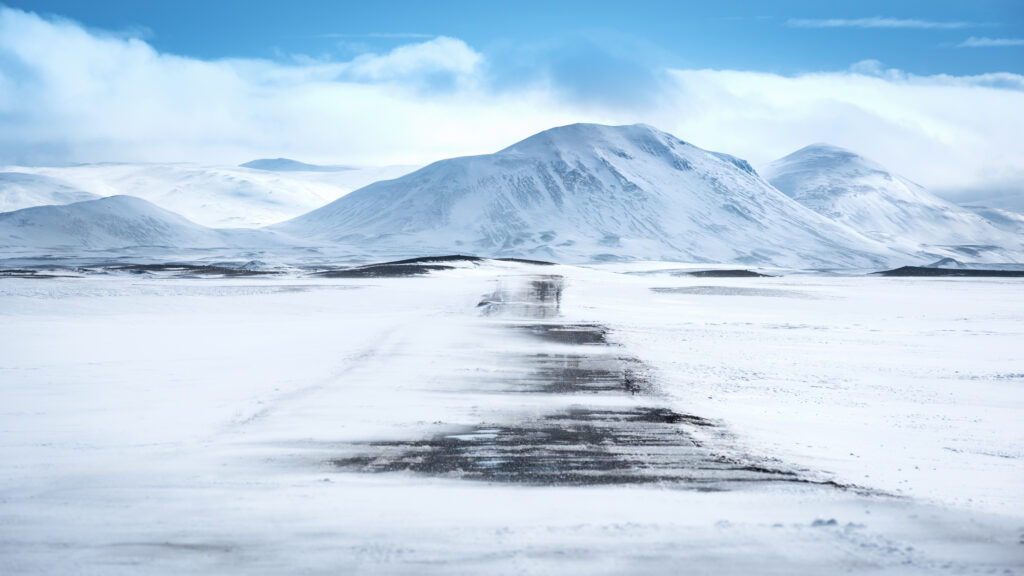
The blue hour — the period before sunrise and after sunset when the sky produces a deep, even blue — is similarly extended. For waterfall photography, seascape work, and any composition where soft, directional light matters, winter Iceland is not a compromise. It is an advantage.
Plan your shoots around the light windows. In December and January, you might have a two-to-three hour golden window in the middle of the day. Know where you want to be before the light arrives.
Northern Lights — Peak Season
Winter is aurora season at its most reliable. The combination of long dark nights, low light pollution outside Reykjavík, and statistically higher geomagnetic activity makes December through February the strongest period for Northern Lights photography.
The practical approach to aurora shooting in winter follows the same principles as the rest of the year — check Veðurstofa Íslands for both the KP forecast and cloud cover, check moon phase alongside it → Iceland Moon Calculator, get away from artificial light, and have your foreground scouted before dark.
What changes in winter is the extended window. With darkness from mid-afternoon, you have significantly more time to work with than in October or March. A display that begins at 10pm and runs until 2am gives you multiple opportunities to adjust composition, wait for conditions to improve, and move locations if needed.
For camera settings, gear, and foreground recommendations, the dedicated Northern Lights guide covers everything in detail.
Subjects Worth Planning Around
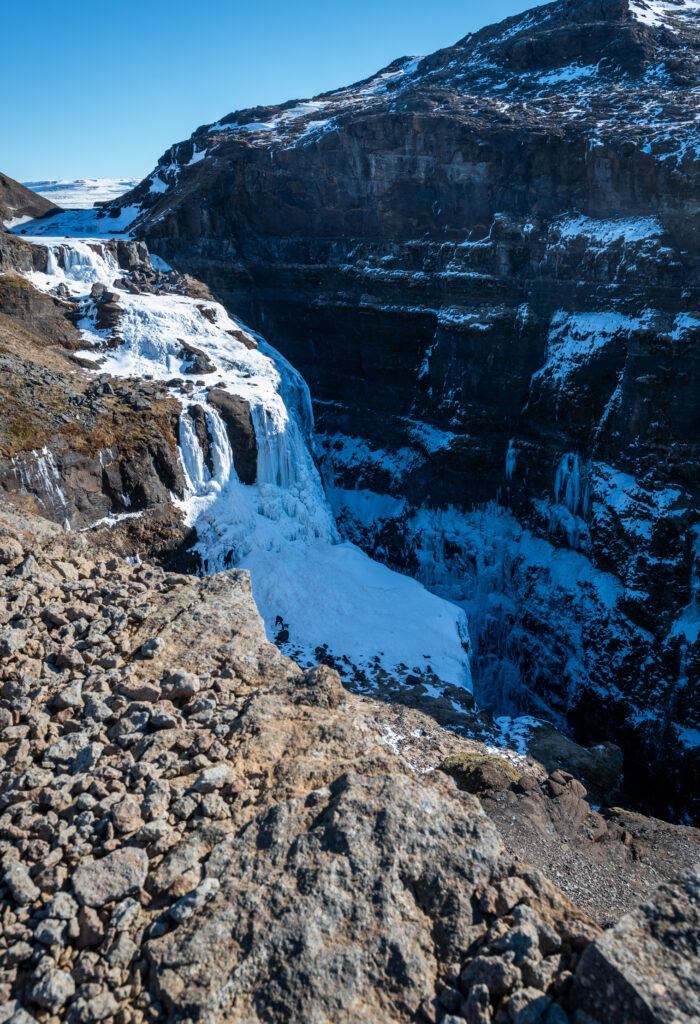
Frozen waterfalls. Iceland’s waterfalls partially freeze in cold winters, creating formations of ice curtains and frozen spray that are unlike anything visible in other seasons. Skógafoss and Seljalandsfoss are the well-known options. Lesser-known falls in the interior freeze more completely and see a fraction of the visitors — research before you travel.
Snow-covered lava fields. The contrast between Iceland’s black volcanic rock and deep snow is one of the most visually striking things the island produces. The south coast between Vík and Jökulsárlón becomes a monochrome landscape of black and white that has almost no equivalent anywhere.
Jökulsárlón in winter. The glacier lagoon without summer’s tour boats and crowds is a different place entirely. Icebergs calve year-round; in winter they drift through still, dark water under skies that can produce aurora overhead. Diamond Beach directly adjacent receives the largest ice blocks of the year — as I have seen first-hand on autumn and winter visits, the scale of some pieces is extraordinary.
Goðafoss in winter. Ice forming along the canyon edges, aurora potential overhead, Ring Road access year-round — one of north Iceland’s most accessible winter photography locations. Full guide: Goðafoss — The Waterfall of the Gods.
Ice on lesser-known lakes and rivers. Winter Iceland freezes in patterns that reward photographers who leave the main road. Ice formations on smaller lakes, frost on volcanic rock, and snow-dusted moss create textures that are invisible in summer.
Vestrahorn gives you a 454-metre foreground for an aurora frame, with very little light pollution in any direction.
Safety — The Honest Assessment
Winter Iceland is genuinely hazardous in ways that are easy to underestimate until you are in the middle of a situation.
Safety
Winter Iceland — the non-negotiables
I know this from direct experience — and from two incidents that happened not in winter, but in spring, when conditions looked more benign than they were.
On one trip I broke through a snow-covered field into a deep hole beneath, dislocating my shoulder. On another, a slope I judged manageable sent me sliding because I was neither equipped nor positioned for what the conditions actually required. I lost a tripod and collected scrapes. Both incidents happened without leaving any marked path.
Spring is deceptive. Winter is explicit — the cold, the darkness, and the wind make the risks visible. But the same conditions that make winter Iceland dramatic for photography make it unforgiving for anyone who isn’t prepared.
The non-negotiables:
- 4WD vehicle with winter tyres. Not a recommendation — a requirement. Studded tyres are strongly advised for serious winter driving.
- Proper layering. A warm jacket is not sufficient. Base layer, mid layer, waterproof outer layer, insulated gloves, hat, and spare dry clothing in the vehicle.
- Crampons and trekking poles for any glacier or snow-covered terrain.
- Check road conditions daily at road.is. Roads that are open in the morning can close by afternoon.
- Monitor weather constantly. Veðurstofa Íslands should be checked before every drive and every shoot. Iceland’s weather changes fast — wind speeds that seem manageable can escalate to dangerous levels within an hour.
- Tell someone your plan. Where you are going, when you expect to be back, and what to do if they don’t hear from you.
- Never drive onto a frozen lake or river. Ice thickness in Iceland is unpredictable and rarely sufficient to support a vehicle.
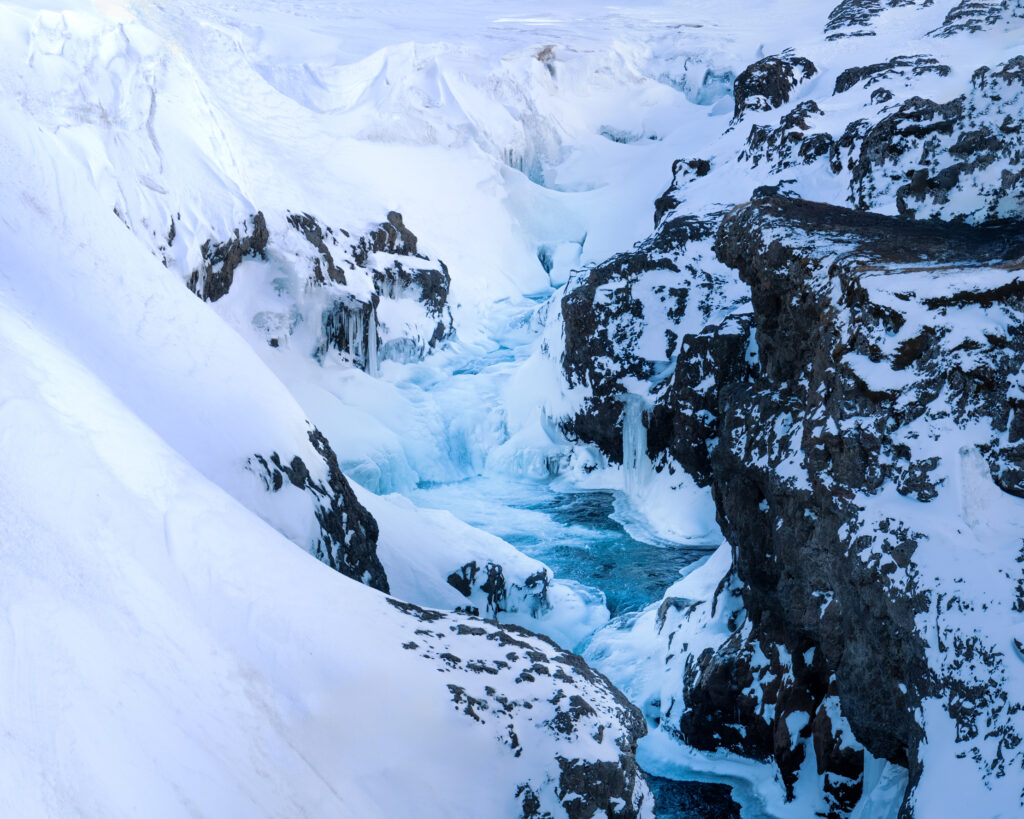
No photograph is worth your life. That is not a figure of speech — and it is not a warning aimed at careless people. It is a reminder for experienced photographers who know exactly what they want and sometimes let that focus narrow their attention to the conditions around them.
What You Cannot Access in Winter
Honest planning requires knowing what is off the table:
F-roads are closed. The Highland interior — Landmannalaugar, Kerlingarfjöll, and the other major highland destinations — is inaccessible by road from approximately October through late May or June, conditions dependent. Check road.is for current status.
Some coastal roads close temporarily. Severe weather can close sections of the Ring Road. This is not common but it happens — plan with flexibility.
Boat tours to Hornstrandir are finished. The last boats run in early September. The Westfjords themselves are accessible by road in winter, but some mountain passes close in severe conditions.
Practical Planning
Accommodation: Book well in advance, particularly around the Christmas and New Year period when Iceland sees a surge of visitors specifically chasing the aurora. Popular areas near Jökulsárlón fill quickly.
Rental car: Specify winter tyres and 4WD explicitly when booking. Confirm the specification before you accept the vehicle. Studded tyres rather than standard winter tyres make a significant difference on ice.
Daylight planning: Download a sun position app before your trip. Knowing exactly when and where the sun rises and sets — and the direction of the golden light — allows you to place yourself correctly before the window opens.
Battery management: Cold kills batteries faster than anything else. Carry minimum two batteries per camera body, keep spares inside your jacket, and charge everything each evening regardless of apparent charge level.
Further Reading
- Best Time to Visit Iceland for Photography — full seasonal comparison
- How to Photograph the Northern Lights in Iceland
- Iceland F-Roads for Photographers: Access, Safety & Seasons
- Leave No Trace in Iceland: A Photographer’s Guide