
The water is the easy part. Everything around it is where judgement matters.
Iceland’s geothermal water is one of the country’s defining experiences — and one of its most photogenic subjects. Steam rising from a pool at the edge of a fjord. The contrast between warm turquoise water and snow-covered ground. A bather’s silhouette in the mist with mountains behind.
It is also a subject that brings together almost every responsibility a photographer in Iceland carries at once: safety in an environment that can cause serious injury, protection of fragile ecosystems, the privacy of other people at their most relaxed and least guarded, and regulations that exist for reasons that become obvious the moment someone ignores them.
I have photographed and bathed in geothermal water across Iceland — from a deserted roadside pool in the Westfjords to commercial facilities with hundreds of guests. This guide covers what I have learned about doing both well.
Three Kinds of Hot Springs — Three Different Sets of Rules
Iceland’s geothermal bathing culture spans a spectrum, and the photography rules shift along it.
Three Categories
Natural springs, community pools, commercial spas — different rules apply
The pattern across all three: the less infrastructure a place has, the more the responsibility shifts to you. A commercial spa has staff to intervene. A natural spring has only the people who visit it — and what they choose to do when no one is watching.
Natural, undeveloped springs
Wild hot springs — pools formed where geothermal water surfaces naturally, sometimes with minimal human intervention like a stone wall or a simple basin. They are often unmarked, unstaffed, and free.
These are the most photogenic and the most demanding category. No infrastructure means no safety oversight, no temperature regulation, and no one to tell you that the ground beside the pool is thinner than it looks. It also means the photography is entirely your responsibility — there are no rules posted because there is no one to post them. The rules are the ones you bring with you.
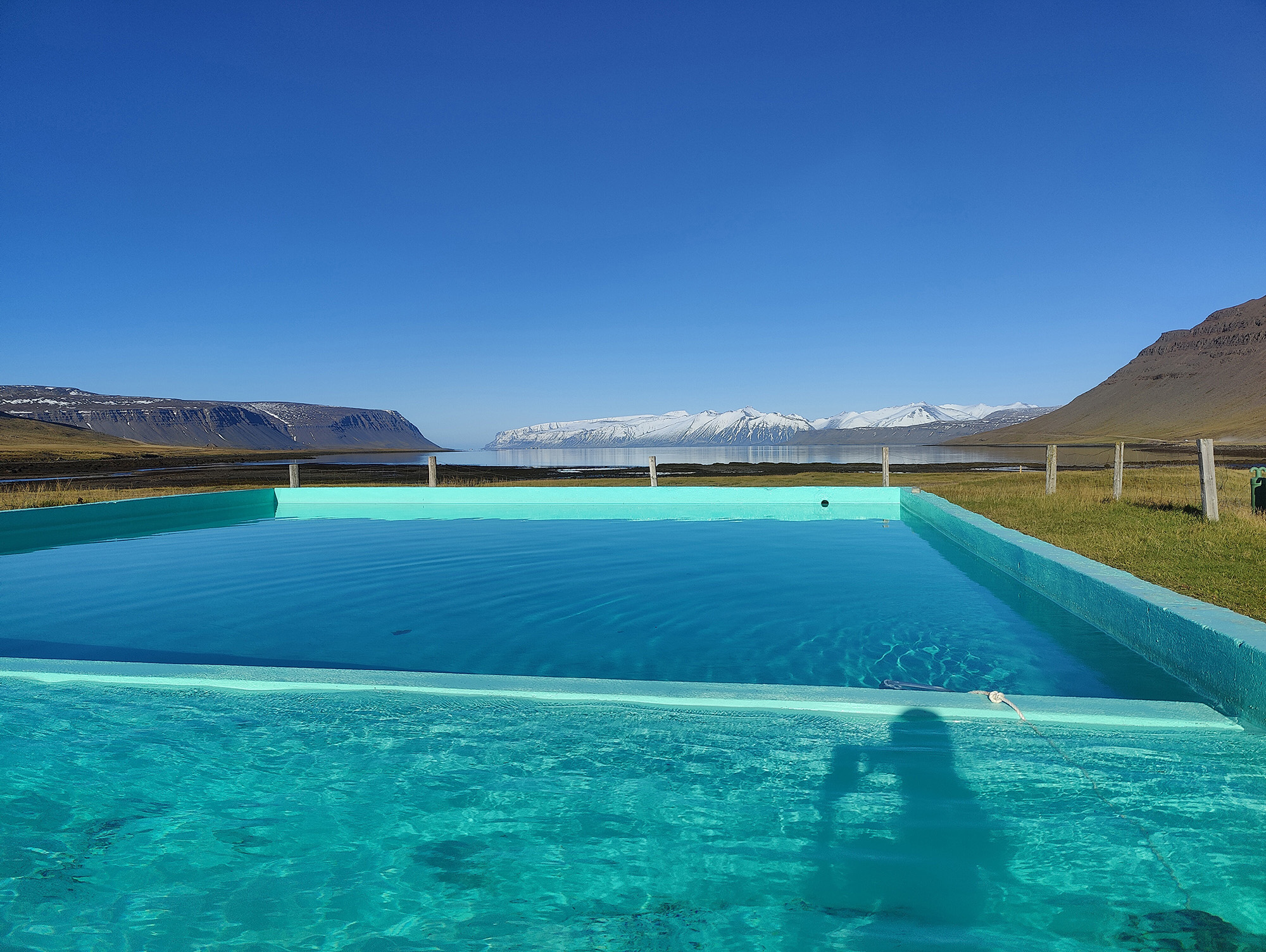
Reykjafjarðarlaug is the example that stays with me. Driving a small coastal road in the Westfjords with no expectation of anything in particular, the pool simply appears — a proper swimming-pool-sized basin of warm water beside the road, with no one else there and a view across the fjord that stops you mid-step. Two pools, one hot and one cooler, and the kind of silence that makes you lower your voice without deciding to. It is one of the best breaks I have had anywhere in Iceland, and it cost nothing.
Community pools and tubs
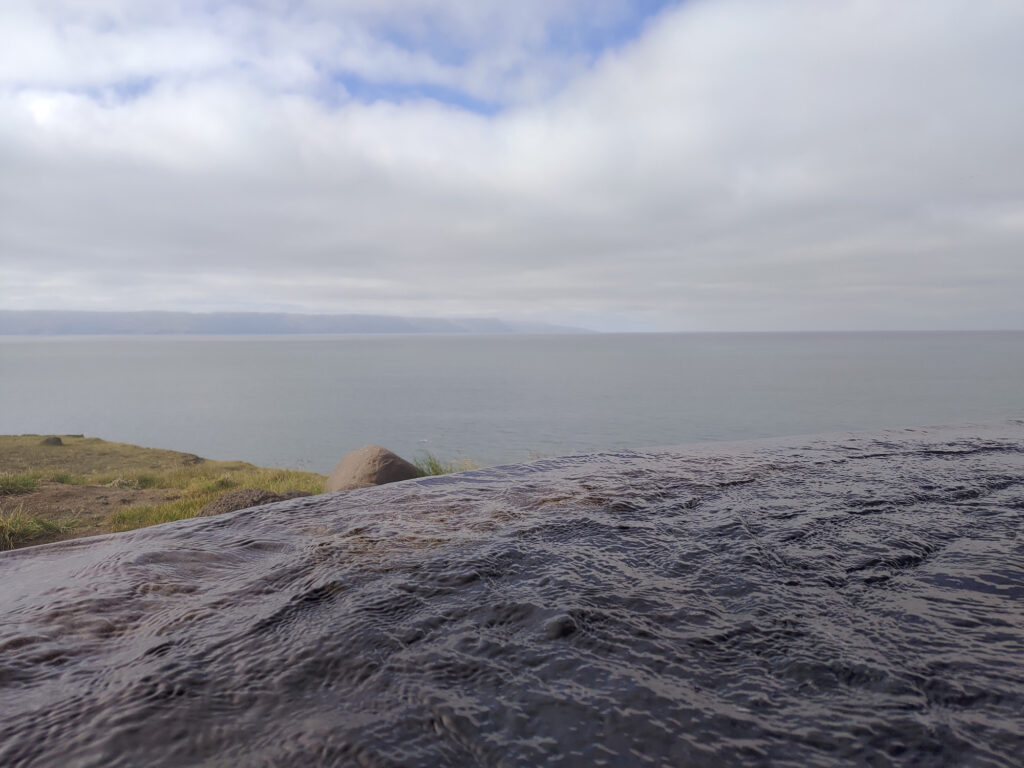
Iceland’s villages maintain local pools and hot tubs — like the seaside tubs at Drangsnes on the Strandir coast, where I sat in geothermal water while sleet fell and the sound of the sea carried over the wall. These facilities are simple, inexpensive or free, and maintained by the communities that use them.
The defining quality here is that these are local spaces first and visitor attractions second. The photography etiquette follows from that: you are a guest in something that belongs to the people who live there.
What struck me most about Icelandic community pools is how unbothered they are by weather. The outdoor areas stay open year-round — hot tubs steaming in snow, and even the water slides run with warm water. At the pools in Bolungarvík and Höfn, we went down the slides in snow and rain, the warm water on the slide a strange and wonderful contrast to the cold air. It is a small detail, but it tells you something about how Icelanders relate to their geothermal resources: not as a special occasion, but as infrastructure that works in every condition.
Another small thing that has stayed with me: most community pools have a small centrifuge — a spin dryer for swimwear — tucked away near the changing rooms. Drop your wet swimsuit in, a minute later it’s nearly dry. I have never seen this at any of the larger commercial spas. It is exactly the kind of practical, unglamorous infrastructure that exists because locals use these pools daily, not because tourists expect it — and it is one of my favourite small discoveries in Iceland.
Commercial geothermal spas
The Blue Lagoon, Mývatn Nature Baths, Vök Baths, Geosea, Sky Lagoon — developed facilities with entry fees, staff, changing rooms, and explicit rules. I have visited several. My personal preference is the Geosea in Húsavík, with its infinity edge above Skjálfandi Bay — but each has its own character.
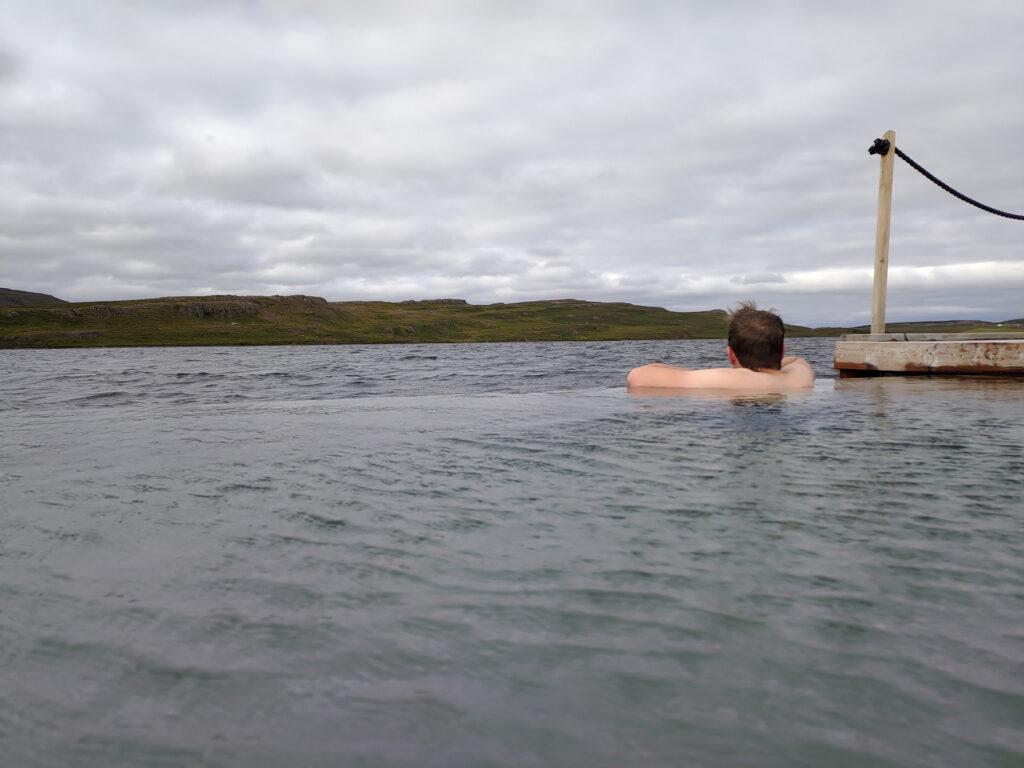
Vök Baths in East Iceland has a particular appeal for me: the pools sit directly in Lake Urriðavatn, connected to the open water. On one visit, the lake was frozen, and a ladder led directly from the warm pool into the ice-cold lake beyond — the option to step from one extreme into the other, a few feet apart. It is the kind of contrast that geothermal bathing in Iceland does uniquely well, and it is part of why Vök remains one of my preferred commercial facilities despite the drone incident described below.
Commercial facilities have photography policies. Some prohibit cameras beyond the changing area entirely. Some allow phones and personal photography. All of them prohibit photographing other guests without consent. Check the policy before you visit, and treat it as a floor, not a ceiling — the fact that photography is permitted does not mean every photograph is appropriate.
Temperature: The Danger That Doesn’t Look Like One
Geothermal water in Iceland can emerge from the ground at temperatures far above what skin tolerates. Some natural springs are comfortable bathing temperature. Some are near boiling. Many fluctuate — the same pool can be pleasant one season and scalding the next, depending on geothermal activity below.
Temperature Safety
The danger that doesn’t look like one
“The visual difference between a 38°C pool and a 70°C pool is approximately nothing.”
identical
to
The Grjótagjá example: the cave near Mývatn is beautiful, photogenic, and posted with no-swimming signs precisely because its temperature fluctuates unpredictably. Signs at geothermal sites exist for reasons that become obvious the moment someone ignores them — at this site and at every other.
The visual difference between a 38°C pool and a 70°C pool is approximately nothing.
The rules that follow from this:
Never enter unmarked geothermal water without testing it gradually. Hand first, then slowly. If a spring has no established bathing history — no basin, no obvious signs of regular use — treat it as too hot until proven otherwise.
The ground around geothermal features is part of the hazard. Thin crusts over boiling mud or water exist at geothermal sites across Iceland. The Grjótagjá cave near Mývatn — beautiful, photogenic, and posted with no-swimming signs precisely because its temperature fluctuates unpredictably — is a good example of a place where the rules exist for reasons. Stay on established paths at any geothermal area, full stop.
Children and photography are a dangerous combination at hot springs. A photographer focused on a composition is not watching a child near hot water. If you are travelling with family, photograph when someone else has explicit charge of supervision.
For photographers specifically: the best steam conditions — cold air, hot water — are exactly the conditions where the water temperature is hardest to judge and the ground may be icy. The most photogenic moment is the most dangerous one. Plan accordingly.
The Contamination Rule — Why “Just This Once” Doesn’t Exist
Natural hot springs are living ecosystems. The microbial communities in geothermal water — some of them found nowhere else — are sensitive to contamination in ways that are invisible until the damage is done.
No soap. No shampoo. Nothing. Not biodegradable soap, not “just a quick rinse.” The biodegradable label means a substance breaks down eventually — not that it is harmless to a closed geothermal ecosystem in the meantime.
No food, no drinks in the water. The hot tub beer is an Icelandic tradition in private and commercial settings with filtration systems. A natural spring has no filtration system. What goes in stays in.
Shower before entering where facilities exist. This is standard Icelandic pool etiquette and the practice extends to natural springs: sunscreen, insect repellent, and skin products all wash off into the water.
The cumulative logic matters here. One person’s sunscreen in a small pool is a trace. A summer’s worth of visitors each leaving a trace is a changed ecosystem. The Westfjords pools I value most — Reykjafjarðarlaug above all, with its two pools and its fjord view and its total absence of other people — stay as they are only because enough visitors follow rules that no one is there to enforce.
Photographing People in Geothermal Water
This deserves its own section because it is where photographers most often get it wrong.
Photographing People in Geothermal Water
Where photographers most often get it wrong
The Vök Baths drone — what it looked like in practice
Do not fly drones over bathers. Anywhere. Ever. At Vök, fellow guests launched a drone over the bathing area to film themselves from above. Other guests objected immediately, staff intervened, and the pilots were removed within minutes. The episode illustrated the entire problem in miniature: an aircraft above a pool films everyone below it, every one of them in swimwear, none of whom consented. Privacy does not require a posted sign — at natural springs the rule applies identically, for the same reasons.
People in a hot spring are in swimwear, relaxed, and not performing for a camera. The intimacy that makes hot spring photographs compelling is exactly what makes them invasive when done without consent.
The baseline: no identifiable strangers in your photographs without their explicit agreement. Not as background figures you intend to crop later. Not from a distance with a telephoto. If a person is identifiable in your frame and has not agreed to be photographed in their swimwear, the photograph should not exist.
Ask, and accept the answer. Most bathers, asked politely, will either agree or move out of frame for a moment. The asking is not an imposition — the photographing without asking is.
Travel companions change the calculation, not the principle. Photographing your own group is normal. Compose so that strangers stay out of frame, and wait for the moments when the pool’s geography makes that possible.
Empty pools are the cleanest solution. The strongest hot spring photographs I have are from pools with no one in them or with only people I know — Reykjafjarðarlaug deserted beside the road, Drangsnes in weather that kept everyone else away. Off-season, early morning, and bad weather are the photographer’s allies here, exactly as they are everywhere else in Iceland.
The Drone Question — A Story From Vök Baths
At Vök Baths in East Iceland, I watched fellow guests carry a drone into the bathing area and launch it to film themselves in the water from above.
What happened next was predictable: other guests objected immediately, staff intervened, and the drone pilots were removed from the facility. The whole episode took perhaps ten minutes, and it illustrated the entire problem in miniature — a drone above a bathing area films everyone below it, every one of whom is in swimwear, none of whom consented, all of whom came to relax and now have an aircraft overhead.
Do not fly drones over bathers. Anywhere. Ever. Commercial facilities prohibit it explicitly. At natural springs, no posted prohibition exists — and the rule applies identically, for the same reasons. Privacy does not require a sign.
Beyond the privacy issue, standard regulations apply: EU Open Category rules prohibit flying over uninvolved people regardless of location. A bathing area is the definition of uninvolved people.
If you want aerial geothermal photography, the legitimate version exists: unoccupied springs, geothermal landscapes without bathers, steam fields. Check kort.gis.is/mapview/?app=dronar for restrictions, follow the rules in our drone guide, and keep the camera away from people in the water.
The Aurora Hot Tub Moment — And What It Taught Me
The strongest geothermal experience of my Iceland trips involved no photograph at first.
At Hótel Laxárbakki in northwest Iceland, in October 2024, our group was in the hotel’s hot tub on an overcast evening. No one had checked the aurora forecast. No one had camera gear staged. Then the sky began to move — faintly first, then unmistakably — and within minutes one of the most intense displays I have witnessed was overhead.
I got out, dressed as fast as wet skin and cold air allow, and photographed from the immediate surroundings with no preparation, no scouted foreground, no plan. The images are good. The foreground is not what I would have chosen with an hour’s notice.
The lesson I take from it, for this article specifically: the hot spring and the camera have different jobs. The water is for being in. The photography happens at its edges — before, after, in the moments when you step out. The photographers who try to do both at once, phone held above the water, gear bag at the pool edge in the steam and the spray, tend to end up with damp equipment and a diminished soak.
Soak first. Photograph deliberately. Keep the camera staged somewhere dry and accessible for the moment the sky does something — and check the forecast before you get in, which is the part I failed at.
Leave No Trace at Hot Springs
Here is the uncomfortable truth: places like Reykjafjarðarlaug stay wonderful only because the people who visit treat them that way. On one visit, the changing area had rubbish and dirt left behind by previous visitors — wrappers, debris, general mess in a space that has no staff, no cleaning schedule, and no one coming after you to put it right. If you are fortunate enough to find a place like this, the responsibility that comes with it is not abstract. Take out what you bring in, leave the changing area as you found it or better — and if you find rubbish that isn’t yours, take it with you anyway. Someone has to set the example, and it may as well be you. The silence and the empty pool are not guaranteed. They depend on everyone who comes here behaving as though someone is watching, even when no one is.
The standard principles, adapted to geothermal settings:
Take everything out. Towels, swimwear packaging, food wrappers, hand warmers. Natural springs have no bins because they have no services.
Leave the structures alone. The stone basins, simple walls, and steps at natural springs are maintained by locals and volunteers. Do not modify them, add to them, or dismantle them for a cleaner composition.
Park where parking exists. The vegetation around hot springs suffers from exactly the off-path pressure that affects every Icelandic location — compounded by people walking barefoot and looking for the shortest route. Use established paths even when barefoot on cold ground makes the shortcut tempting.
Quiet is part of the place. The sound of Drangsnes was the sea beyond the wall. The sound of Reykjafjarðarlaug was nothing at all. Bluetooth speakers do not belong at natural hot springs, and a photography session that takes over a shared pool — gear spread out, repeated requests for people to move — is its own form of intrusion.
Where to Go From Here
The hot pools mentioned in this article are covered in their full context elsewhere on this site:
- Westfjords Deep Dive — Reykjafjarðarlaug and the Drangsnes hot tubs in detail
- Mývatn Region Photography Guide — Mývatn Nature Baths, Grjótagjá, and the Geosea alternative in Húsavík
- Leave No Trace in Iceland — the full hot springs safety section
- Drone Photography in Iceland — complete regulations
Sources
- Nature Conservation Agency of Iceland — nattura.is
- Veðurstofa Íslands (Icelandic Meteorological Office) — vedur.is
- Ferðamálastofa (Icelandic Tourist Board) — visiticeland.com