
The season I keep coming back to
Ask me which season defines Iceland for me, and the answer is immediate: autumn. Not because the other seasons disappoint — winter’s ice caves and aurora, summer’s midnight sun, spring’s returning light all have their case. Autumn wins for me because it combines more of what makes Iceland extraordinary than any other single season, without asking for the sacrifices that winter demands.
September and October sit in a genuine sweet spot. The summer crowds have thinned substantially by mid-September. The Northern Lights return as the nights lengthen. The light itself changes character — lower, warmer, more generous with the golden hour than the flat overhead light of July. And the landscape itself shifts colour, the greens of summer giving way to amber, rust, and ochre that sit beautifully against black rock and grey sky.
This is not a seasonal overview repeating what the site’s Best Time to Visit guide already covers in brief. This is what six autumn visits across different years have taught me about shooting Iceland in its best season.
This guide is one part of the complete guide to photographing Iceland responsibly — start there if you are planning a first trip.
Why Autumn Works
The crowds thin, but the access doesn’t fully close
This is autumn’s core advantage over both summer and winter. By late September, the tour buses that fill car parks at Kirkjufell, Reynisfjara, and Jökulsárlón in July have mostly gone. Accommodation is easier to find and often cheaper. But most F-roads remain passable well into September, and the Ring Road itself sees none of winter’s closures.
You get access without the audience. That combination doesn’t exist in the same way at any other time of year.
The light
Iceland’s midsummer light is famous but, for serious landscape work, often disappointing — the midnight sun means the golden hour never fully arrives, replaced by hours of flat, directionless daylight. Autumn restores what photographers actually want: a sun that sits low on the horizon for extended periods, casting long shadows and warm, raking light across the landscape.
By October, sunrise and sunset have moved close enough together that a single day can realistically include both golden hours without an exhausting schedule stretched across twenty hours of daylight.
The colour
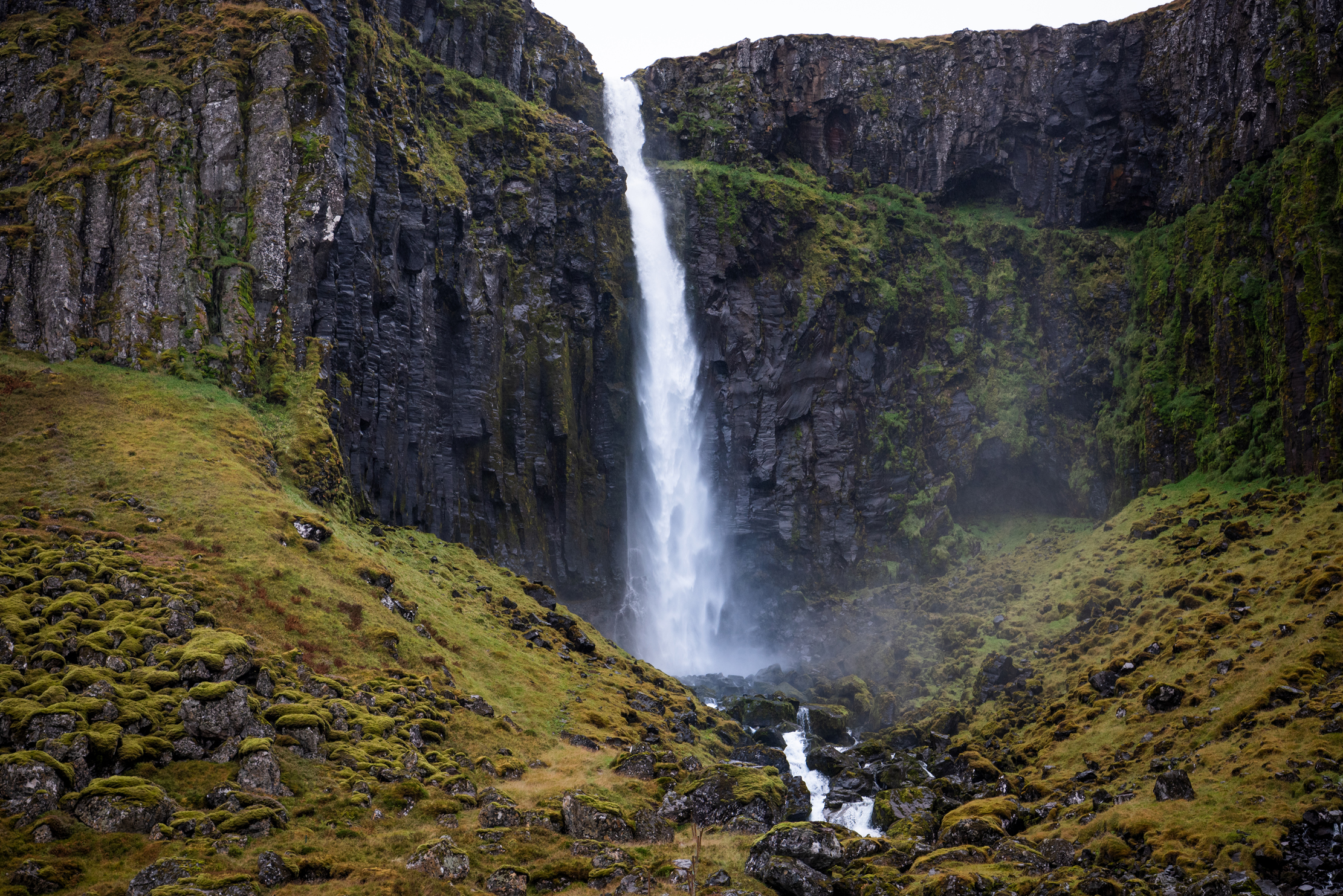
This is autumn’s most visually obvious gift and the one summer and winter cannot replicate. Iceland’s low vegetation — the birch scrub, the blueberry bushes, the grasses covering the lava fields — turns through amber, deep red, and ochre through September and into October. Paired with black volcanic rock and grey Atlantic skies, the effect is a colour palette unique to this window.
I have photographed the same locations across seasons, and the autumn versions consistently carry more warmth and visual interest than their summer equivalents, where uniform green can flatten a composition that autumn colour gives genuine depth.
The aurora returns
Iceland’s summer nights are too bright for Northern Lights. That changes as autumn deepens — by late August the darkness has returned sufficiently for aurora activity to become visible again, and September and October offer a genuine bonus that winter’s aurora season shares but summer cannot: the chance to combine Northern Lights with landscape features that still show autumn colour rather than snow.
What Autumn Looks Like at Iceland’s Signature Locations
Diamond Beach — the icebergs I have never seen matched
I have visited Jökulsárlón and Diamond Beach across three seasons. Only in autumn have I found genuinely massive icebergs washed up on the black sand — sculptural blocks of glacial ice, some larger than I have encountered at any other time of year, meeting the Atlantic surf in a way that felt different from every other visit.
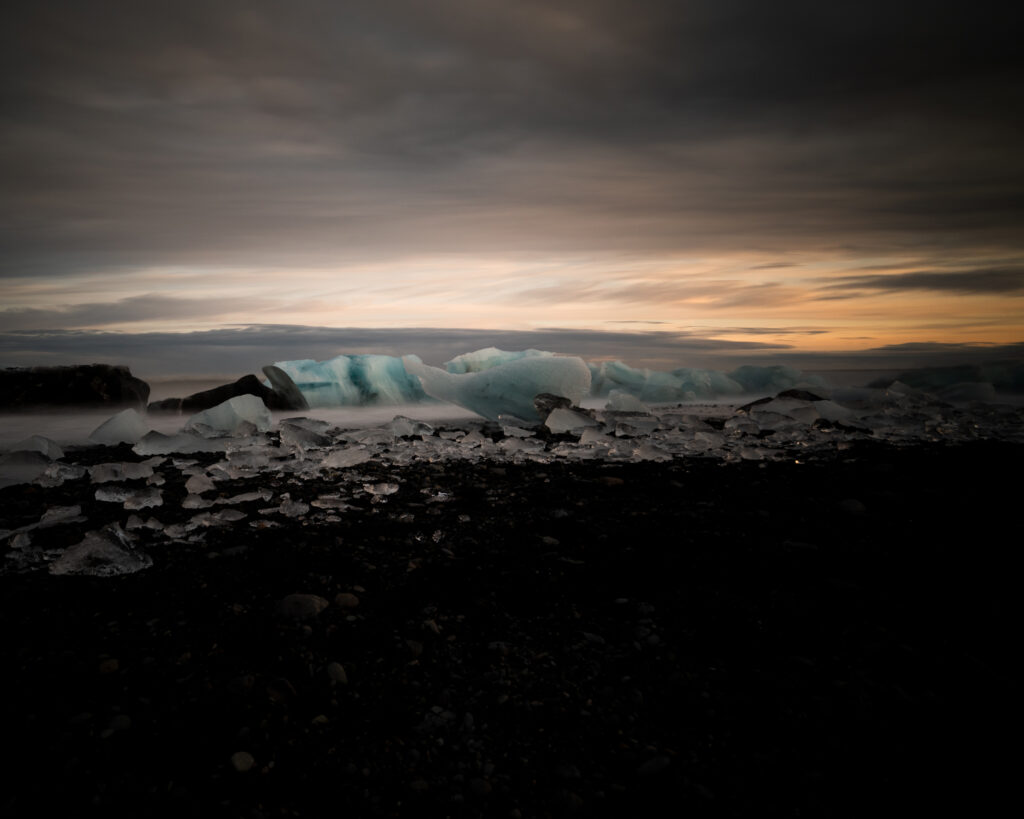
I described this in detail in the Jökulsárlón & Diamond Beach guide, and the image from that evening — a sky burning deep red over the lagoon, icebergs scattered across still water — remains the single Iceland photograph I return to most. That evening has not repeated itself on later visits. Autumn, and particularly the accumulated calving of a full summer season, seems to concentrate the largest ice on the beach precisely in September and October.
The Westfjords — solitude that autumn makes possible
October in the Westfjords, covered fully in the Westfjords guide and the Westfjords Deep Dive, showed me a version of Iceland that felt genuinely different from the rest of the country — abandoned in the best sense, quiet, and generous with light that lasted for hours rather than minutes. The trade-off — Hornstrandir boat access ending for the season, some village restaurants already closed — is real, but for photography specifically, autumn is when the region performs best.
Kirkjufell in the rain, and other accidental gifts
Some of my strongest autumn images came from conditions I didn’t choose. Arriving at what turned out to be Kirkjufellsfoss in October rain, with no one else present and no idea at the time that I had photographed one of Iceland’s most iconic mountains — that accident, told fully in the Snæfellsnes guide, is the kind of image that autumn’s quieter, wetter days make possible. Summer’s crowds would have made the same frame impossible regardless of the weather.
For a single location that carries an entire autumn trip, Vestrahorn is the one — if the mountain shows itself.
Practical Autumn Shooting
Practical Autumn Shooting
What autumn demands — and what it gives back
What to pack (autumn-specific)
How to shoot autumn Iceland
The instability is the gift. Iceland’s autumn weather changes within a single afternoon more dramatically than any other season. That same instability produces the dramatic cloud, sudden clearings, and raking low light that make autumn images distinctive. Do not try to forecast your way around it — plan to be in position when it happens.
Weather
Autumn weather in Iceland is genuinely unstable — more so than the settled stretches summer sometimes offers, less extreme than deep winter. Rain, wind, and sun can rotate through a single afternoon. This instability is not a problem to solve; it is the source of autumn’s best light. Dramatic cloud, sudden clearings, rainbows after a shower — these are autumn phenomena more than any other season’s.
Check Veðurstofa Íslands daily, and build the flexibility into your itinerary that Iceland always rewards — a second visit to a location a few hours later, once conditions have shifted, consistently produces better results than pushing through poor light out of schedule pressure.
What to pack
Layering matters more in autumn than in summer’s relative predictability. Days can start cold and clear, turn to driving rain by midday, and settle into a still, golden evening. A full rain shell, warm layers, and gloves belong in the bag from September onward. See the Camera Gear guide for the full kit list — nothing changes for autumn specifically except a slightly greater emphasis on weather protection for both photographer and equipment.
Aurora planning
September and October aurora hunting benefits from a specific combination: check both the KP forecast and cloud cover on Veðurstofa Íslands, and plan for locations that still show autumn colour in the foreground rather than waiting for full winter snow cover. A birch-covered hillside turning amber beneath a green aurora is a distinctly autumn image that winter’s white landscape cannot produce. Full technique is covered in the Northern Lights guide.
Timing within the season
September and October are not interchangeable. Early September still carries some summer crowd residue and daylight length; by early October, both have receded fully, but some F-roads and highland routes begin closing. Late September through mid-October is, in my experience, the genuine peak — autumn colour near its most vivid, crowds at their lowest, most roads still open, and aurora activity increasingly reliable.
Timing
September or October — they are not interchangeable
Marcel’s recommendation: late September to mid-October is the genuine sweet spot — colour near its peak, F-roads mostly still open, crowds at their lowest, and aurora nights long enough to hunt effectively. That specific window is what six autumn trips have pointed to consistently.
Leave No Trace in Autumn
The principles from the site’s Leave No Trace guide apply without modification, but two points deserve autumn-specific emphasis.
Wet ground is more vulnerable, not less. Autumn rain softens paths and vegetation edges. A footstep off the marked route in October causes more visible, longer-lasting damage than the same footstep on dry July ground. Stay on paths with extra discipline as the season turns wet.
Reduced visibility affects everyone’s safety, not just yours. Shorter days and more frequent low cloud or rain mean less daylight margin for error. Plan drives and hikes with the season’s earlier sunset in mind, and don’t assume the long light of a July evening when October’s darkness arrives considerably sooner.
My Honest Recommendation
If you are planning your first Iceland photography trip and can choose only one season, choose autumn. Specifically: late September to mid-October.
You will not get the ice caves that winter offers, and you will not get the midnight sun’s unique 2am golden light that summer provides. What you will get is nearly everything else — colour, manageable crowds, workable light, aurora potential, and a landscape that, across six trips, has consistently given me more than any other season.
Further Reading
- Best Time to Visit Iceland for Photography — full seasonal comparison
- Jökulsárlón & Diamond Beach Photography Guide
- Photographing the Westfjords: Iceland’s Forgotten Region
- How to Photograph the Northern Lights in Iceland
- Snæfellsnes Peninsula Photography Guide
Sources
Ferðamálastofa (Icelandic Tourist Board) — visiticeland.com
Veðurstofa Íslands (Icelandic Meteorological Office) — vedur.is
Vegagerðin (Icelandic Road Administration) — road.is