You can photograph the ice caves of Vatnajökull only on a guided tour. The safe season is typically November to March, sometimes into April, and the melt season from April or May to September or October is the dangerous time. Inside you get a short time, often 15 to 20 minutes, in dim light among blue ice. Use a wide-angle lens, shoot RAW, no flash, and use a tripod if your operator allows one. If not, raise your ISO. Stay with the guide, because a fatal collapse in 2024 is the reason the rules are now strict. Book with flexibility, because tours are cancelled when conditions are not safe.
Why ice caves are special to photograph
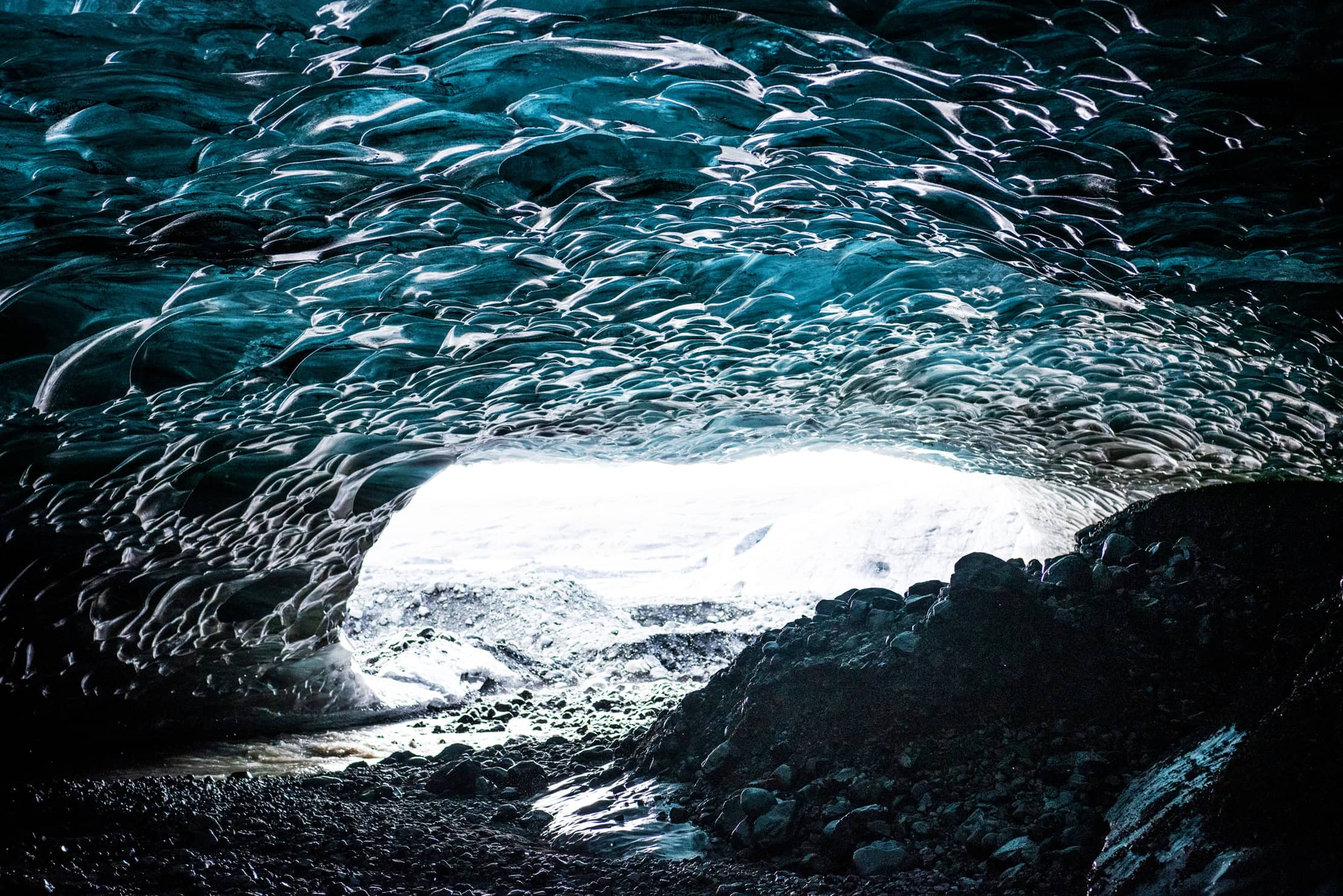
The ice in these caves has been compressed over centuries until it absorbs red light and transmits blue. When light enters through the ice, the walls glow in every shade from pale white to deep turquoise, crossed by dark stripes of volcanic ash that record old eruptions. The Winter Guide describes the experience in more detail. For the camera it means two things: the blue is real and does not need enhancement, and the light is dim, so the exposure is the challenge.
My tour in March 2022
I visited an ice cave in March 2022 with Ice Explorers of Vatnajökull, on a tour from the Jökulsárlón area. We were about ten people in the group, and I had roughly 15 to 20 minutes inside the cave. It was the end of the season, and you could already feel that the tours would not go on for much longer: the ice was melting fast and there was a lot of water. I do not know which cave we visited. The caves change every year, and the operator chooses the cave on the day, so there is no fixed location to recommend.
I had lost my tripod shortly before the trip and shot handheld at ISO 2000, without flash, and corrected the white balance later when editing. I saw no one else in the group with a tripod. It is the only ice cave tour I have done so far, and I was very satisfied with it, but I cannot compare it with other operators. This guide is not sponsored and has no affiliate links.
Season and safety
Entering a glacier cave requires a certified guide, as the conditions change daily. The guide checks the cave, provides the safety equipment and leads the group along an assessed route. According to an analysis of the Icelandic Tourist Board from October 2024, the park cannot close an area because of a natural process such as the development of the ice, and the green light can only be given on site by the guide on the day. That is the reason to follow the guide.
- Typical season: November to March, with January and February the most stable months according to the Winter Guide. The analysis, which is based on measurements at Breiðamerkurjökull from 2002 to 2023, puts the melt season from April or May to September or October. The low-risk period is usually about six months, from early November to the end of April, and in very warm winters only four months, from December to March. Warmth, rain and wind can bring danger in winter as well. In March the ice was already melting when I visited in 2022.
- The main hazards named in a risk assessment that the park commissioned in 2017: collapse, which is greatest near the cave mouth where the ice is thinnest, water flowing through the cave and sudden changes when accumulated water drains, vertical shafts where snow collects, and slipping on uneven ice.
- Who may run tours: Operators need a contract with the national park. The current contracts for the southern area run from 1 October 2025 to 30 September 2027. Since 2020 the contracts require trained glacier guides and a maximum number of guests per guide. According to the Reykjavík Grapevine, 30 of 34 applicants received contracts in 2025, and a guide may lead only 8 to 16 guests depending on the tour.
- Daily risk assessment: After a fatal accident on 25 August 2024, when a tourist died after ice collapsed in a moulin at Breiðamerkurjökull, the park tightened the contract terms. According to Iceland Review, operators must carry out daily safety assessments of each ice cave and of overhanging ice such as ice walls and moulins, and must stay away from a location that is judged unsafe that day.
- Cancellations: Tours are cancelled on the day when conditions are not safe. Build at least one buffer day into your itinerary.
- Check the current rules with Vatnajökull National Park at vjp.is before you book.
Choosing an operator
- Choose a licensed operator that has a contract with the national park, and that holds a licence from the Icelandic Tourist Board. Solo access is prohibited.
- Read recent reviews and opinions of other visitors before you book, and check what happens on days with poor conditions.
- Ask about the group size, the time you spend inside the cave and whether tripods are allowed. The answers differ between operators.
- Book weeks ahead for January and February. Popular tours sell out.
Camera settings
Guides and photographers recommend a tripod, but on my tour I saw no one using one. These are the starting points for both. ISO 2000, no flash and white balance in post are what I did, the other handheld values are advice.
| Setting | On a tripod (guides’ advice) | Handheld |
|---|---|---|
| Lens | Wide angle, 15 to 30 mm full-frame equivalent, or a 24 to 70 mm zoom for flexibility | Wide angle, as on a tripod |
| ISO | 200 to 800, up to 1600 in a dim cave | 2000 (what I used) |
| Aperture | f/9 to f/13 for depth, f/4 to f/5.6 in very dim light | As wide as the depth of field allows |
| Shutter speed | About 1 to 6 seconds, with a 2-second timer or remote release, stabilisation off | As fast as the ISO allows, stabilisation on |
| White balance | Auto, adjust later from RAW | Corrected later when editing (what I did) |
| Flash | None. It flattens the ice and removes the blue | None |
- Shoot RAW. It gives you room to correct the white balance and recover the highlights near the entrance.
- Entrance light: if the entrance is much brighter than the cave, take two exposures, one for the highlights and one for the shadows, and blend them later. A slight underexposure helps preserve the detail in bright ice.
- Composition: shoot towards the entrance for natural backlight through the ice, and get low with the wide angle to show the size of the cave.
- A polariser can reduce glare on wet ice.
The Winter Guide has a short card with the same starting points, and it suggests ISO 800 to 1600. The settings depend on the cave and the day. Check the histogram and adjust one setting at a time.
Handling your gear in the cave
- Meltwater: carry microfibre cloths for water drops on the lens, and keep the camera in a waterproof bag or dry sack when you do not use it. In late season, as in March 2022, there is a lot of water.
- Condensation: watch the lens when you move from cold air to warm air, for example into a heated truck. The routine is in Shooting the Aurora in the Cold.
- Batteries: cold drains them quickly, so carry a spare in an inner pocket, as in the Camera Gear guide.
- Hands: the operator provides crampons. Wear warm, waterproof gloves that still let you use the controls.
Making the most of 15 minutes
Decide on your first frames before you walk in, and then look before you raise the camera. The Winter Guide describes it well: the instinct inside is simply to stop and look. Take your wide frames first, then details of the ash layers and the ice, and leave time for the entrance shot. Do not hold up the group, and do not step away from the route for a better angle.
Tours run in daylight, but the days are short in December and January. Check the daylight for your date in the Iceland Photo Planner, and take a midday departure in the darkest weeks. Guide to Iceland notes that departures between about 10:45 and 13:00 stay in daylight all season, while an early slot can leave before sunrise from early December to mid-January.
Leave No Trace and conduct
- Stay with the guide and on the assessed route. On my tour some people wanted to leave the path for photographs, and the guide politely reminded them that it was dangerous. There is no photograph worth a collapse.
- Do not break off or take ice. The caves change every year, and what you remove is gone.
- Take your rubbish with you, and follow the drone rules of the national park.
- No exact locations. This guide does not publish caves or coordinates. They change every year, and going without a guide is dangerous. Booking a tour is the only way to enter, and the operator picks the cave on the day. The principles are in the Leave No Trace guide.
Plan the rest of your winter trip
Ice caves combine well with the glacier lagoon and Diamond Beach, which are covered in the Jökulsárlón guide, and with glacier photography at Skaftafell in the glacier guide. In the evening, the aurora is possible: start with the Northern Lights guide. The Best Time to Visit guide compares the seasons.
Frequently asked questions
Can I visit an ice cave in Iceland without a tour?
No. The caves in Vatnajökull can only be entered with a certified guide, because the conditions change from day to day and ice can collapse without warning. Solo access is prohibited and dangerous.
When is the ice cave season in Iceland?
The caves are typically visited from November to March. According to an analysis from the Icelandic Tourist Board, the low-risk period usually runs from early November to the end of April, and in very warm winters it shrinks to December to March. Access still depends on the conditions of the day, and late in the season rising temperatures bring meltwater and tours end.
Can I use a tripod in an ice cave?
That depends on the operator and the group. Guides and photographers recommend a tripod for the long exposures, but on our tour in March 2022 no one in the group of about ten used one. Ask your operator before you book.
What camera settings work in an ice cave?
Shoot RAW with a wide-angle lens, no flash, and let the white balance be corrected later. On a tripod, ISO 200 to 800 at f/9 to f/13 and one to six seconds is a typical starting point. Handheld, you need a much higher ISO: we used ISO 2000.
How long do you spend inside an ice cave?
Not long. On our tour we had about 15 to 20 minutes inside the cave with a group of about ten people, so decide your first shots before you enter.
Sources
Icelandic Tourist Board (Ferðamálastofa) — Íshellaferðir og jöklagöngur, Greinargerð um stöðu og þróun (draft, Icelandic, 1 October 2024)
Vatnajökull National Park — Ice cave tours and glacier hikes, announcement of 26 September 2024 and vjp.is. Nature Conservation Agency — application for ice cave tours and glacier walks, contract period 1 October 2025 to 30 September 2027 (Icelandic)
Iceland Review — Stricter Safety Rules Imposed for Vatnajökull Ice-Cave Tours (16 October 2024). Reykjavík Grapevine — Visitor numbers may be limited on Vatnajökull ice cave tours (16 September 2025)
Guide to Iceland — How to Photograph Ice Caves in Iceland (updated 19 October 2026). Icelandic Mountain Guides — A Photographer’s Guide to Iceland’s Glaciers (16 September 2025)
Last verified: October 2026.