An hour at Dettifoss that summer gave us for free
In the summer of 2020, we reached the east bank of Dettifoss on a day of genuinely good weather — a road that’s often closed, often rough, and usually rewards you with a scattering of other visitors even when it’s open. That day, there was almost no one there. We sat down at the edge, close enough to feel the spray on calm gusts, and stayed for an hour. Not shooting constantly. Mostly just sitting with the sound and the scale of it — Europe’s most powerful waterfall, and for that hour, close to ours alone.
I didn’t fully understand how rare that was until this year, watching footage of a summer queue forming at Gljúfrabúi — a waterfall that used to be a genuine secret. Iceland’s summer of 2020 was unlike any other summer before or since, for reasons that had nothing to do with photography and everything to do with a closed border. What that summer showed me, though, is worth carrying into any summer visit: this is the season when Iceland is most crowded, and also the season with the most daylight, the most access, and — if you plan around the crowds rather than through them — still real opportunities for solitude.
This guide is built from that summer and from summers since, on the technique, the timing, and the honest trade-offs of shooting Iceland between June and August.
The Defining Feature: The Midnight Sun
From late May through late July, the sun in Iceland barely sets. In Reykjavík, official sunset might read close to midnight, but true darkness never arrives — the sky holds a soft, extended twilight through the night before brightening again toward a sunrise that isn’t far behind it.
Season Overview
Summer — what it gives and what it doesn’t
Summer is the right season if: puffins, highland F-road access, or the midnight sun experience are central to your trip. It is the wrong season if aurora, ice caves, or solitude at Iceland’s famous locations are what you’re primarily after. For photographers who’ve already done a summer trip, autumn delivers a fundamentally different experience — and one that many find more rewarding for landscape photography specifically.
For photographers, this changes the entire rhythm of a day. The golden hour doesn’t last twenty minutes at dawn and dusk — it stretches, softens, and reappears at hours that feel deeply strange the first time you experience them.
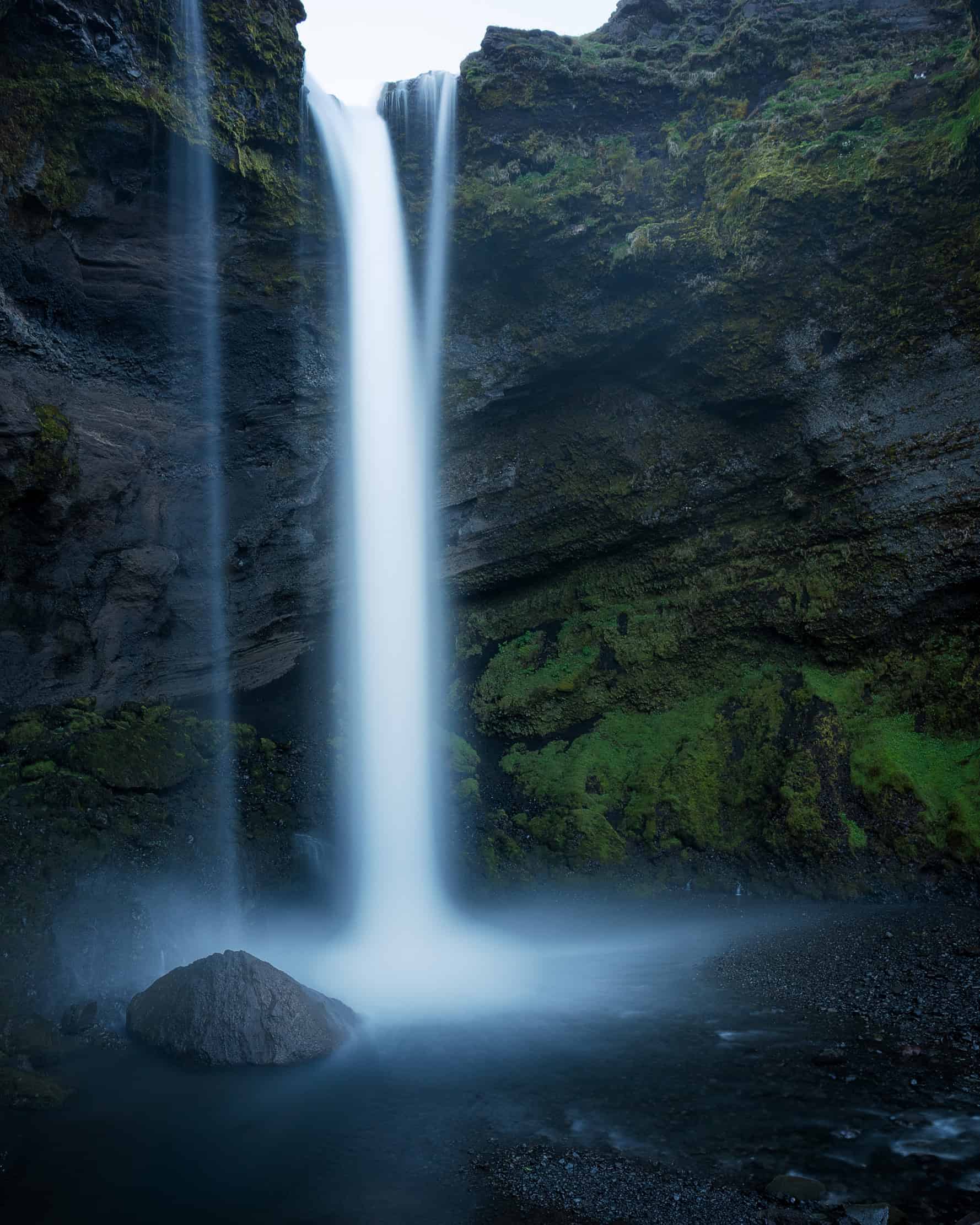
My own experience with this comes with a caveat worth naming. The image accompanying this article — Kvernufoss, a quieter neighbour to Skógafoss tucked into its own canyon just behind the Skógar Museum — was taken at 23:30 in late May, in light that had the warmth of evening without any of the darkness that would normally follow it. That was a deliberate late-night session, and the light rewarded it.
But on the 2020 trip that gave us the hour at Dettifoss, we mostly slept at normal hours instead. That wasn’t a missed opportunity so much as a deliberate one: with the border effectively closed and almost no one else travelling, the usual reason to chase 2am light — escaping daytime crowds — simply didn’t apply. We had quiet locations available in ordinary daylight, so we used ordinary hours.
In a normal summer, that calculation changes. Shooting through the night to catch empty light is a genuinely effective strategy — but it’s also one plenty of other photographers have already worked out. A 2am session at a well-known waterfall can still mean sharing it with several tripods set up around you, especially at locations already established as “the place to shoot the midnight sun.” The advantage isn’t automatic; it depends on where you go, not just when.
Midnight Sun
How to actually use the light — in practice
The light — what it actually means
Planning your sessions
The 2020 lesson: on a trip when almost no one else was in Iceland, the midnight sun advantage — escaping crowds via unusual hours — simply didn’t apply. We had quiet locations in ordinary daylight and used ordinary hours. In a normal summer, the calculation is different. The extended light is a genuine tool — but it’s a tool for managing crowds, not a substitute for choosing the right locations in the first place.
Practical notes for shooting the midnight sun:
- Late May through late July gives the most extended light; June is peak.
- The sun’s low angle for hours means long shadows and warm tones are available far more of the day than the label “midnight sun” suggests — you don’t have to be shooting at 2am specifically to benefit from this season’s light quality.
- Plan one or two late sessions rather than committing to a nocturnal schedule for the whole trip, unless you’re confident you’ll actually sustain it. A tired photographer on unfamiliar roads the next day is a worse trade than the image was worth.
- There is no Northern Lights potential in summer — the sky never gets dark enough. If aurora is part of your goal, this isn’t the season.
Maximum Access — What Summer Opens Up
Summer is the only season when Iceland’s full road network, including the F-roads into the highlands, is realistically open. This is the single biggest practical advantage of shooting in June through August.
F-roads and the highlands. Locations like Landmannalaugar and Kerlingarfjöll — covered in the F-Roads guide — are only accessible once the highland routes open, typically from June, conditions dependent. If highland photography is a goal, summer is your only realistic window.
Puffins. The puffin colonies at Látrabjarg, Borgarfjörður Eystri, and Arnardrangur are active from May through August, with peak numbers in June and July. This is entirely a summer subject — arrive in autumn, as I did on one trip, and the cliffs are simply empty. Full technique is in the Puffin Photography guide.
Waterfalls at maximum flow. Summer meltwater keeps rivers running high, which means waterfalls across the country are at or near their most powerful. This matters for locations like Dynjandi and Dettifoss, where the volume of water is itself part of the spectacle.
Every accommodation option, open. Guesthouses in remote regions that close for winter are running at full capacity. This makes multi-region trips more flexible, though it also means booking further in advance — see below.
The Cost of Access: Crowds
This is the honest trade-off, and it’s worth being direct about it rather than glossing past it the way some guides do.
Summer is Iceland’s peak tourist season by a wide margin. The locations covered across this site that see the heaviest pressure — Reynisfjara, Seljalandsfoss, the Golden Circle, Jökulsárlón’s car park — are at their most crowded exactly when the light is technically best for shooting them. Car parks fill, tour buses run on tight schedules that put dozens of visitors at the same viewpoint within the same twenty minutes, and the quiet, unhurried photography this site generally advocates for becomes genuinely harder to find without deliberate effort.
What deliberate effort looks like in practice:
- Shoot early or very late, using the extended light rather than the conventional golden hour window everyone else is also chasing. A 5am arrival at a popular location can mean having it almost to yourself, even in July.
- Weight your itinerary toward the regions this site already steers you toward — the Westfjords, the east, Snæfellsnes beyond Kirkjufell. These see a fraction of the south coast’s summer traffic even at peak season.
- Accept that some famous locations will simply have people in them. Reynisfjara in July is not going to be empty. Plan your composition and your expectations around that reality rather than fighting it.
- Watch for the “hidden gem gone viral” pattern. Kvernufoss, in the image above, remains genuinely quiet specifically because Skógafoss absorbs the crowd a few hundred metres away. That balance can shift — the Geotagging guide covers exactly this dynamic, and it’s worth reading before you decide what to share from your own summer trip.
Mývatn’s Midges — A Summer-Specific Warning
The Mývatn guide on this site covers this in detail, but it deserves repeating here because it’s a distinctly summer phenomenon that catches people off guard. Lake Mývatn’s midge swarms — the source of its name — peak in summer, and in some recent years have returned in genuinely dense numbers after periods of decline. A head net is not an overreaction; it’s standard kit for a summer Mývatn visit. Most of the swarm is harmless lake midges rather than the biting black fly species, but neither is pleasant in the quantities this region can produce in July and August.
Booking and Planning for Summer
Summer’s popularity has practical consequences beyond crowded viewpoints:
- Accommodation books out early, particularly in July and August, and particularly in smaller towns with limited guesthouse capacity. Book significantly further ahead than you would for shoulder-season travel.
- Car rental prices peak alongside demand. If your dates are flexible, late May or early September (technically shoulder season but close enough to summer conditions for most purposes) can offer meaningfully better rates and thinner crowds while keeping most of summer’s access advantages.
- Weather is genuinely more settled than other seasons, but “more settled” in Iceland still means checking Veðurstofa Íslands daily — see the Weather & Planning Tools guide for the full routine.
What Summer Cannot Give You
Being clear about the season’s limits matters as much as its strengths:
- No Northern Lights. The sky doesn’t get dark enough, full stop.
- No ice caves. These are a winter-only phenomenon in Vatnajökull, structurally unsafe once temperatures rise.
- Less dramatic, more even light for most of the day, outside the extended golden hours — the flat midday light that photographers elsewhere try to avoid is genuinely more common here than in autumn or winter.
- The crowds, discussed above, at the country’s best-known locations.
None of this makes summer the wrong season — it makes it a different tool for a different job. If puffins, highland access, or the specific experience of shooting at 2am in golden light are what you’re after, summer is the only season that delivers them.
My Honest Take
Given the choice, autumn remains my personal favourite — covered in full in the Autumn guide on this site. But summer gave me that hour at Dettifoss, sitting in near-silence at one of the most powerful waterfalls in Europe, in a year when Iceland briefly had far fewer visitors than usual. That specific circumstance won’t repeat. What can repeat, in any summer, is the discipline behind it: arrive early, look past the famous stops, and be willing to let a quiet hour at one location outweigh a checklist of five.
Further Reading
- Best Time to Visit Iceland for Photography — full seasonal comparison
- How to Photograph Puffins in Iceland Without Disturbing Them
- Iceland F-Roads for Photographers
- Mývatn Region Photography Guide
- Dettifoss Photography Guide
Sources
- Veðurstofa Íslands (Icelandic Meteorological Office) — vedur.is
- Vegagerðin (Icelandic Road Administration) — road.is
- Ferðamálastofa (Icelandic Tourist Board) — visiticeland.com