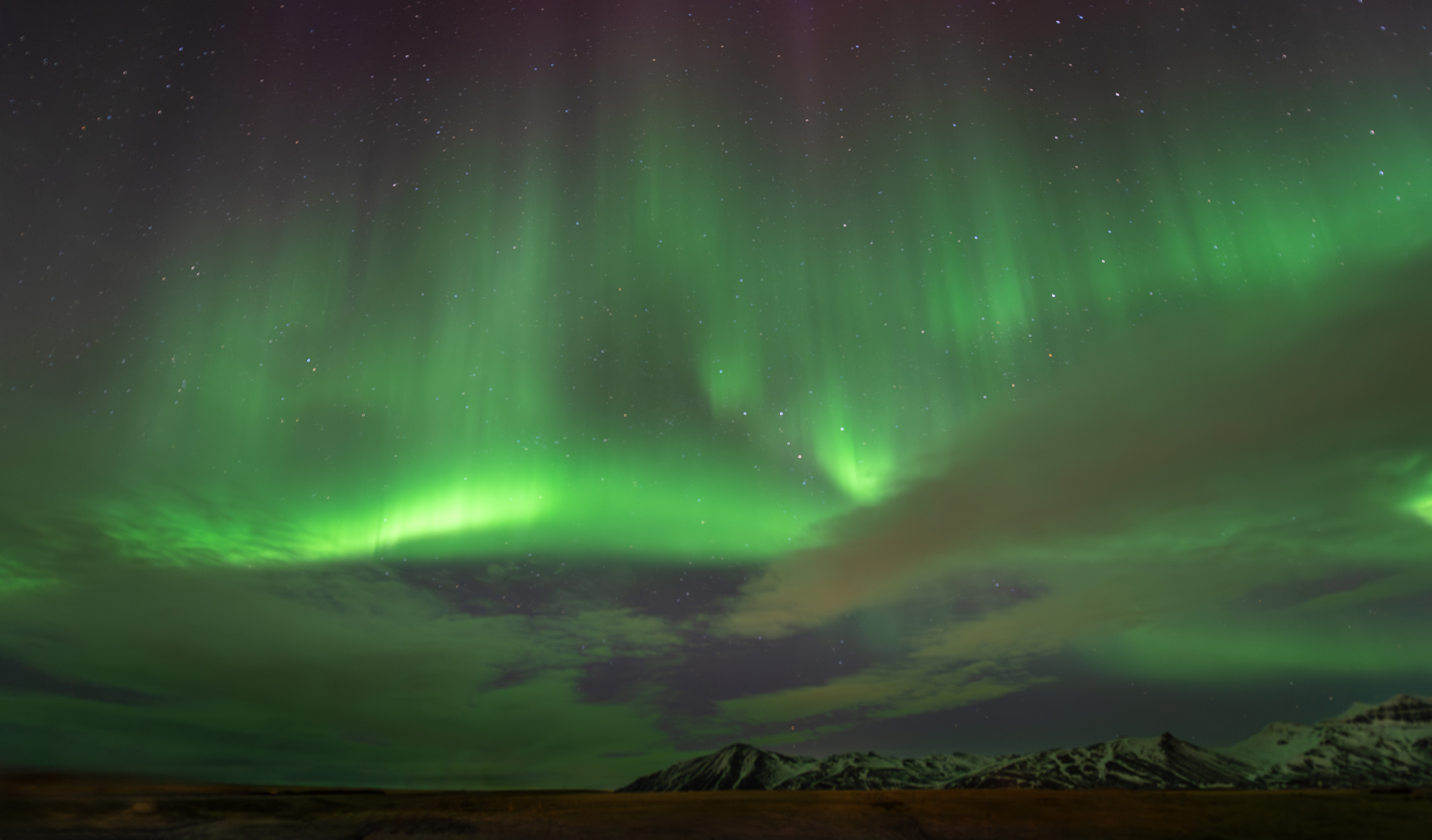
You do not need a tour to photograph the aurora near Reykjavík. Within about an hour of the capital you reach five places with an open northern view, free access and a foreground: the lighthouse at Grótta, the fjord and mountains of Hvalfjörður, the lighthouses of Akranes, the two lighthouses at Garðskagi and the lake Kleifarvatn. Distance from the city is the first filter, because the glow of Reykjavík washes out all but the strongest displays. The second filter is the conditions on the day: check the cloud forecast before the Kp, and on the Reykjanes peninsula check the volcanic situation as well.
How this guide was made: it is based on official sources and on published accounts of local photographers, checked in October 2026. I have not photographed at most of these places myself, so confirm opening hours, parking and conditions before you go. The one display of ours that belongs to this area is the one described in the Northern Lights guide: it happened at Hótel Laxárbakki, in the Hvalfjörður region.
How to choose a spot
- A dark northern horizon. Face north, away from the glow of the city. Even thirty to forty kilometres from the capital make a significant difference.
- A foreground with a shape. A lighthouse, a mountain ridge or a calm lake turns a green smear into a photograph. The Northern Lights guide explains why the foreground decides the image.
- A legal place to park. Use a car park or a pull-out, never the road itself, and stay off private land.
- Scout in daylight. Arriving at a foreground for the first time in the dark, with a display overhead, is not the moment to work out where to stand.
- Clear sky first. Check the cloud forecast before the Kp. The routine is in Aurora Forecasting in Iceland.
Five places within about an hour of Reykjavík
Grótta, Seltjarnarnes
Grótta is the closest option: a tidal islet with a white lighthouse at the edge of Seltjarnarnes, just west of central Reykjavík. A sandy path leads to the lighthouse at low tide and disappears quickly when the water comes in, so check the tide times before you walk out and keep an eye on the water on the way back. You can drive and park at Grótta, or take bus 11 from Mjódd to the stop Hofgarður, about one kilometre away. Visit Reykjavík calls it a local favourite for the northern lights in winter. The city glow reaches the site, so Grótta is a quick option when a strong display is expected, not the place for a quiet one.
Grótta is a protected nature reserve with nesting seabirds, so stay on the marked paths and keep your distance from the birds. On 1 July 2026 the Ministry of Environment, Energy and Climate confirmed an enlargement of the reserve to about 1.5 square kilometres, including the shallow area of Seltjörn. Travel across Seltjörn is prohibited from 1 May to 31 July, so the restriction falls outside the aurora season. Under the earlier 1984 designation, dogs were also not allowed in the reserve, and the new rules may differ in detail, so check the current regulations before you bring a dog.
Hvalfjörður
Hvalfjörður is about 45 minutes by car from central Reykjavík, according to local photographer Jón Hilmarsson. The mountain Skarðsheiði is a great foreground for the aurora. Fiskilækur, an abandoned farm near the main road, is easy to spot, and Arkarlækur is another abandoned farm in the fjord that photographers use as a foreground. Abandoned buildings can look spooky and photogenic, but they stand on private land and can be unsafe, so photograph them from a distance and do not enter. We also do not recommend lighting them with your car headlights, as private property and nearby residents are affected. Near the hotel Laxárbakki, the bridges over the river Laxá are another subject. The Hvalfjörður tunnel on Route 1, which saves the drive around the fjord, has been free of charge since 2018.
Akranes lighthouses, Breiðin
On the other side of the Hvalfjörður tunnel, the town of Akranes has two lighthouses on the peninsula Breiðin. The old lighthouse is no longer in operation. Local photographer Jón Hilmarsson calls the old lighthouse a great location for northern lights photography, and the mountain Akrafjall near the town gives a second foreground. The new lighthouse can be visited and climbed during the day. The opening hours differ between sources (Visit Iceland lists 10:00 to 16:00, with weekends closed in winter, West Iceland lists weekend hours as well), so the interior is a daytime option and you will photograph from outside at night. For current hours and fees, contact the Akranes information office through West Iceland.
Garðskagi, tip of Reykjanes
Garðskagi lies at the northernmost tip of the Reykjanes peninsula, about 60 kilometres from Reykjavík and about 12 kilometres from Keflavík airport. Two lighthouses stand next to each other: a small one from 1897 with two orange stripes and a cylindrical tower from 1944 that is 28 metres tall. Guide to Iceland lists the site as open all days, 24 hours, free of charge. The tall tower is a bird observatory with a viewing deck, and the same guide recommends it in winter as a spot for the aurora away from the city lights. Whether the deck is open at night is not stated in the sources, so treat the lighthouses as a foreground you photograph from the ground. The Heritage Museum next to them is open daily from 10:00 to 17:00 from May to September, and by booking from October to April. The coast is open and offers little shelter from the wind.
Kleifarvatn, Reykjanes
Kleifarvatn, the largest lake on the Reykjanes peninsula, lies between the ridge Sveifluháls and the slope Vatnshlíð. It is about 30 to 40 minutes from Reykjavík: take Route 41 and then Route 42 (Krýsuvíkurvegur). It has very little light pollution, and a calm surface can mirror the aurora. Parking is at small pull-outs along the road, the ground is uneven, and the facilities at the lake are limited to a small fishing lodge. The lake has shrunk since 2000, when two earthquakes probably opened fissures at its bottom, which is a reminder that the area is seismically active. The nearby high-temperature area Seltún has a boardwalk: stay on boardwalks and paths, because the ground in geothermal areas can be hot and unstable.
Check the volcanic situation before you drive to Reykjanes
Garðskagi and Kleifarvatn are on the Reykjanes peninsula, which has been volcanically and seismically active since 2021. The Icelandic Met Office reported on 21 July 2026 that ground uplift at Svartsengi continued slowly and steadily, that seismicity was low, and that a magma intrusion from Svartsengi towards the Sundhnúkur crater row, possibly followed by an eruption, was the most likely scenario. The warning time before earlier events was between about 20 minutes and just over four hours. That hazard assessment was valid until 30 September, and no newer one was available when this guide was checked, so check the current assessment on the Met Office website and safetravel.is on the day, follow the instructions of the authorities and never enter a closed area. If the Met Office raises its warning level or there are closures, choose Grótta, Hvalfjörður or Akranes instead.
Photographic tips for these places
- Lighthouses: at Grótta, Akranes and Garðskagi the lighthouse is your foreground. Its own light is bright, so check your first frames and adjust the exposure, and use a wide-angle lens with the widest aperture you have.
- Mountains and water: in Hvalfjörður, Skarðsheiði and the fjord give you shape. At Kleifarvatn, wait for calm air to get a mirror image.
- Settings: start with f/1.8 to f/2.8, ISO 1600 to 3200 and 5 to 15 seconds, as in the Northern Lights guide.
- Moon: check the moon-free window for your night in the Iceland Photo Planner. A bright moon washes out faint displays the way light pollution does.
- Cold and wind: read Shooting the Aurora in the Cold before you stand still for hours.
Getting there
| Place | From Reykjavík | Route | Note |
|---|---|---|---|
| Grótta | In the capital area | Seltjarnarnes, bus 11 to Hofgarður | Path to the lighthouse only at low tide |
| Hvalfjörður | About 45 minutes | Route 1 north | Tunnel is free of charge |
| Akranes | Through the Hvalfjörður tunnel | Route 1 north, then Akranes | Lighthouse interior only by day |
| Garðskagi | About 60 kilometres | Reykjanes peninsula | Open 24 hours, check Reykjanes conditions |
| Kleifarvatn | About 30 to 40 minutes | Route 41, then Route 42 | Pull-outs along the road, check Reykjanes conditions |
Check the road conditions on road.is and the warnings on safetravel.is before you leave, carry a headlamp every evening in autumn and winter, tell someone your plan and know that the emergency number in Iceland is 112. Winter tyres are required from 1 November. The checklist in the Northern Lights guide covers the rest. Basing yourself in the capital has trade-offs for aurora photography, which Reykjavík as a Photography Base explains.
Leave No Trace
Night shooting pulls photographers off the main roads. A few rules for these places:
- Stay on paths and in pull-outs. The vegetation is invisible in the dark and does not recover from footsteps. At Grótta, stay on the marked paths, keep your distance from the birds and respect the restrictions of the nature reserve.
- Do not trespass. The farms along Hvalfjörður are private land and the abandoned buildings can be unsafe. Photograph from the road.
- Stay on boardwalks in geothermal areas such as Seltún.
- Do not park on the road. Use a car park or a pull-out, and keep your headlights out of other photographers’ frames when you arrive.
- Use a red headlamp and light only your own tripod, not the landscape.
The full rules are in the Leave No Trace guide.
Alternatives for a longer trip
If you can stay a night away from the capital, the Snæfellsnes peninsula with Kirkjufell, the Westfjords and Vestrahorn offer darker skies and bigger foregrounds, at the cost of longer drives and, in the Westfjords, more cloud. The cloud cover by region is in Aurora Season in Iceland. See the Snæfellsnes guide, the Westfjords guide and the Vestrahorn guide.
Frequently asked questions
Do I need a tour to see the northern lights near Reykjavík?
No. Several places within about an hour by car have an open northern view, free access and a foreground such as a lighthouse or a mountain. A tour saves you the driving and the decision, but it does not see anything you cannot see yourself, and the weather decides the night either way.
How far from Reykjavík do I need to drive to see the aurora?
Reykjavík is the only significant source of light pollution in Iceland, and its glow is visible across a wide area. Getting away from the capital by thirty to forty kilometres makes a significant difference, and a strong display is visible even closer to the city.
Can I see the northern lights from Reykjavík itself?
Yes, when the display is strong. The glow of the city washes out all but the strongest displays, so a quiet aurora needs a darker location outside the capital area.
Is it safe to photograph the aurora on the Reykjanes peninsula?
Garðskagi and Kleifarvatn are tens of kilometres from the Sundhnúkur crater row, but the peninsula is volcanically active and conditions can change quickly. The Icelandic Met Office said in July 2026 that a new magma intrusion towards the crater row was the most likely scenario, with a warning time of as little as twenty minutes. Check the current assessment and safetravel.is before you drive out, and never enter a closed area.
When is the best time to look for the aurora near Reykjavík?
From early September to early April, when the sky is fully dark. Choose nights within about three days of a new moon and check the cloud cover forecast first.
Sources
Visit Reykjavík — Grótta lighthouse. Ministry of Environment, Energy and Climate — announcement of 1 July 2026 on the enlargement of the Grótta nature reserve (Icelandic)
Guide to Iceland — Best Places to Shoot the Northern Lights in West Iceland (Jón Hilmarsson, updated 25 August 2026), Garðskagi Lighthouses and Northern lights info and shooting spots near Reykjavík
Visit Reykjanes — Kleifarvatn. Visitors Guide — The Heritage Museum at Garðskagi. Visit Iceland — Akranesviti og Akrafjall. West Iceland — Akranes lighthouses
Veðurstofa Íslands — Ground uplift and magma accumulation continue beneath Svartsengi (update of 21 July 2026). Safetravel — safetravel.is. Wikipedia — Hvalfjörður Tunnel
Last verified: October 2026.