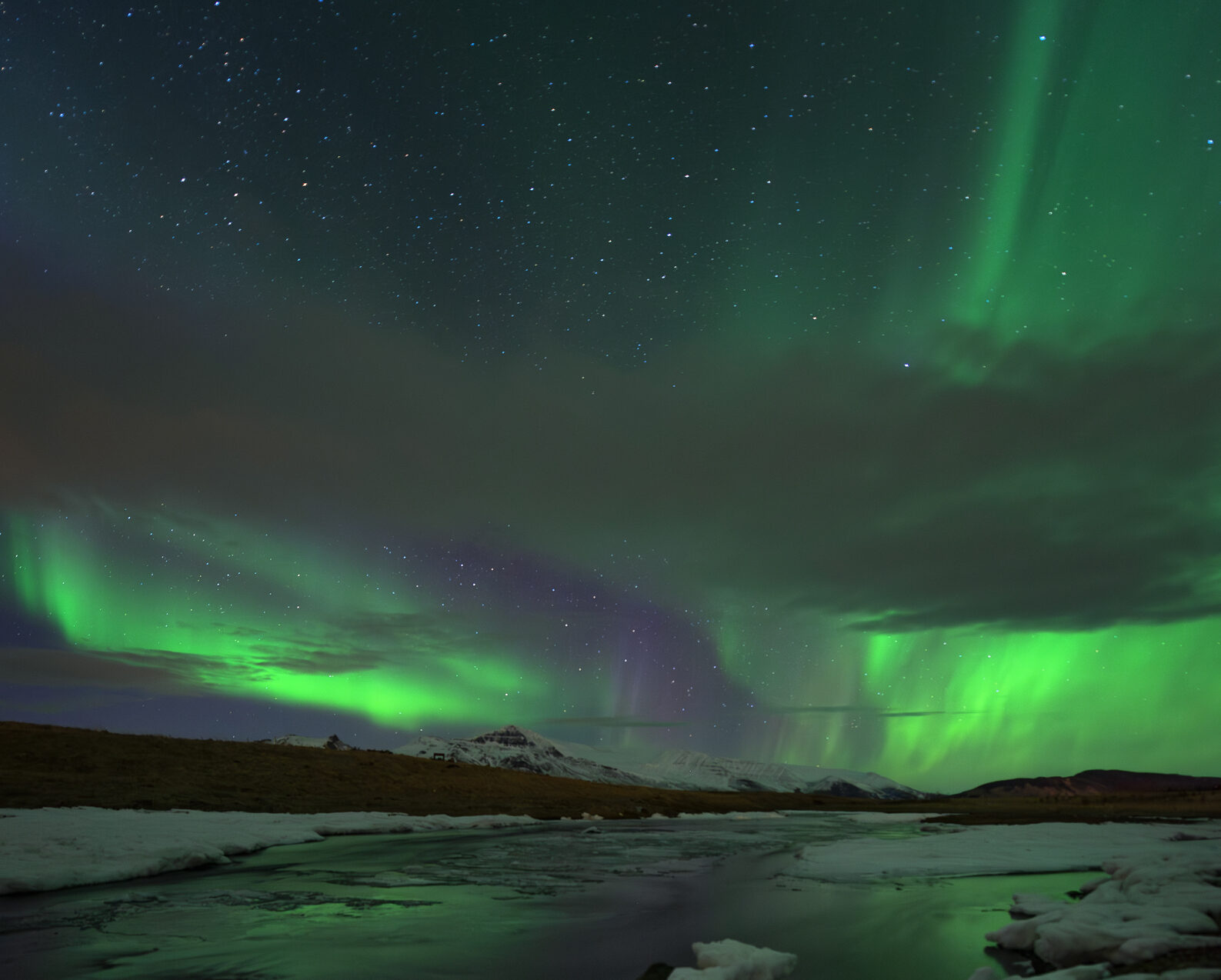
Iceland has fully dark skies from early September to early April. In Reykjavík that is roughly 2 September to 9 April, in Akureyri 7 September to 5 April. The longest nights come in December, with almost 13 hours of astronomical darkness, and the darkest nights of every month fall within about three days of a new moon. Below you find the hours of darkness, the new moon window, the weather and the road situation for every month of the 2026/27 aurora season, from late August to April.
How to read the numbers
Astronomical darkness means the sun is more than 18 degrees below the horizon. It is the darkest the sky gets and the best condition for faint aurora. Nautical darkness (12 to 18 degrees) is already dark enough for a strong display, so the usable season is a little longer than the astronomical dates. All times are Iceland time, which is UTC all year, and all values come from the Iceland Photo Planner. Use it for any date and location that is not in the table.
Hours of darkness by month
| Month (15th) | Reykjavík | Akureyri | Höfn | Ísafjörður | Reykjavík: dark from – to (UTC) | Reykjavík: sunset |
|---|---|---|---|---|---|---|
| August | none | none | none | none | — | 21:45 |
| September | 4.8 h | 4.0 h | 4.7 h | 3.8 h | 23:01 – 03:46 | 19:55 |
| October | 8.8 h | 8.7 h | 8.8 h | 8.6 h | 20:49 – 05:39 | 18:09 |
| November | 11.6 h | 11.6 h | 11.6 h | 11.6 h | 19:25 – 07:00 | 16:29 |
| December | 12.9 h | 13.0 h | 12.9 h | 13.1 h | 18:56 – 07:50 | 15:29 |
| January | 12.3 h | 12.4 h | 12.3 h | 12.4 h | 19:28 – 07:45 | 16:18 |
| February | 10.0 h | 9.9 h | 9.9 h | 9.9 h | 20:42 – 06:40 | 17:59 |
| March | 6.8 h | 6.4 h | 6.7 h | 6.3 h | 22:13 – 04:58 | 19:26 |
| April | none | none | none | none | — | 20:59 |
Hours of astronomical darkness from noon to noon. August and April have no astronomical darkness in the middle of the month, but still nautical darkness in April: 4.4 hours in Reykjavík and 3.5 hours in Akureyri on 15 April. The location makes little difference for the hours. The month makes all of it.
Month by month
Late August: the nights return
There is no full darkness yet, but nautical darkness comes back in the last days of the month, about 5 hours in Reykjavík on 31 August. A first faint aurora is possible, and the highlands are still open. Treat it as a bonus on a summer trip, not as the plan.
September: full darkness returns
Astronomical darkness is back from about 2 September in Reykjavík and 7 September in Akureyri. By mid-month you get 4.8 hours of it, from roughly 23:00 to 03:45, plus more than 7 hours of nautical darkness. Geomagnetic activity is statistically higher around the equinox, the highlands show their autumn colours, and the first highland roads start to close late in the month. See the Autumn Guide for the daytime side of the season.
October: the sweet spot for shoulder-season travel
8.8 hours of darkness, from about 20:50 to 05:40, and sunset already at 18:09 so you can shoot a sunset and an aurora on the same day. The new moon fell on 10 October (darkest window 7 to 13 October), the full moon follows on 26 October. Most F-roads close this month, and winter tyres are required from 1 November. Quiet roads and fewer people at the locations are the reward. In October 2024 I saw one of the most intense displays I have witnessed, unplanned, from a hot tub at Hótel Laxárbakki in west Iceland (the story is in the Northern Lights guide). Check the F-roads guide before you plan any highland route.
November: ice caves open, nights get long
11.6 hours of darkness from about 19:25 to 07:00, and sunset at 16:29. New moon on 9 November (darkest window 6 to 12 November), full moon on 24 November. The ice cave season opens, the highlands are closed and the days are very short, so plan your driving around the light.
December: the longest nights
The peak: 12.9 hours of astronomical darkness, from about 18:55 to 07:50. The sun rises at about 11:15 and sets at about 15:30 in Reykjavík. New moon on 9 December (darkest window 6 to 12 December), full moon on Christmas Eve, 24 December. Golden hour lasts for what feels like the whole day, and the highlands remain closed. I have seen the aurora in autumn, but the winter displays, when conditions align, are on a different scale entirely.
January: deep winter
12.3 hours of darkness, from about 19:30 to 07:45. New moon on 7 January (darkest window 4 to 10 January), full moon on 22 January. Very short days with a long blue hour, winter tyres are required and most F-roads are closed. It is the coldest part of the season, so batteries and fingers need extra care.
February: aurora and ice caves together
10 hours of darkness, from about 20:40 to 06:40, with the days clearly lengthening. New moon on 6 February (darkest window 3 to 9 February), full moon on 20 February. Statistically, February is among the most active aurora months and the ice caves are at their best, so it is a strong month for a combined trip. Read the Winter Guide for the ice caves and the winter light, and Ice Cave Photography in Iceland for the rules, the season and the camera settings.
March: the season winds down
6.8 hours of darkness, from about 22:15 to 05:00, and the equinox brings a statistically higher level of activity. New moon on 8 March (darkest window 5 to 11 March), full moon on 22 March. Snow is still widespread and F-roads remain closed. Of all the winter months, March is the one I return to most: the daylight is coming back, the snowpack is still deep and the aurora activity remains high. It is the last month with a long dark window, and with sunset at 19:26 you have time to scout your foreground in daylight before the night starts.
April: the last dark nights
Astronomical darkness ends around 9 April in Reykjavík and around 5 April in Akureyri. Mid-month you still have 4.4 hours of nautical darkness, which is enough for a strong display. New moon on 6 April (darkest window 3 to 9 April), full moon on 20 April. Highland roads are closed, many gravel roads have axle-weight restrictions and the puffins return from mid to late April, so the season changes completely.
Darkest is not the same as clearest
Hours of darkness say nothing about cloud. An analysis by Guide to Iceland of Icelandic Met Office (Veðurstofa Íslands) station data ranked the regions by average cloud cover from November to March. The clearest skies are in the southeast and the cloudiest in the Westfjords, but the spread is small:
| Region | Average cloud cover (oktas) | Approx. share of sky |
|---|---|---|
| Southeast (Höfn) | 5.57 | 70 % |
| Southeast (Öræfi and Skaftafell) | 5.67 | 71 % |
| East Iceland | 5.79 | 72 % |
| South lowlands | 5.82 | 73 % |
| Southwest (capital area and Reykjanes) | 5.84 | 73 % |
| Northeast inland (Mývatn) | 5.98 | 75 % |
| West (Borgarfjörður and Snæfellsnes) | 6.27 | 78 % |
| North and northeast coast | 6.34 | 79 % |
| Westfjords | 6.49 | 81 % |
One okta is one eighth of the sky; the percentages are the oktas divided by eight. Source: Guide to Iceland, Best Places in Iceland to See the Northern Lights, based on Veðurstofa station data. Two things follow. Every region is cloudy most of the time, so you will have to chase gaps. And the Westfjords, which have some of the darkest skies in terms of light pollution, are also the cloudiest region on average. As the source itself says, no cloud average predicts a single night: use the cloud cover forecast of the Icelandic Met Office on the day. For Vestrahorn and the southeast, see the Vestrahorn guide. A routine for reading these forecasts, from the Icelandic Met Office cloud overlay to NOAA’s short-term forecast, is in Aurora Forecasting in Iceland. The cloudiest region can still be worth the gamble: on a clear autumn night the rusting hull of the Garðar BA 64 at Patreksfjörður is one of the most extraordinary aurora foregrounds I have encountered, described in the Westfjords guide.
Choosing your month
- Longest nights: November to January, with 12 to 13 hours of darkness in December.
- Best balance of darkness, roads and crowds: late September to October, with open roads, 5 to 9 hours of darkness and fewer visitors. After six trips, late September to mid-October is, in my experience, the genuine peak: autumn colour near its most vivid, crowds at their lowest, most roads still open and aurora activity increasingly reliable.
- Aurora plus ice caves: February, with 10 hours of darkness and lengthening days.
- Daylight for scouting: March, with 6.8 hours of darkness and a late sunset to find your foreground before the night starts. It is the winter month I return to most.
Whatever the month, book around the new moon, and plan two or three nights, not one. The full camera settings, the Kp scale for Iceland and the checklist are in How to Photograph the Northern Lights in Iceland. For a month-by-month look at everything else, see Best Time to Visit Iceland for Photography.
Chase the aurora without leaving a trace
Night shooting pulls photographers into dark, remote places. Stay on paths and established tracks, because moss is invisible in the dark and does not recover from footsteps. Do not walk onto private farmland, and park in pull-outs, never on the road. Use a red headlamp so other photographers keep their night vision, and carry one every evening in autumn and winter: when the Northern Lights appeared while I was staying near Goðafoss, I drove to the falls and turned back, because approaching an unfenced waterfall in complete darkness without a headlamp was not a reasonable decision (the full story is in the Goðafoss guide). More in the Leave No Trace guide.
Frequently asked questions
Which month has the most hours of darkness in Iceland?
December. Around the middle of the month Reykjavík has 12.9 hours of astronomical darkness, Akureyri 13.0 hours. January follows with 12.3 hours and November with 11.6 hours.
When does the northern lights season start in Iceland?
Nautical darkness returns in the last days of August, and full astronomical darkness from about 2 September in Reykjavík and 7 September in Akureyri. A strong aurora is already possible under nautical darkness.
When does the northern lights season end in Iceland?
Astronomical darkness ends around 9 April in Reykjavík and around 5 April in Akureyri. In mid-April there are still about 4 hours of nautical darkness, but the nights get too short for a reliable shoot.
Is September or March better for the northern lights?
Both are close to the equinox, when geomagnetic activity is statistically higher. March has more darkness (6.8 hours in mid-month against 4.8 hours in September) but more snow and closed F-roads. September has open roads and autumn colour, but the darkness only begins around 23:00.
Where in Iceland are the clearest skies for the northern lights?
The southeast, around Höfn and Skaftafell, has the lowest average cloud cover between November and March, followed by East Iceland and the south. The Westfjords are the cloudiest region on average. No average predicts a single night, so check the cloud cover forecast of the Icelandic Met Office on the day.
Is it dark enough for the northern lights in April?
Until about 9 April there are still short astronomical nights. After that you get nautical darkness only, about 4 hours in the middle of the month, which is enough for a strong display but not for faint ones.
Sources
Veðurstofa Íslands (Icelandic Meteorological Office) — vedur.is
Guide to Iceland — Best Places in Iceland to See the Northern Lights: A Study of 89 Years of Cloud Coverage
Náttúruverndarstofnun (Nature Conservation Agency of Iceland) — nattura.is
Moon phase dates: US Naval Observatory based tables. Darkness hours: Iceland Photo Planner.
Last verified: October 2026. Changelog: 19 October 2026 — first version for the 2026/27 season.